
Polytetrafluoroethylene (PTFE), renowned as the “king of plastics,” offers exceptional chemical resistance, a low friction coefficient, and stability across extreme temperatures. However, its inherent limitations—such as poor wear resistance, low hardness, and susceptibility to creep—have driven the development of filled PTFE composites. By incorporating fillers like glass fiber, carbon fiber, and graphite, manufacturers can tailor PTFE’s properties for demanding applications in aerospace, automotive, and industrial sealing. This article explores how these fillers enhance PTFE and provides guidance for selecting the right composite based on operational requirements .
1. The Need for PTFE Modification
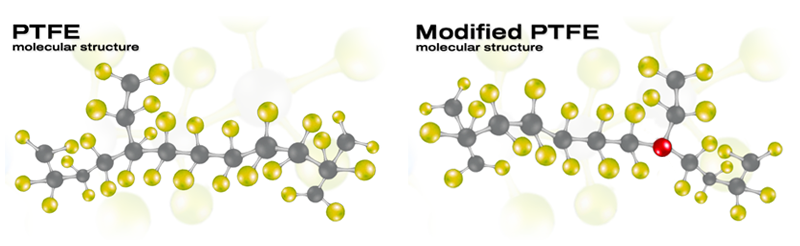
Pure PTFE excels in corrosion resistance and low friction but suffers from mechanical weaknesses. For example, its wear resistance is inadequate for dynamic sealing applications, and it deforms under sustained pressure (cold flow). Fillers address these issues by acting as reinforcing skeletons within the PTFE matrix, improving creep resistance, wear tolerance, and thermal conductivity without compromising its core advantages .
2. Glass Fiber: The Cost-Effective Reinforcer
Key Properties
Wear Resistance: Glass fiber (GF) reduces PTFE’s wear rate by up to 500 times, making it ideal for high-load environments .
Creep Reduction: GF enhances dimensional stability, reducing deformation under continuous stress .
Thermal and Chemical Limits: GF performs well in temperatures up to 400°C but degrades in hydrofluoric acid or strong bases .
Applications
GF-reinforced PTFE is widely used in hydraulic seals, pneumatic cylinders, and industrial gaskets where mechanical strength and cost-efficiency are prioritized. Its compatibility with additives like MoS₂ further optimizes friction control .
3. Carbon Fiber: The High-Performance Choice
Key Properties
Strength and Stiffness: Carbon fiber (CF) offers superior tensile strength and flexural modulus, requiring lower filler volumes than GF to achieve similar reinforcement .
Thermal Conductivity: CF improves heat dissipation, critical for high-speed applications .
Chemical Inertness: CF resists strong acids (except oxidizers) and is suitable for harsh chemical environments .
Applications
CF-PTFE composites excel in automotive shock absorbers, semiconductor equipment, and aerospace components, where lightweight durability and thermal management are essential .
4. Graphite: The Lubrication Specialist
Key Properties
Low Friction: Graphite-filled PTFE achieves friction coefficients as low as 0.02, reducing energy loss in dynamic systems .
Thermal Stability: Graphite enhances thermal conductivity, preventing heat buildup in high-speed contacts .
Soft-Mating Compatibility: It minimizes wear against softer surfaces like aluminum or copper .
Applications
Graphite-based composites are preferred in non-lubricated bearings, compressor seals, and rotating machinery where smooth operation and heat dissipation are critical .
5. Comparative Overview: Selecting the Right Filler
| Filler Type | Wear Resistance | Friction Coefficient | Thermal Conductivity | Best For |
| Glass Fiber | High (500x improvement) | Moderate | Moderate | Cost-sensitive, high-load static/dynamic seals |
| Carbon Fiber | Very High | Low to moderate | High | Lightweight, high-temperature, and corrosive environments |
| Graphite | Moderate | Very Low (0.02) | High | Non-lubricated, high-speed applications |
Synergistic Blends
Combining fillers—e.g., glass fiber with MoS₂ or carbon fiber with graphite—can optimize multiple properties. For instance, GF-MoS₂ hybrids reduce friction while maintaining wear resistance .
6. Implications for Industry and Sustainability
Filled PTFE composites extend component lifespan, reduce maintenance frequency, and enhance energy efficiency. For example, graphite-PTFE seals in LNG systems withstand temperatures from -180°C to +250°C, outperforming conventional materials . These advancements align with circular economy goals by minimizing waste through durable design .
Conclusion
The choice of filler—glass fiber, carbon fiber, or graphite—dictates the performance envelope of PTFE composites. While glass fiber offers balanced cost and durability, carbon fiber excels in extreme conditions, and graphite prioritizes lubrication. Understanding these differences enables engineers to tailor sealing solutions for reliability and efficiency.
As industries evolve toward higher operating standards, partnering with experts in material science ensures optimal product development. Ningbo Yokey Precision Technologyleverages advanced compounding expertise to deliver seals that meet stringent requirements for automotive, energy, and industrial applications.
Keywords: PTFE composites, sealing solutions, material engineering, industrial applications
References
PTFE Material Modification Techniques (2017).
Compound PTFE Materials – Micflon (2023).
Filler Effects on PTFE Properties – The Global Tribune (2021).
Modified PTFE Gasket Performance (2025).
Advanced Fluoropolymer Developments (2023).
Post time: Jan-09-2026