
Executive Summary
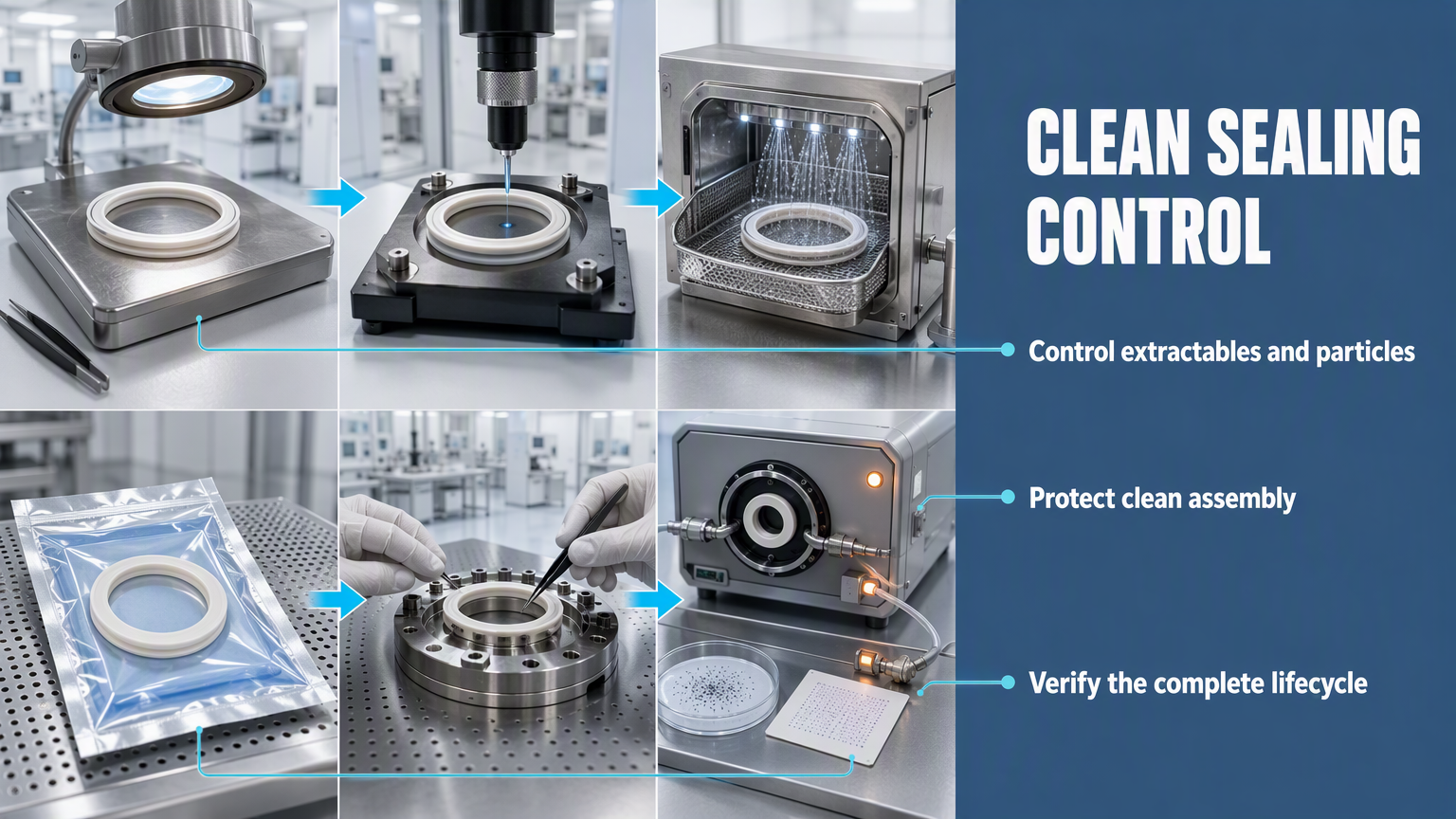
A semiconductor equipment seal does more than maintain a pressure or fluid boundary. It can influence particles, extractables, outgassing, ionic contamination, process stability, vacuum or fluid integrity and wafer-yield protection. Clean sealing is therefore a lifecycle control problem: raw material, compounding, molding or machining, surface condition, cleaning, drying, packaging, transportation, cleanroom assembly, installation and final validation must work together.
A low-outgassing material is not automatically a clean assembled seal. A clean package does not prove that the part remained clean after opening. A passed leak test does not prove that particles, ions or extractables are within process limits. The correct control strategy separates contamination mechanisms, assigns a detection method to each one and preserves traceability across every handoff.
Material-Originated Contamination
Material-originated contamination may include volatile compounds, extractables, low-molecular-weight residues, processing additives, lubricants, plasticizers, moisture, ionic residues and degradation products. These sources differ in how they enter a process: some are released into a liquid, some into a vacuum, some permeate through the material and some appear as particles after wear or handling.
FKM, FFKM, EPDM, PTFE, PFA and silicone rubber must be compared by grade, formulation, processing history, temperature, chemical medium and cleanliness requirement. A material family name is only a screening category. The final evaluation should consider the compound or construction, surface treatment, thickness, exposure duration and the test method used to measure release.
Processing, Machining and Surface Contamination
Molding and machining can introduce flash, burrs, cutting debris, embedded particles, uneven surface finish, tool-wear debris and post-process residue. These defects can damage a sealing interface, detach during operation or make cleaning incomplete. A seal can be chemically compatible and still become a contamination source because its surface was poorly trimmed, handled or inspected.
Precision parts should be controlled through appearance, dimensional, surface and batch checks. Surface inspection should look for particles, scratches, burrs, residue and damage at the actual sealing region. Batch traceability should connect the part to material grade, process route, cleaning record and packaging condition so a contamination event can be investigated rather than treated as an isolated failure.
Cleaning, Drying and Packaging Control
Cleaning removes processing residue, but the cleaning step can introduce ions, particles or chemistry of its own. Rinsing quality, drying temperature, drying time and moisture retention affect later outgassing and extractables. Packaging material can also contribute particles or residues, while a damaged package can expose a qualified part to uncontrolled humidity and handling.
Clean packaging, double-bag handling, storage conditions, transport protection and controlled opening time should be defined as process requirements. The seal should be installed within the approved exposure window and handled with qualified gloves, tools and wipes. Storage and package-opening records are part of the final cleanliness evidence.
Cleanroom Assembly and Installation Contamination
Assembly introduces a different contamination path from material-originated release. Gloves, tools, lubricants, wipes, packaging fragments, human handling, incorrect storage, repeated installation, seal twisting, groove contamination and flange contamination can all affect the installed condition. These risks should be investigated separately from compound chemistry or raw-material quality.
A clean assembly process requires qualified tools, operator training, lubricant control, orientation checks, groove and surface inspection, installation records and batch traceability. If a seal is removed and reinstalled, its history and exposure must be known. Replacement parts should be accepted by identity, packaging condition and process-specific verification rather than by visual appearance alone.
Validation and Cleanliness Verification
Extractables testing evaluates chemical species removed by a defined fluid or solvent. Outgassing testing evaluates volatile release under a defined vacuum and temperature condition. Particle inspection evaluates physical particulate release. Ionic analysis evaluates ionic residues. Rinse-water analysis evaluates carryover after a defined cleaning process. Helium leak and rate-of-rise tests evaluate pressure integrity and pressure behavior, not every cleanliness attribute.
A defensible record should include seal material, grade, part number, batch, cleaning process, drying process, packaging condition, test medium, temperature, duration, detection method, result and acceptance basis. A test result without these conditions is difficult to transfer to another tool or process.
Table I: Contamination Sources Across the Seal Lifecycle
|
Lifecycle stage |
Contamination source |
Contaminant type |
Local effect |
Process risk |
Recommended control |
| Raw material | Additives, moisture or residues | Extractables, ions or volatiles | Material release | Process drift | Grade and incoming inspection |
| Molding or machining | Flash, burrs or tool debris | Particles and residues | Surface contamination | Seal or wafer contamination | Process control and surface inspection |
| Cleaning | Chemistry, rinse or handling | Ions, residues or particles | Changed surface state | False cleanliness result | Qualified cleaning and rinse |
| Drying | Insufficient time or heat | Moisture and volatiles | Outgassing or residue | Pump-down or process instability | Defined drying and storage |
| Packaging | Bag, wipe or fragment | Particles or chemical residue | Cleanliness loss | Contaminated part at receipt | Qualified packaging and integrity check |
| Transportation | Damage, package breach or humidity | Particles or moisture | Surface contamination | Installation contamination | Protected transport and receipt check |
| Cleanroom assembly | Gloves, tools, lubricant or handling | Particles, ions or residues | Installed contamination | Yield or reliability risk | Qualified tools, training and records |
| Maintenance replacement | Reused part or open exposure | Residue, particles or wrong part | Repeat contamination | Recurring process issue | Traceability and release verification |
Table explanation: cleanliness is a lifecycle property. A clean incoming seal can become contaminated during machining, packaging or assembly, so the control plan must preserve evidence and condition across every handoff.
Table II: Seal Material Cleanliness Risk Comparison
|
Material |
Extractables risk |
Outgassing concern |
Particle risk |
Ionic concern |
Chemical limitation |
Verification requirement |
| FKM | Compound and processing dependent | Moisture and volatile history | Wear or processing dependent | Formulation dependent | Medium-specific | Grade, exposure and rinse testing |
| FFKM | Compound and process dependent | Must be validated by grade | Processing and assembly dependent | Formulation dependent | High-cost compound still needs chemistry test | Extractables, exposure and cleanliness tests |
| EPDM | Compound and additive dependent | Moisture and processing dependent | Surface and wear dependent | Formulation dependent | Chemical envelope specific | Fluid exposure and rinse verification |
| PTFE | Processing and filler dependent | Surface history and residue dependent | Machining or wear dependent | Processing dependent | Construction-specific | Surface, extractables and particle tests |
| PFA | Processing and construction dependent | Low-outgassing claim requires test | Machining and handling dependent | Processing dependent | Temperature and process-specific | Cleanliness and extraction testing |
| Silicone rubber | Formulation and additive dependent | Volatile and permeation concern | Wear and processing dependent | Formulation dependent | Use only in defined applications | Compound and outgassing verification |
Table explanation: material family names are screening categories. The final selection must use grade, formulation, processing, chemical medium, temperature, cleaning and acceptance method.
Table III: Cleanliness Verification Method Matrix
|
Method |
Test objective |
Detectable contamination or failure |
Main parameter |
Main limitation |
Suitable stage |
| Extractables test | Measure released species | Chemical extractables | Medium, temperature, time and analysis | Method and detection-limit dependent | Material and process qualification |
| Outgassing test | Measure volatile release | Volatile species and moisture release | Vacuum, temperature and time | Does not prove liquid cleanliness | Vacuum qualification |
| Particle inspection | Find surface particles | Particles on seal or package | Sampling and count method | Surface coverage limitation | Incoming and assembly audit |
| Ionic analysis | Measure ionic residue | Ionic contamination | Rinse medium and analysis | Does not replace particle test | Process qualification |
| Rinse-water analysis | Assess residue after rinse | Carryover or extractables | Rinse volume, sampling and analysis | Represents only tested rinse | Cleaning validation |
| Helium leak test | Verify pressure boundary | Defined gas leak path | Test configuration and helium response | Does not prove cleanliness | Assembly acceptance |
| Rate-of-rise test | Assess vacuum pressure behavior | Leak, outgassing or virtual volume trend | Pressure slope and time | Requires controlled starting state | Vacuum troubleshooting |
| Packaging integrity check | Verify delivered condition | Breach, damage or contamination entry | Seal, bag and storage record | Does not prove material cleanliness | Shipping and receipt |
Table explanation: no test covers every contamination mechanism. Extractables, particles, ions, outgassing, pressure integrity and packaging condition must be matched to the process risk.
Lifecycle Control and Traceability
Lifecycle control begins with incoming inspection and continues through storage, package opening, installation, replacement, re-cleaning and supplier-change management. A replacement seal should be linked to its part number, grade, batch, cleaning status, package condition, installation location and release result.
Supplier and process changes require controlled review. A change in compound, molding, machining, cleaning chemistry, drying, packaging material or transport route can alter contamination behavior even when the part number remains unchanged. The change record should identify affected lots, risk assessment, required revalidation and the point at which production use is allowed.
A release decision should be based on the complete evidence chain, not on one clean-looking surface or one passed pressure test. The evidence should remain linked to the part, batch, process route, package and installation record.
Release decisions must combine incoming inspection, package integrity, cleaning status, assembly records and process-specific verification. For a vacuum tool, pressure behavior and outgassing may be dominant; for a wet-process module, rinse-water analysis, particles, ions and extractables may carry more weight. The same seal should not receive one universal release rule across different equipment boundaries.
If a contamination incident occurs, the investigation should compare material, process, packaging, transport and assembly records. A supplier change in compound, molding, cleaning, packaging or facility can alter extractables or particles even when the part number remains unchanged. The change-control process should define when revalidation is required.
FMEA Risk Analysis
A clean-sealing FMEA should distinguish material release, processing residue, packaging contamination, tool contamination, lubricant contamination, assembly damage and incomplete traceability. The system effect may be wafer-process contamination, vacuum background rise, chemical carryover, yield loss, repeated maintenance or an unverified replacement.
RPN is a prioritization aid, not a universal safety limit. The values below are illustrative engineering assessments; project scoring must define Severity, Occurrence and Detection and convert high-priority items into lifecycle controls.
Table IV: Clean Sealing FMEA and RPN Analysis
|
Failure mode |
Cause |
Local effect |
System effect |
Detection method |
Illustrative RPN |
Corrective action |
| Material extractables | Compound or additive release | Chemical enters process | Process contamination | Extractables testing | 175 | Qualify grade and process |
| Outgassing | Moisture, residue or volatile material | Pressure or gas background rise | Process instability | Outgassing or rate-of-rise test | 170 | Improve drying and storage |
| Particle shedding | Surface wear, flash or handling | Particles enter fluid or chamber | Yield or reliability risk | Particle inspection and rinse test | 180 | Control finish and handling |
| Incomplete cleaning | Insufficient chemistry, rinse or dry | Residue remains | Chemical or ionic contamination | Cleaning record and analysis | 175 | Qualify cleaning process |
| Packaging contamination | Bag, wipe or transport breach | Clean part exposed | Installation contamination | Packaging integrity check | 160 | Qualify packaging and transport |
| Tool contamination | Unqualified tool or lubricant | Local residue or particles | Assembly contamination | Tool audit and visual inspection | 165 | Control tools and lubricant |
| Assembly damage | Twist, stretch or wrong handling | Seal surface damage | Leak or particle generation | Assembly inspection and test | 180 | Train operators and verify installation |
| Incorrect storage | Time, humidity or package exposure | Material or package condition changes | Uncontrolled incoming state | Storage and traceability audit | 150 | Define storage limits |
| Reused seal | Prior process or deformation unknown | Residue or loss of recovery | Repeat contamination or leak | Part history and inspection | 185 | Controlled replacement policy |
| Supplier process change | Unnotified material or cleaning change | Unknown contamination state | Unvalidated process risk | Change-control audit | 190 | Require supplier revalidation |
Table explanation: all RPN values are illustrative engineering assessments, not universal safety limits, certification results or field-failure statistics. Project scoring must define Severity, Occurrence and Detection and convert high-priority items into lifecycle controls.
Conclusion
Semiconductor clean sealing is a lifecycle quality-control problem, not a single-material problem. The final contamination state is determined by material selection, processing, surface condition, cleaning, drying, packaging, transport, cleanroom assembly, installation, validation and traceability.
Low-outgassing material does not guarantee a clean assembly. Clean packaging does not prove that the installed seal remains uncontaminated. A passed leak test does not prove that particles, ions or extractables are within process limits. Final acceptance must combine the actual seal, equipment, process medium, assembly procedure and verification method.
Engineering FAQ
Q:What is the difference between extractables, outgassing and particle shedding?
A:Extractables are substances removed by a defined liquid or solvent; outgassing is release into a gas or vacuum environment; particle shedding is physical particulate release. They require different sampling and detection methods.
Q:Why is a low-outgassing seal not automatically a clean seal?
A:Outgassing is only one contamination mechanism. Particles, ions, extractables, machining residue, packaging fragments and assembly lubricants can still contaminate a clean seal or installed system.
Q:How can seal packaging introduce contamination before assembly?
A:Packaging can release particles or residues, absorb moisture, fail during transport or expose the seal after opening. Packaging material, integrity, storage and opening time should be controlled and recorded.
Q:Which cleanliness tests are appropriate for semiconductor equipment seals?
A:Use extractables, outgassing, particle, ionic, rinse-water, surface and packaging tests as appropriate. Helium leak testing verifies a pressure boundary but does not replace cleanliness testing.
Q:Can a seal pass a leak test and still contaminate a process?
A:Yes. Leakage and contamination are different failure dimensions. A seal may hold pressure while releasing particles, ions, extractables or volatile species.
Q:How should clean seals be stored and handled before installation?
A:Keep qualified packaging intact, control storage time and environment, inspect packaging at receipt, limit exposure after opening, use clean tools and record the part, batch and installation history.
Post time: Aug-25-2026