
Executive Summary
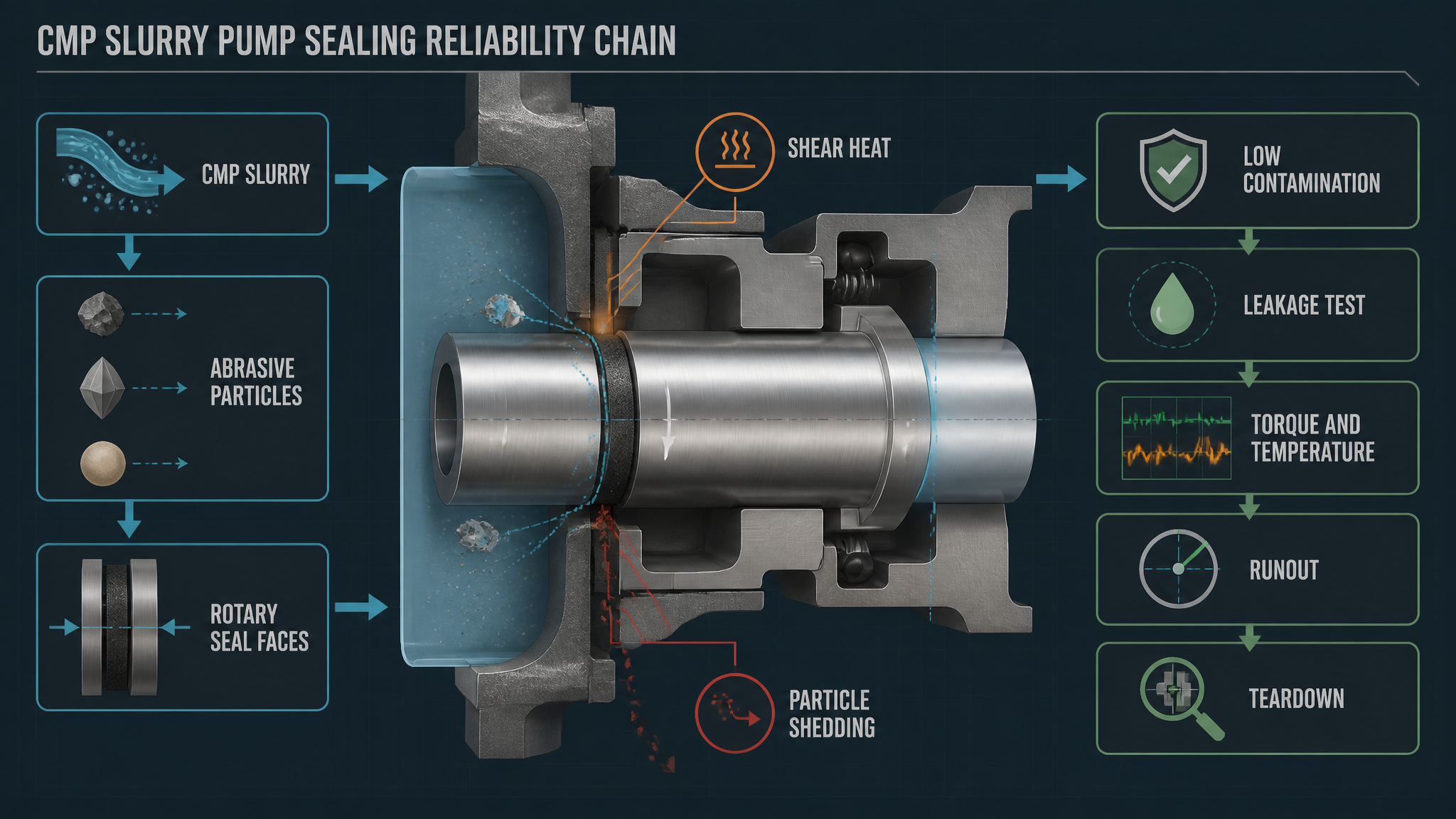
CMP slurry pump sealing must contain an abrasive suspension while limiting wear debris, temperature rise and process contamination. Unlike a clean liquid, slurry can transport hard particles into a rotating seal interface, change the local lubrication state and create a damaging combination of contact, sliding and shear.
A reliable assessment therefore considers seal-face stability, particle entry, contact pressure, shaft alignment, frictional heating, slurry compatibility, leakage, particle generation, cleaning and rotary-cycle history. A static leakage result is useful but does not prove that a seal will remain low-contamination during slurry circulation. The engineering record should distinguish design expectation, laboratory observation, operating condition, maintenance finding and field evidence.
CMP Slurry and Rotary Seal Operating Environment
CMP slurry contains liquid, abrasive solids and chemical additives. Particle hardness, size distribution, concentration, viscosity, flow rate, pH, temperature, agglomeration and residence time can all change the behavior of the rotary sealing interface. A hard particle may enter a face gap and score a surface; an agglomerate may create local point loading; deposited solids may increase start-up friction after a dwell period.
The relevant risk is not defined by particle presence alone. Particle size relative to the face gap, particle hardness relative to the counterface, solids loading, flow path and cleaning condition determine whether particles pass through, become trapped, embed in a softer material or leave as wear debris. Slurry viscosity and temperature also affect shear, heat transfer and the stability of any liquid film between seal faces.
Table I: CMP Slurry Factors and Rotary Seal Risks
|
Slurry factor |
Seal-interface effect |
Likely damage |
System symptom |
Control focus |
| Particle hardness | Raises abrasive severity | Face scoring | Leakage or torque rise | Material and flush review |
| Particle size | Changes entry and bridging | Local wear or gap | Particle excursion | Particle-control review |
| Solids loading | Raises contact frequency | Accelerated wear | Reduced cycle stability | Slurry condition record |
| Agglomeration | Creates unstable point contact | Scoring or embedding | Intermittent leakage | Dispersion and cleaning |
| Viscosity | Changes shear and heat removal | Temperature rise | Seal instability | Operating-envelope review |
| Flow and residence time | Changes deposition and transport | Deposits or dry contact | Start-up friction | Flush and cleaning control |
Slurry factors must be interpreted together with seal architecture, shaft speed, contact pressure and cleaning history. No single slurry property predicts seal life by itself.
Rotary Seal Architecture and Sealing Mechanism
A CMP slurry pump rotary seal normally includes a rotating seal face, stationary seal face, secondary seal, shaft sleeve, loading element, housing and a slurry-side interface. The rotating and stationary rings form the primary barrier; the secondary seal supports the moving or stationary member; the shaft sleeve protects the shaft and defines the rotating surface. A flush or barrier path may help manage heat, particles or leakage, but its effect depends on the actual design and operating condition.
Contact pressure must be sufficient to maintain a stable sealing interface without creating unnecessary frictional heat. Sliding speed increases the work at the interface, while shaft runout, misalignment and assembly error create cyclic local loading. A seal may provide acceptable leakage control while still generating particles, and a low-shedding design may still fail if the shaft is eccentric or the slurry deposits at the face.
Silicon carbide, tungsten carbide, carbon-based, ceramic, polymer and elastomeric components each have different wear, thermal, chemical and cleaning boundaries. A material combination must be judged against the actual slurry, temperature, pressure, speed, solids loading and contamination requirement. No single face or secondary-seal material is a universal solution.
Abrasive Wear and Particle Intrusion
Particles can enter the rotary interface through the slurry-side path, a damaged secondary seal, an open clearance or a disturbed deposit. Two-body abrasion occurs when a particle is fixed between contacting surfaces. Three-body abrasion occurs when a particle moves between the surfaces. Both mechanisms can increase roughness, create grooves and generate secondary debris.
A particle may embed in a softer component and continue to abrade the harder counterface. Wear debris can become a new abrasive population. Slurry deposition or drying may create a high-friction start-up condition even when the pump ran acceptably before the dwell period. These mechanisms should be distinguished from chemical degradation, shaft runout and incorrect assembly rather than being assigned to “slurry particles” without inspection.
Shear Heat, Friction and Thermal Risk
Frictional heat is influenced by contact pressure, sliding speed, friction behavior and the ability of the surrounding slurry or flush path to remove heat. Slurry shear can add local heating and change viscosity. A hot spot may alter material modulus, secondary-seal behavior, liquid-film stability and contact pressure. Thermal expansion can change face loading or shaft alignment during operation.
High speed does not automatically define failure. The result depends on contact load, slurry condition, heat transfer, cooling or flushing, shaft stability and the duration of operation. Temperature monitoring is therefore a diagnostic stream rather than a complete seal-life model. A rising temperature with rising torque may indicate deposition, abrasive wear, poor lubrication or misalignment; the mechanism requires correlation with leakage, particles and teardown evidence.
Table II: Abrasive Wear and Shear-Heat Influence Matrix
|
Stress factor |
Primary physical effect |
Secondary effect |
Potential failure mode |
Required measurement |
Main limitation |
| Particle hardness | Abrasive contact | Roughness increase | Face scoring | Particle and surface review | Hardness alone is insufficient |
| Particle concentration | More contact events | Debris accumulation | Accelerated wear | Slurry condition record | Not the only driver |
| Contact pressure | Friction and local stress | Heat and wear increase | Thermal or abrasive damage | Force and torque trend | Local pressure may be unknown |
| Sliding speed | Higher sliding work | Temperature rise | Face instability | Speed and temperature | Speed alone cannot predict life |
| Slurry viscosity | Shear and heat-transfer change | Lubrication change | Thermal leakage | Viscosity and temperature | Temperature-dependent |
| Shaft runout | Cyclic local loading | Uneven contact | Repeated-cycle leakage | Runout and vibration | Static alignment may miss rotation |
| Deposition or drying | Local solid contact | Start-up friction spike | Scoring or shedding | Cleaning inspection | Timing is service-specific |
Material Selection and Low-Contamination Design
Material selection should compare abrasive-wear behavior, thermal conductivity, friction, chemical compatibility, particle generation, extractables, cleaning tolerance, temperature boundary and pressure boundary. Carbon-based faces may have useful friction behavior in some systems; silicon carbide or tungsten carbide may offer different wear resistance; ceramic or coated components may introduce separate brittleness, adhesion or counterface risks. PTFE-based or elastomeric secondary seals must be reviewed for swelling, hardening, extractables and temperature exposure.
The design objective is not simply minimum leakage. It is stable sealing with controlled particle release, predictable heat behavior, compatible materials and a cleaning process that can restore the interface. Low leakage does not automatically mean low contamination, because a seal can retain pressure while shedding particles or altering slurry cleanliness. Any material conclusion must be tied to the specific slurry and test envelope. Design risk is associated with contact geometry, loading, material pairing and heat removal. Slurry-management risk is associated with solids condition, agglomeration, deposition and cleaning. Operating risk is associated with speed, runout, pressure, temperature and duty history. Maintenance risk is associated with assembly, flushing, cleanliness and verification. Separating these categories prevents every failure from being assigned to the seal material alone.
Inspection, Testing and Maintenance
Static leakage testing establishes a stationary baseline. Dynamic leakage and slurry circulation testing are needed to observe the interface under rotation and solids exposure. Particle monitoring identifies released debris but depends on sampling location, background and particle-size range. Temperature and torque monitoring reveal changes in thermal and friction behavior but do not identify a unique cause.
Shaft runout inspection, seal-face microscopy, post-test teardown, wear-debris analysis, slurry cleanliness checks and flush verification complete the evidence chain. A slurry circulation test can pass while long-term particle generation remains unresolved; a temperature trace can be stable while a face is being scored. After maintenance, the pump cavity, shaft, seal faces, slurry path and cleaning state must be requalified together.
Table III: CMP Slurry Pump Seal Verification Guide
|
Test or inspection |
Test purpose |
Key variable |
Detectable issue |
Suitable stage |
Main limitation |
| Static leakage test | Check stationary boundary | Leak signal and pressure | External leakage | Assembly baseline | No slurry circulation |
| Dynamic leakage test | Observe sealing during rotation | Speed, pressure and leakage | Motion-induced leakage | Qualification | Needs representative slurry |
| Slurry circulation test | Assess real interface | Slurry condition and time | Wear, deposit and leakage | Design validation | Slurry history matters |
| Particle monitoring | Detect released debris | Size, count and location | Particle shedding | Cleanliness validation | Sampling may miss events |
| Temperature monitoring | Track thermal risk | Seal temperature and speed | Hot spot or heat drift | Design and life test | Surface value may be indirect |
| Torque monitoring | Track friction change | Torque, speed and time | Abrasion or deposition | Integration and life test | Torque is not unique diagnosis |
| Runout inspection | Check rotational alignment | Runout and vibration | Uneven contact | Assembly and maintenance | Static measurement is limited |
| Post-test teardown | Confirm wear mechanism | Scoring, embedding and debris | Face or sleeve damage | Failure analysis | Destructive |
No single test proves complete CMP slurry pump reliability. Evidence must connect leakage, circulation, particles, temperature, torque, runout, cleaning and physical inspection.
Data Interpretation and Maintenance Planning
Retain pump type, seal architecture, face and secondary-seal materials, slurry type, particle characteristics, concentration, temperature, pressure, shaft speed, runout, alignment, leakage trend, seal temperature, torque or power, particle result, cleaning history, assembly history, teardown morphology and corrective action.
Maintenance may be calendar-based, cycle-based, condition-based, leakage-trend-based, particle-trend-based, temperature-trend-based or risk-based. Laboratory rotations must not be converted directly into a universal field life. Replacement and requalification should reflect the actual slurry, duty severity, contamination consequence and monitoring capability.
FMEA Risk Analysis
The RPN values below are illustrative engineering risk rankings, not field statistics or experimental results.
Table IV: CMP Slurry Pump Seal FMEA and RPN Analysis
|
Failure mode |
Cause |
Local effect |
System effect |
Detection method |
RPN |
Corrective action |
| Abrasive particle intrusion | Slurry entry into interface | Abrasive contact | Wear and leakage | Particle and teardown review | 185 | Control entry and flushing |
| Seal-face scoring | Hard particle or debris | Damaged face | Leakage and shedding | Surface inspection | 180 | Replace or requalify |
| Particle embedding | Soft material contact | Embedded abrasive | Continued wear | Microscopy | 165 | Review material pair |
| Shear-heat damage | Friction and poor heat removal | Local thermal damage | Seal instability | Temperature and torque trend | 175 | Review load and heat path |
| Shaft runout | Shaft or sleeve condition | Cyclic contact load | Repeated-cycle leakage | Runout measurement | 175 | Correct shaft condition |
| Misalignment | Incorrect assembly | Uneven contact | Local leakage | Alignment inspection | 170 | Correct assembly |
| Slurry deposition | Drying or poor flushing | Start-up friction | Particle event or damage | Cleaning inspection | 160 | Improve flush and cleaning |
| Secondary-seal degradation | Chemistry or temperature | Loss of support | Leakage or contamination | Material and teardown review | 165 | Check compatibility |
| Wear-debris generation | Abrasion or face damage | Released particles | Process contamination | Particle monitoring | 180 | Remove source and verify |
| Incomplete post-maintenance cleaning | Residual slurry or debris | Contaminated interface | Recurring leakage or particles | Requalification audit | 175 | Reclean and requalify |
Corrective action should improve seal design, slurry control, pump operation and maintenance verification together.
Conclusion
CMP slurry pump sealing is a coupled problem of abrasive-particle control, rotary contact, shear heat, shaft stability, low particle generation and leakage verification. A seal can leak, wear, heat or contaminate the slurry through different mechanisms, and no single material or test eliminates every risk.
Reliable performance requires representative slurry circulation, controlled alignment, temperature and torque monitoring, particle evidence, teardown inspection and post-maintenance cleaning verification. Long-term reliability is established by connecting seal-face condition, slurry history, operating data and physical evidence rather than relying on a static leakage result alone.
Engineering FAQ
Q:Why are CMP slurry pumps difficult for rotary seals?
A:They combine rotating contact with abrasive solids, chemical additives and changing slurry conditions. Particles can enter the interface, alter friction and create wear debris even when the initial seal is leak-tight.
Q:How do abrasive particles damage a rotary seal face?
A:Particles can pass through the interface, become trapped, embed in a softer component or move as three-body abrasives. The result may be scoring, roughness growth, debris and a local leakage path.
Q:How does shear heat affect CMP slurry pump sealing?
A:Friction and slurry shear can raise local temperature. Temperature changes may alter material modulus, viscosity, liquid-film stability, secondary-seal behavior and contact pressure.
Q:Why can a seal pass a leakage test but still generate particles?
A:A leakage test measures a gas or liquid boundary under a defined condition. It may not reproduce slurry circulation, particle entry, friction, thermal cycling or wear debris generation.
Q:Which tests verify low-contamination rotary sealing?
A:Use a combination of dynamic leakage, slurry circulation, particle monitoring, temperature and torque trends, runout inspection, seal-face inspection, teardown and cleaning verification.
Q:What should be checked after replacing a CMP slurry pump seal?
A:Check the pump cavity, shaft and sleeve, rotating and stationary faces, secondary seals, alignment, runout, slurry path, cleaning state, leakage, particles, temperature and torque under representative operation.
Post time: Aug-28-2026