
Executive Summary
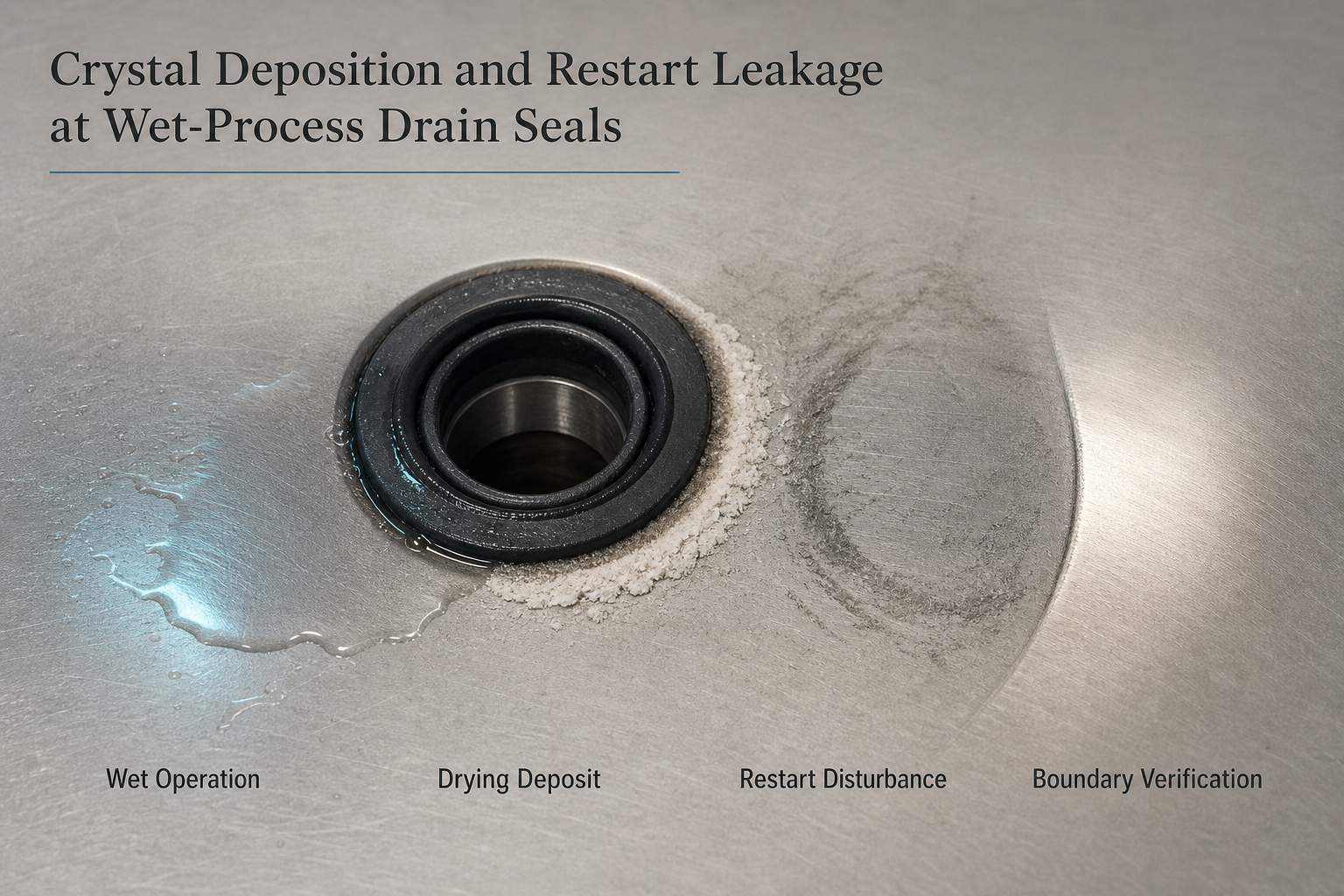
Restart leakage at a wet-process equipment drain seal should be treated as a sequence-dependent boundary symptom, not automatic proof of seal-material failure. Liquid residue may remain near a drain outlet, dry into a deposit, alter local contact or restrict the discharge path, and then be disturbed when equipment operation resumes. Rewetting, pressure or flow reintroduction, thermal change, actuation, vibration or measurement timing may reveal a weakness that was not obvious during wet operation.
A visible deposit does not identify its composition, and a restart-only leak does not prove chemical attack, compression loss or permanent damage. The observation may involve standoff, particles, scratches, cleaning residue, drain geometry, maintenance damage, stress relaxation or measurement error. Preserve the original state, separate wet, dry and restart observations, inspect before cleaning, and verify the assembled seal under defined conditions.
This is a general engineering framework, not a qualification of a named tool, liquid, crystal, seal compound or leak-test limit. Site conclusions require the actual liquid history, drain geometry, seal details, maintenance record, restart sequence and test method.
Drain-Seal Boundary and Deposition Paths in Wet-Process Equipment
The relevant boundary may include the equipment drain outlet, liquid-facing surface, drain channel, seal groove or seat, mating surface, downstream discharge path and nearby low-exchange regions. The exact boundary depends on the equipment design. A local drain-seal symptom must be kept distinct from the complete liquid and waste system because downstream fittings, restrictions, retained liquid or remote interfaces can produce a similar signal.
During wet operation, liquid may contact the seal and move through the drain path. Incomplete exchange, a low point, recess or restriction may retain liquid near the interface. During drying, the retained liquid may leave residue or a deposit. Location depends on liquid history, evaporation and drainage; appearance alone does not establish composition or mechanism.
Table 1. Possible Deposition Paths and Drain-Seal Consequences
| Possible location or state | Local condition | Possible seal or drain-path consequence | Evidence to check | Limitation |
| Liquid retention near the drain seal | Liquid remains at or near the boundary during wet operation | Possible residue formation or altered local wetting | State history, drain condition and pre-cleaning record | Retention must be confirmed against actual geometry |
| Drying at a low-exchange region | Evaporation occurs where exchange or discharge is limited | Possible deposit accumulation or local standoff | Deposit location, drying history and drain-path review | Appearance does not identify composition |
| Deposit on groove, seat or mating surface | A dried residue is located in the contact region | Possible wedging, scratching or contact-pressure redistribution | Pre-cleaning images and interface inspection | Deposit may be incidental rather than causal |
| Restricted outlet or retained liquid | Discharge is limited or a path holds liquid | Possible delayed drying, splash-back or repeat deposition | Outlet condition, routing and discharge evidence | Requires the actual drain configuration |
How Drying Deposits Can Alter Seal and Interface Conditions
A dried deposit may create a standoff, act as a wedge, enter the contact line, restrict a nearby path, or change wetting during liquid reintroduction. Hard or particulate residue may scratch a mating surface or move during restart. The effect depends on location, geometry and sequence.
Deposit-related interference is not the same as chemical incompatibility. A seal may swell, soften, harden, embrittle, extract components or lose recovery after exposure, but a visible deposit does not prove that any of these occurred. Compression set and stress relaxation are also separate mechanisms. Contact force may decline with time, temperature, exposure or repeated service, while a deposit may be present at the same time. Both conditions may need evaluation.
Particles, dried solids, fibers and cleaning films can create local openings without changing the bulk seal material. Conversely, a material response can change contact even when no visible deposit remains. A restart leak should therefore be assessed against physical evidence from the seal, groove or seat, mating surface, drain path and maintenance history rather than assigned to the most visible feature.
Table 2. Restart-Leakage Signatures and Alternative Mechanisms
| Observation or symptom | Deposit or restart possibility | Alternative mechanism to separate | Verification approach | Limitation |
| No obvious wet-state leak, then restart leakage | Drying or rewetting changes interface contact | Compression loss, timing effect or boundary misclassification | Compare wet, dry and restart states with isolated boundaries | State timing must be documented |
| Leakage changes after cleaning or rewetting | Deposit removal or redistribution changes contact | Cleaning residue, assembly change or measurement drift | Preserve pre-cleaning evidence and repeat defined checks | A change does not identify the cause |
| Leakage after maintenance | Cleaning or drying may expose a deposit-related weakness | Pinching, twisting, misalignment or seat damage | Review assembly record and inspect seating | Maintenance history may be incomplete |
Restart Thermal, Mechanical, Liquid and Measurement Effects
Restart is a state transition, not simply a return to the prior operating condition. Temperature may change seal stiffness or recovery. Pressure or flow reintroduction may move retained liquid or disturb a deposit. Actuation, vibration or fixture movement may shift an interface that was static during shutdown. Rewetting may soften or redistribute residue, while a trapped volume may release liquid or vapor after the test has already begun.
These effects can expose a local opening without proving that the seal material is defective. A deposit may be displaced, compressed or driven into a contact line. A drain restriction may delay discharge and make the symptom appear after restart. A seal with reduced compression recovery may respond differently when the boundary is reloaded. The sequence, timing and repeatability must be recorded before selecting a mechanism.
Measurement practice can also create apparent differences between wet, dry and restart states. Sensor placement, stabilization time, calibration, test-medium choice, detection threshold, background condition and boundary isolation affect what is observed. A local leak test under one state does not establish behavior in every state, and a post-cleaning pass does not prove recurrence control without a defined follow-up condition.
Table 3. Inspection and Validation Guide for Drain-Seal Restart Leakage
| Check or test | Objective | Key variable or evidence | What it may indicate | Limitation |
| Pre-cleaning state record | Preserve the original symptom and deposit evidence | Location, wet/dry state, timing and visible condition | State-dependent behavior or deposit association | Observation is not composition proof |
| Wet, dry and restart comparison | Separate state-specific leakage | Defined sequence, state and boundary isolation | Restart-only or persistent leakage | Conditions must be representative |
| Seal, groove, seat and mating-surface inspection | Find local physical evidence | Cuts, scratches, residue, seating and recovery | Deposit, assembly or material concern | Cleaning and disassembly can erase evidence |
| Drain-path and retained-liquid review | Assess discharge and evaporation behavior | Restriction, dead volume, routing and splash-back | Path-related deposition or delayed release | Actual geometry is required |
| Deposit or residue characterization | Assess composition or morphology when defined | Sample location, handling and analytical method | Possible source or material class | A sample result may not prove leak causation |
| Cleaning compatibility and residue check | Separate cleaning effects from process deposition | Cleaner, rinse, dry and handling history | Residual film or surface change | No cleaner is assumed |
| Seal exposure and compression review | Assess material response and recovery | Actual compound, exposure history and assembly | Possible swelling, hardening or compression loss | Component evidence is not assembled proof |
| Boundary-isolated verification after service | Check the restored drain boundary | Defined test state and test method | Persistent or removed symptom | No lifetime claim follows |
Seal Material, Drain Geometry and Maintenance Considerations
There is no universal seal material or cleaning method for every wet-process drain outlet. Selection should connect the confirmed liquid and cleaning environment with compatibility, swelling or extraction, compression retention, geometry, surface condition and service access. A component exposure result does not establish assembled sealing unless the actual boundary and sequence are represented.
Drain geometry can influence deposition independently of seal chemistry. Outlet slope, low-exchange regions, dead volume, restrictions, splash-back and evaporation paths may determine where liquid remains and where residue accumulates. A corrective action aimed at the seal compound may not address a path that retains liquid. Conversely, a drainage change may not correct compression loss, chemical response, particle inclusion or seat damage.
Maintenance controls should protect evidence and the interface. Before wiping or cleaning, record the deposit and symptom. During service, control orientation, seating, alignment, surface protection and handling. After service, verify the drain boundary under defined wet, dry and restart conditions. If the actual acceptance limit, interval or cleaning chemistry is not supplied, the article can recommend review but cannot assign a universal threshold.
Inspection, Root-Cause Separation and Validation Testing
Begin with an evidence-preserving record. Note whether the symptom occurs during wet operation, during drying, at restart or after stabilization. Record the liquid history, drain state, cleaning history, restart sequence and test configuration only when supplied or measured. Photograph or otherwise document deposit location and morphology before cleaning. Classify each statement as observed, suspected, confirmed, inconclusive or not evaluated.
Preserve the seal, deposit, groove or seat and mating-surface evidence before alteration where safe. Inspect for swelling, hardening, cracking, cuts, compression recovery loss, particles, scratches, pinching, twisting and uneven seating. Review the drain path for restriction, retained liquid, poor discharge, splash-back and low-exchange regions. Isolate downstream boundaries so a remote joint or fitting is not assigned to the local seal.
Separate chemical or material evidence from particles, dried solids, cleaning residue and handling contamination. Microscopy or chemical characterization may help define a sample, but it does not automatically prove that the sample caused the leak. A material exposure test addresses selected component response; a leak test addresses the tested assembly and condition; a wet-state test does not establish restart behavior.
After cleaning or seal replacement, verify seating, alignment, drain behavior, restart sequence and the assembled boundary under relevant defined conditions. State the objective, variables, evidence produced and limitation for every test. If evidence remains incomplete, report the conclusion as inconclusive or not evaluated instead of using a visible deposit or a restart symptom as a root-cause shortcut.
Design, Maintenance and Process Controls
Controls should match the mechanism. For deposition, improve drainage and evaporation only after the path is understood. For chemistry, review liquid history and compatibility evidence. For particles and residue, control cleaning, rinsing, drying, handling and contact surfaces. For assembly, verify seating, alignment and surface condition.
Restart controls should document the transition from shutdown to operation, including relevant liquid, pressure, temperature, actuation, vibration and detection states. Maintenance records should link seal orientation, cleaning, deposit observations, drain condition, assembly checks and post-service verification. A longer purge or new compound may not correct a scratched seat, trapped liquid or measurement error.
FMEA Risk Analysis: Crystal Deposition and Restart Leakage at Drain Seals
The following qualitative FMEA is an engineering screening aid, not field statistics, a product rating or a confirmed failure analysis. It contains no assumed probability, severity, RPN, deposit thickness, liquid identity, temperature, pressure, flow rate, leak rate, cycle count or service-life claim. Each row is a conditional concern requiring confirmation against the actual equipment, liquid history, maintenance record and measurement method.
Table 4. Qualitative FMEA for Crystal Deposition and Restart Leakage at Drain Seals
| Failure Mode | Cause | Local Effect | System Effect | Detection Method | Control Action |
| Drying deposit at seal interface | Liquid residue dries near the groove, seat or mating surface | Possible standoff or altered contact | Restart leakage or repeat deposition | Pre-cleaning record and interface inspection | Control drainage, drying and evidence preservation |
| Particle or deposit inclusion | Dried solids, particles or cleaning residue enter the contact line | Local opening, wedge or scratch | Leakage or contamination signal | Microscopy, mapping and boundary inspection | Control cleanliness and service handling |
| Restricted drain path | Retention zone, restriction or unfavorable discharge path | Delayed drainage or splash-back | Deposit recurrence or delayed restart symptom | Drain-path and discharge review | Review routing and low-exchange regions |
| Chemical seal response | Liquid or cleaner affects the seal material | Possible swelling, hardening or recovery change | Reduced sealing margin | Compatibility and material evidence | Use representative exposure evidence |
| Compression loss or stress relaxation | Time, temperature, exposure or repeated service | Reduced contact recovery | Leak sensitivity during restart | Seal inspection and compression review | Assess actual geometry and service state |
| Restart disturbance | Rewetting, pressure, flow, actuation or vibration | Deposit displacement or contact change | Leak appears only after restart | Sequence record and state comparison | Define and verify restart conditions |
| Cleaning or maintenance damage | Wiping, incompatible cleaning, pinching or twisting | Surface damage or uneven seating | Post-service repeat leakage | Maintenance record and inspection | Controlled cleaning and assembly |
| Boundary misclassification | Remote fitting, drain path or downstream interface | Local seal receives incorrect attribution | Wrong corrective action | Boundary isolation and repeat test | Define the tested boundary |
| Measurement error | Calibration, placement, background or timing | Apparent leak or changing signal | Wrong corrective action | Calibration review and repeat method | Standardize measurement practice |
Conclusion
Restart leakage at a wet-process equipment drain seal should be investigated as a state-dependent drain-boundary condition involving wetting, drying deposition, contact, chemistry, compression, geometry, maintenance and measurement. A visible deposit may be relevant, incidental or one part of a coupled mechanism. It does not identify its own chemistry or prove permanent seal damage, and a restart-only symptom does not automatically establish a root cause.
A defensible corrective action begins with the drain design, liquid and drying history, deposit evidence, seal details, maintenance records, restart sequence and test method. Separate deposit effects from chemistry, compression loss, particles, drain behavior, cleaning residue, assembly damage and remote boundaries before changing the seal, geometry, cleaning control, restart sequence or measurement method.
FAQ
Q:Why can a wet-process drain seal leak after equipment restart?
A:A restart changes the boundary state. Rewetting, pressure or flow reintroduction, thermal change, actuation, vibration, retained liquid or deposit disturbance may reveal a local opening that was not obvious during wet operation. The symptom still requires separation from compression loss, chemical response, maintenance damage and measurement effects.
Q:Can dried residue or crystal-like deposits cause drain-seal leakage?
A:They can contribute when they create standoff, enter the contact line, scratch a surface, restrict drainage or move during restart. A visible deposit does not prove its composition or that it caused the leak; location, timing and interface evidence must be evaluated together.
Q:Does a visible deposit prove chemical attack on the seal?
A:No. A deposit may be process residue, dried solids, cleaning residue, particles or another material. Chemical attack requires evidence from the actual liquid, seal material, exposure history and appropriate characterization; appearance alone is insufficient.
Q:How can wet-state leakage be separated from restart-only leakage?
A:Record the symptom separately during wet operation, drying, restart and stabilization, then compare defined tests with boundary isolation. The state, sequence, timing and measurement method must be documented because a single wet-state result cannot establish restart behavior.
Q:What should be inspected before cleaning the deposit?
A:Record the deposit location, appearance, coverage and relation to the seal, groove, seat, mating surface and drain path. Preserve photographs or samples where safe, and record the symptom timing and maintenance history before wiping or disassembly changes the evidence.
Q:Which tests can verify a drain seal after wet and dry cycling?
A:Combine pre-cleaning inspection, wet/dry/restart comparison, drain-path review, seal and seat inspection, characterization where appropriate and boundary-isolated verification. Each method has a separate limit.
Q:How can cleaning residue or maintenance damage be distinguished from deposition?
A:Preserve the pre-cleaning condition, review cleaning and assembly records, and compare residue location with process history. These mechanisms can coexist, so one observation is not conclusive.
Post time: Sep-12-2026