
Executive Summary: Volume Change Is a System Response
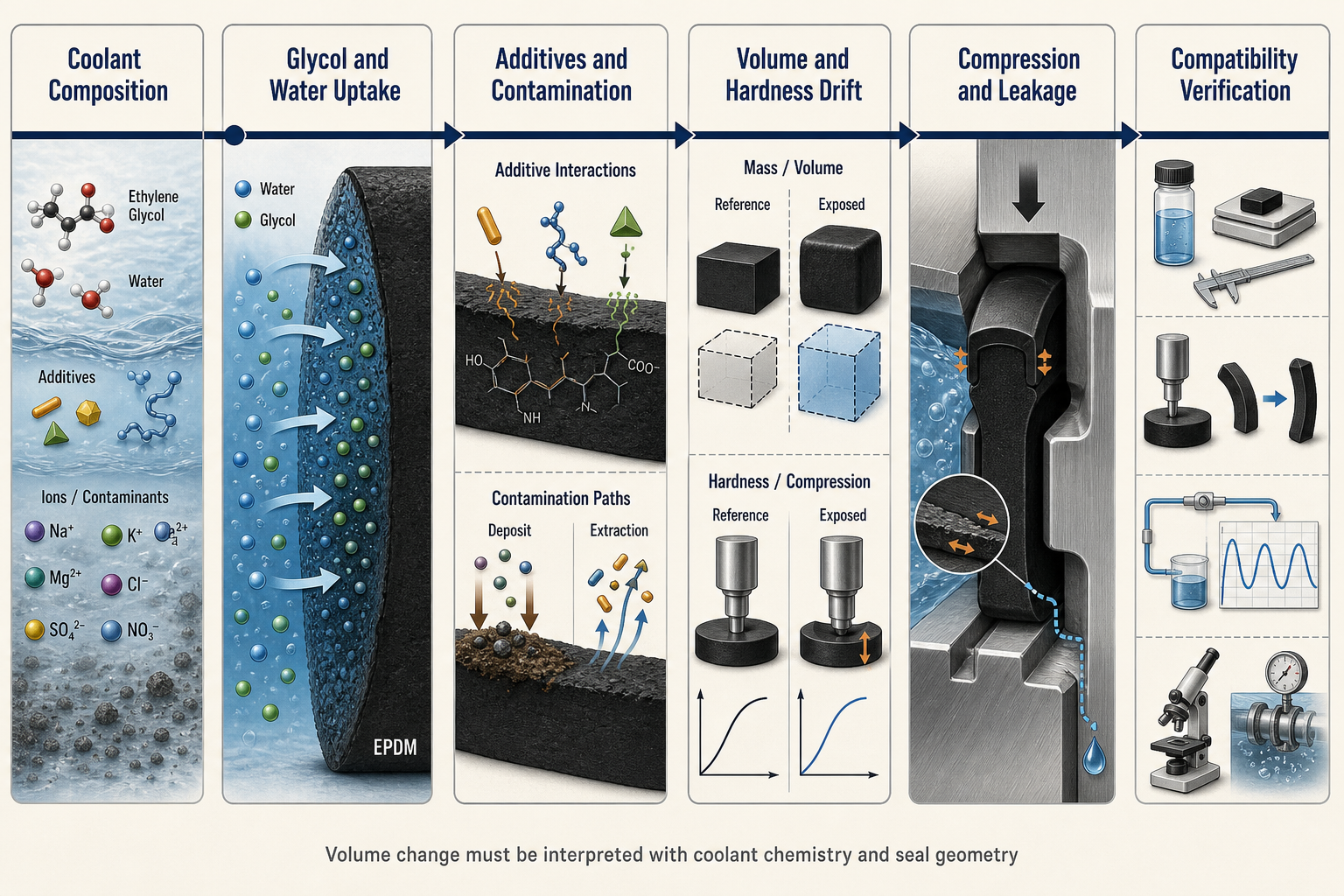
An EPDM seal in ethylene-glycol coolant is exposed to a multicomponent fluid, not glycol alone. Water, glycol, inhibitors, buffers, anti-foam agents, stabilizers, contaminants and oxidation products affect uptake, extraction, lubrication and surface condition. Early responses include mass uptake, volume swelling, softening and friction drift; later consequences may be extrusion, compression loss, wear or leakage.
Volume change is not chemical degradation. Mass gain may contain water, glycol and additive adsorption; mass loss may reflect extraction or material loss. Hardening can result from aging, oxidation, drying or chemical change, while softening can reflect plasticization or absorption. A seal may change dimension without losing cohesion, or lose sealing through compression set while remaining enlarged.
Reliability requires coolant composition, water quality, EPDM formulation, cure system, temperature, pressure, flow, exposure, geometry and cycle history to be evaluated together. Initial hardness, short immersion, one volume measurement or a room-temperature pressure test cannot qualify a circulating coolant seal alone.
Coolant Sealing Architecture and Leakage Boundaries
A coolant channel, pump, valve, heat exchanger or manifold creates a pressure boundary around an EPDM O-ring, gasket or lip seal. Static seals depend on compression and recovery; pump-shaft and valve-stem seals add speed, friction, coolant-film behavior, counterface roughness and start-stop loading. Similar EPDM can therefore face different deformation boundaries.
The coolant-facing surface admits water, glycol and additives, while compression changes uptake paths in the contact band or dynamic lip. Swelling can increase contact in one zone while relaxation or set reduces it in another. Groove fill, clearance, pressure direction and support determine contact gain, loss or extrusion. Scratches, runout, misalignment, deposits, pinching and contamination can mimic incompatibility and must be separated from bulk change, permeation and test artifacts.
Table I. EPDM Glycol-Coolant Sealing Zones and Functions
| Seal zone | Adjacent medium | Static or dynamic function | Coolant-exposure risk | Leakage consequence | Verification focus |
| Coolant-facing surface | Water-glycol coolant | Exposure boundary | Uptake and additives | Contact change | Mass and dimensions |
| Compressed band | Coolant and housing | Static isolation | Set and recovery loss | Static leakage | Compression and leak test |
| Dynamic lip | Coolant and moving shaft | Sliding seal | Swelling and wear | Dynamic leakage | Friction and cycling |
| Groove interface | Housing and clearance | Restraint | Deposits or extrusion | Interface leak | Groove inspection |
| Moving counterface | Rod, shaft or stem | Contact surface | Roughness and damage | Wear path | Finish and runout |
Glycol-Water Interaction with EPDM
Ethylene-glycol coolant contains base fluid, water and additives. Glycol diffusion and water diffusion can occur together but are not the same uptake. Concentration, viscosity, renewal, temperature and flow shape the surface boundary layer. Stagnant, circulating, concentrated, premixed, diluted and aged coolants create different exposure histories.
Mass uptake may contain glycol, water and additive adsorption; mass loss may reflect extraction, migration, deposit removal or material loss. Volume swelling may occur without proportional mass uptake, and mass uptake may occur with limited dimensional change. Measure these separately rather than calling every result glycol swelling.
EPDM formulation, filler interaction, cure system, thickness and time influence response. Peroxide- and sulfur-cured compounds may differ, but neither is universal. Temperature changes transport and mobility, while thermal cycling separates wet-state behavior from dry recovery. Any calculation is an illustrative engineering example tied to defined compound, coolant, temperature, pressure, geometry and method.
Table II. Glycol Coolant Chemistry, EPDM Volume Change and Leakage-Risk Matrix
| Operating factor | Primary effect | Secondary effect | Potential failure mode | Required measurement | Main limitation |
| Glycol and water ratio | Uptake and diffusion | Mass or volume drift | Swelling or extraction | Composition, mass, size | Mixture-specific |
| Water quality | Ions and deposits | Friction or surface change | Wear or leakage | Conductivity and ions | Does not prove bulk damage |
| Additive package | Adsorption or extraction | Hardness or lubrication drift | Softening or friction change | Coolant and material analysis | Formulation-dependent |
| Temperature | Transport and aging | Recovery or modulus change | Set or cracking | Fluid and seal temperature | No universal limit |
| Flow and renewal | Boundary-layer change | Exposure-history change | Different swelling trend | Flow and renewal record | Loop-specific |
| Wet-dry and pressure cycles | Repeated expansion and load | Interface stress | Leakage or extrusion | Cycle history and leak data | Multiple causes |
Coolant Chemistry, Additives and Thermal History
Coolant chemistry changes during service. Inhibitors may be consumed, glycol may oxidize, acids or aldehydes may accumulate, and metal ions or chloride may enter from components or poor water quality. Buffers, anti-foam agents, stabilizers, biocides and dyes alter surface interactions. Similar glycol content does not guarantee similar EPDM exposure.
pH, conductivity, oxygen, salinity and deposits are useful indicators, but no single value proves compatibility. Supplement water changes concentration, ionic balance and inhibitor reserve; mixed coolants disturb additives. Detergent, oil or cleaning contamination can cause extraction, plasticization, hardening, deposits or abrasive wear before obvious swelling.
Temperature and history act with chemistry. High temperature accelerates transport, oxidation and aging; low-temperature startup tests flexibility; thermal, pressure and wet-dry cycles change contact and reveal leakage missed by constant immersion. Record composition, water quality, contamination, temperature and replacement history.
Volume, Mass, Hardness and Compression Drift
EPDM swelling changes the relationship between seal, groove, shaft and housing. Moderate swelling may raise contact pressure and mask a problem; excessive swelling increases groove fill, friction, actuation force and extrusion. After coolant removal or drying, dimensions may not recover because set, extraction, aging or surface damage changed recovery.
Mass, volume and hardness need not move together. A seal may gain mass with limited size change, gain volume with little hardness drift, or lose mass and harden after extraction or aging. Recovery may decline while wet volume remains high, and local lip drift can be hidden by bulk hardness. Interpret mass uptake, dimensions, hardness, modulus, set, recovery and morphology together.
Pressure direction and restraint determine the interface consequence. Swelling may improve static contact but close clearance or raise friction; contraction may reduce contact during cooling. Deposits create high spots and contamination promotes wear. No single volume or hardness shift is a universal failure threshold.
Static and Dynamic Performance, Geometry and Interface Control
Static EPDM seals depend on compression, contact pressure, relaxation and recovery. Volume increase may improve contact, but excessive fill raises corner stress and installation difficulty. Contraction, extraction or set reduces contact and may cause low-pressure or startup leakage. Separate coolant and hardware thermal expansion from material leakage.
Dynamic seals add pump rotation, valve motion, reciprocation, flow, coolant-film stability and counterface condition. Glycol concentration and temperature change viscosity and lubrication. Swelling raises friction and heat; softening reduces lip stability; hardening or contamination creates abrasive debris. Source identification requires particle and morphology evidence.
Cross-section, compression, fill, clearance, pressure direction, support, finish, runout, alignment, edge radius, stretch, twisting and pinching determine the response after exposure. A backup ring reduces some extrusion but cannot remove volume change or aging. Static immersion cannot represent dynamic life.
Leakage Diagnosis, Compatibility Verification and Reliability Planning
Static, dynamic, interface, permeation, swelling, set, extrusion and thermal-cycle leaks can look similar. Pressure decay requires coolant temperature, fluid expansion, entrained gas, volume and instrument controls. A leak proves lost containment, not an EPDM mechanism; evaporation or a temperature transient can create pressure response without a new path.
Preserve failed seal and original coolant before cleaning or cutting. Record orientation and compare coolant-facing, contact, groove, lip and counterface regions. Measure coolant concentration, pH, conductivity, mass uptake, volume, dimensions, hardness, recovery and friction. Use microscopy, cross-sections, deposit and chemistry analysis to separate swelling, extraction, cracking, wear, oxidation and installation damage.
Compare general and coolant-grade EPDM, peroxide- and sulfur-cured compounds, high-temperature, low-set, low-extractable, low-temperature, filled or reinforced grades and alternatives against actual coolant, temperature, pressure, motion, surface and maintenance. No cure system or hardness is universal. Qualify with immersion, flow-loop, thermal, pressure, wet-dry and dynamic tests as required.
After replacement, verify identity, batch, coolant condition, storage, dimensions, groove, counterface, cleanliness, assembly, compression, flow, temperature and leakage. One no-leak run or acceptable volume change is not qualification.
Table III. EPDM Glycol-Coolant Compatibility and Verification Guide
| Test or inspection | Test objective | Key variable | Detectable issue | Suitable stage | Main limitation |
| Coolant sampling | Verify fluid condition | Glycol, pH, conductivity, ions | Degradation or contamination | Service and failure analysis | Does not prove seal damage |
| Immersion exposure | Measure material response | Composition, temperature, time | Mass, volume, hardness drift | Material screening | May miss flow effects |
| Flow-loop test | Reproduce circulation | Flow, pressure, temperature | Swelling or leakage trend | Component qualification | Loop-specific |
| Thermal and pressure cycle | Reproduce state changes | Cycle history and waiting | Set, extrusion or leakage | Seal qualification | Multiple causes |
| Dynamic seal test | Assess motion behavior | Speed, friction, wear, leak | Lip damage or leakage | Component qualification | Geometry-dependent |
| Post-test inspection | Classify damage | Dimensions, microscopy, chemistry | Cracks, deposits or wear | Failure analysis | Preparation may alter evidence |
FMEA, Conclusion and Engineering FAQ
The RPN values are illustrative engineering risk rankings, not field statistics or experimental results. Recalculate them using the organization’s definitions. Reliability records should connect EPDM category, cure system, batch, coolant composition, glycol concentration, water quality, additives, pH, conductivity, temperature, pressure, flow, exposure, cycles, geometry, compression, leakage, mass uptake, volume, hardness, recovery, friction, wear and coolant analysis.
Table IV. EPDM Glycol-Coolant Sealing FMEA and RPN Analysis
| Failure mode | Cause | Local effect | System effect | Detection method | RPN | Corrective action |
| Swelling | Glycol-water uptake | Groove fill and contact drift | Leakage or extrusion | Mass, dimensions, leak | 230 | Control coolant and geometry |
| Additive extraction | Incompatible package | Softening or mass loss | Recovery loss | Coolant and material analysis | 210 | Review additive compatibility |
| Hardening | Oxidation or thermal aging | Low flexibility and cracks | Dynamic leakage | Hardness and microscopy | 220 | Control temperature and fluid age |
| Compression loss | Set or relaxation | Lower contact pressure | Static leakage | Recovery and leak test | 210 | Review compression and cycling |
| Dynamic wear | Poor film or rough counterface | Lip-edge damage | Dynamic leakage | Friction and morphology | 260 | Match material to motion |
| Extrusion | Swelling and clearance | Material displacement | Leak and damage | Gap and section inspection | 190 | Review clearance support |
| Coolant contamination | Deposits or mixed fluid | Local contact disturbance | Wear or leakage | Coolant sampling | 180 | Control cleanliness and fluid change |
| Misdiagnosed pressure decay | Temperature or test error | Wrong corrective action | Recurring failure | Controlled repeat test | 150 | Separate thermal and test effects |
Conclusion
EPDM stability in ethylene-glycol coolants is governed by glycol-water composition, water quality, additives, temperature, flow, exposure history, formulation and seal geometry. Uptake can change mass and volume without proving chemical degradation; extraction, oxidation and thermal aging can produce different hardness and recovery changes. These material states alter groove fill, contact pressure, friction, extrusion, wear and static or dynamic leakage. Reliable decisions require controlled coolant condition, condition-specific flow and cycling tests, preserved failure evidence and post-maintenance verification.
Engineering FAQ
Q:Why can EPDM swell in an ethylene-glycol coolant?
A:Glycol, water and additives can interact with EPDM, changing mass, volume and mobility; the response depends on formulation and coolant condition.
Q:Is volume swelling the same as chemical degradation?
A:No. Swelling is dimensional change and may occur without chain damage, extraction or oxidation.
Q:How do glycol concentration and water quality affect EPDM seal behavior?
A:They change viscosity, transport, ions, lubrication and additives, so similar glycol content does not ensure the same exposure.
Q:Can coolant additives change EPDM hardness or compression recovery?
A:Yes. Additives, contaminants and degradation products can influence extraction, plasticization, aging and recovery.
Q:Why can an EPDM seal pass a short immersion test but fail in service?
A:Short immersion may omit circulation, thermal or pressure cycling, fluid aging, wet-dry exposure and dynamic loading.
Q:Can EPDM volume increase cause extrusion or higher friction?
A:Yes. Swelling can reduce clearance, increase fill and raise contact or sliding resistance.
Q:How should coolant degradation and seal degradation be distinguished?
A:Analyze coolant and deposits together with mass, dimensions, hardness, morphology, friction and leakage.
Q:Which tests are needed after abnormal EPDM swelling or leakage?
A:Use coolant sampling, mass and dimensions, hardness and recovery, microscopy, flow or dynamic testing and leakage checks.
Q:Does one EPDM formulation suit every glycol-based coolant system?
A:No. Compatibility depends on compound, cure, chemistry, temperature, geometry, motion and history.
Post time: Sep-02-2026