
Executive Summary: The Failure Chain Is Longer Than Water Exposure
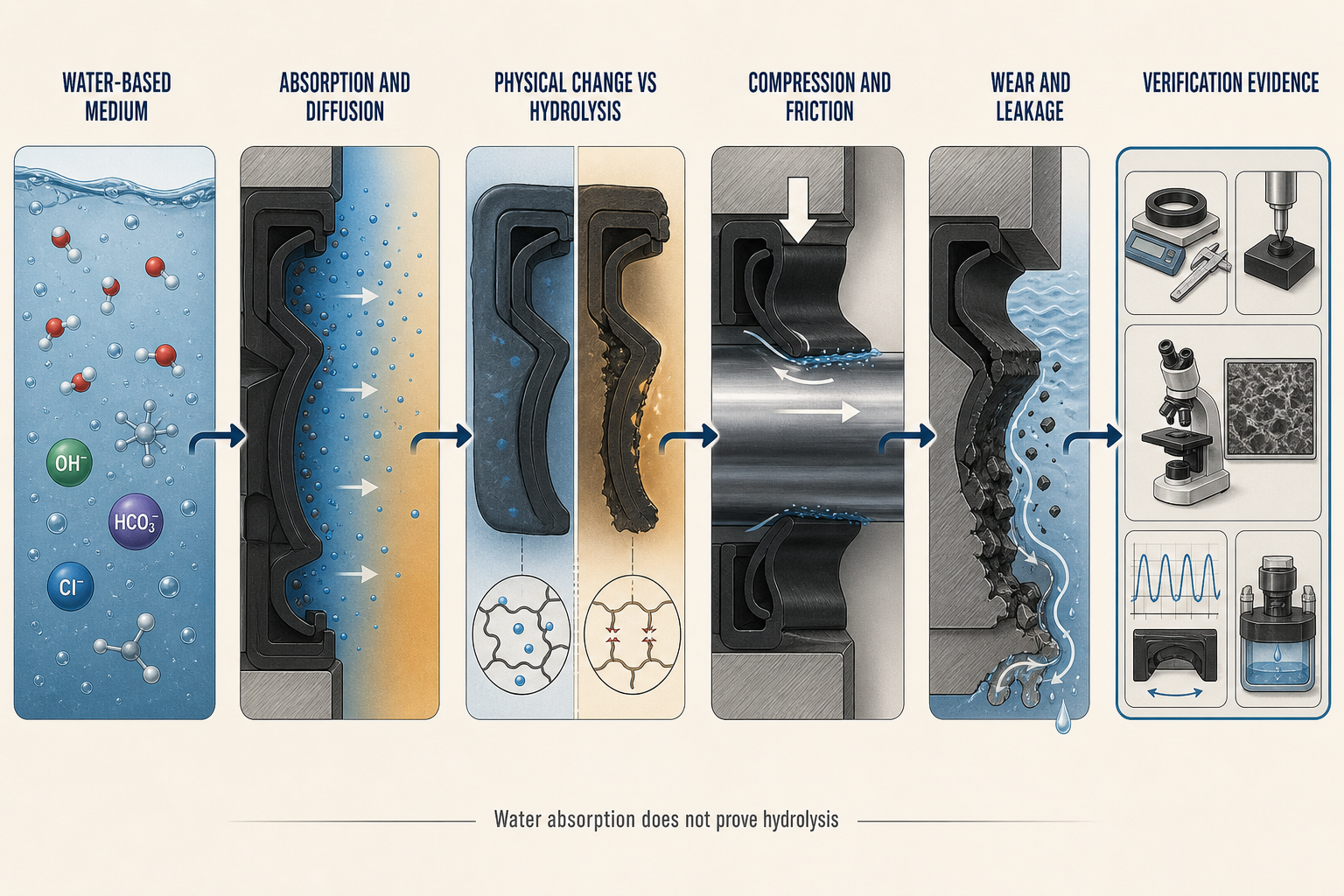
A PU seal in a water-based medium does not fail through one isolated event. Water absorption begins at the exposed surface, water diffusion develops a concentration gradient through the section, and the medium chemistry determines whether that absorbed water mainly plasticizes the polymer, changes its dimensions, extracts low-molecular constituents or contributes to hydrolytic chain scission. The seal can still hold pressure while its hardness, modulus, recovery and friction have already moved away from the original condition.
The failure sequence may therefore begin with swelling or softening, continue through changed contact pressure and lubrication, and end as static leakage, dynamic leakage, wear debris, extrusion or cracking. Hardening is not proof of hydrolysis: drying, oxidation, thermal aging, surface reaction and chemical extraction can produce a different damage path. Initial hardness, short immersion, room-temperature tightness or one static pressure test cannot independently establish long-term service life.
The correct engineering question is not whether a PU label is “water resistant,” but whether a defined material, medium, temperature, geometry and load history preserve the required sealing function. Verification must connect material evidence with dimensions, compression recovery, friction, wear and leakage rather than treating one property as a lifetime limit.
Sealing Architecture: Where Water Enters and Leakage Develops
A housing, shaft, piston, rod and groove establish the boundary between the water-based medium and the low-pressure or atmospheric side. An O-ring, gasket or static PU element relies mainly on compression and contact pressure. A lip seal, U-cup, rod seal, piston seal or wiper adds a moving interface in which speed, stroke, pressure, counterface finish, water-film stability and edge support determine whether the seal survives. A guide ring may control alignment and clearance while experiencing a different exposure from the primary seal.
The medium-facing surface is the entry boundary for water, but compression changes free volume and transport paths in the contact band. The exposed lip, compressed root and bulk centre can therefore develop different moisture states. Swelling may increase contact in one region while softening reduces support in another. Groove fill, clearance and pressure direction decide whether dimensional change improves contact, causes loss of contact or drives the material toward extrusion.
Scratches, runout, misalignment, pinching and contamination can create wear or leakage that resembles hydrolysis. Investigation must distinguish bulk degradation, surface damage, interface leakage, permeation, installation damage and test-system leakage.
Table I. PU Water-Based Sealing Zones and Functions
| Seal zone | Adjacent medium | Static or dynamic function | Water-exposure risk | Leakage consequence | Verification focus |
| Medium-facing surface | Water or aqueous fluid | Exposure boundary | Absorption and swelling | Contact change | Mass and dimensions |
| Compressed band | Medium and housing | Static contact | Set or recovery loss | Static leakage | Compression and leak test |
| Dynamic lip | Fluid and moving shaft | Sliding seal | Plasticization and wear | Dynamic leakage | Friction and cycling |
| Groove interface | Housing and clearance | Restraint | Contamination or extrusion | Interface leak | Groove inspection |
| Moving surface | Rod, shaft or piston | Counterface | Roughness and damage | Wear path | Finish and runout |
Water Diffusion, Polyurethane Structure and Hydrolytic Degradation
Water absorption is physical entry; water diffusion redistributes it through the section. The moisture profile depends on thickness, exposed area, free volume, temperature, architecture, defects and time. A surface or lip edge may swell while the interior remains less affected. Absorption, swelling and plasticization do not prove chain damage.
Hydrolysis cleaves water-sensitive bonds. Polyester- and polyether-based PU can show different tendencies, but hard segments, molecular weight, crosslinking, additives, cure quality and defects also control the result. Neither category is universally suitable or unsuitable; compare defined formulations under defined media and temperatures.
Chain scission can lower molecular weight, modulus, tensile and tear strength, and recovery. Damage may begin at the surface or where heat, pH, stress and moisture overlap. Swelling can occur without scission, while scission can later cause shrinkage, cracking or debonding. Any calculation is an illustrative engineering example tied to formulation, medium, temperature, thickness, time and method.
Table II. Water Chemistry, PU Degradation and Leakage-Risk Matrix
| Operating factor | Primary effect | Secondary effect | Potential failure mode | Required measurement | Main limitation |
| Water content and time | Absorption and diffusion | Moisture gradient | Swelling or hydrolysis | Mass, dimensions and time | Not chain scission alone |
| PU structure | Bond sensitivity | Molecular-weight drift | Strength loss | Chemistry and mechanics | Category is not full formulation |
| Temperature | Transport and reaction rate | Modulus change | Softening or cracking | Medium and seal temperature | No universal life rule |
| pH and salts | Chemical environment change | Surface or interface reaction | Hardening or degradation | pH, ions and deposits | Local conditions vary |
| Additives and contaminants | Extraction or lubrication change | Friction and wear drift | Dynamic leakage | Fluid analysis and friction | Mixture-specific |
| Wet-dry and pressure cycles | Repeated expansion and load | Interface stress | Set, cracking or wear | Cycle history and leakage | Cannot isolate one cause |
Water Chemistry, Temperature and Property Drift
Water-based media differ in pH, salinity, ions, viscosity, lubricity and additives. Cooling water, water-glycol fluid, hydraulic fluid, seawater, process water, cleaning fluid, emulsions and fire-resistant fluids can respond differently. Surfactants, detergents, preservatives, antifreeze components and oil contamination change absorption, extraction, surface energy or friction.
Temperature affects transport and degradation pathways, but the result is structure- and chemistry-dependent. Acid or alkali can change reaction rates; salts, metal ions and hardness can create deposits or abrasive conditions. Wet-dry cycling repeats swelling and contraction, while microbial influence requires separate fluid and surface evidence.
Absorption and plasticization lower hardness and modulus, allowing lip deformation and changing friction. Swelling may raise contact pressure but also increase groove fill, actuation force, rubbing and extrusion. After drying, contact may not recover because set, chain damage or cracking developed.
Hardening may result from drying, oxidation, thermal aging, extraction, surface reaction or embrittlement. Similar hardness values do not exclude lip damage, while a large shift does not prove failure. Interpret mass, volume, hardness and mechanics as a pattern; use microscopy for cracks, delamination, debonding and localized softening.
Static and Dynamic Durability After Water Exposure
Static seals depend on compression, contact pressure, recovery and dimensional stability. Absorption may raise initial contact, but softening, chain scission, set or recovery loss can reduce margin. Thermal and wet-dry cycles repeatedly change the interface, so leakage may follow measurable drift before visible rupture.
Dynamic seals add speed, stroke or rotation, pressure, lubrication, water-film stability, counterface roughness and start-stop behavior. Water may provide less stable boundary lubrication than oil. Softened PU can show adhesive wear and friction increase; hardened or cracked PU can generate abrasive debris. Swelling raises friction and extrusion risk; strength loss accelerates edge tearing.
Analyze dynamic leakage with motion history, not immersion time alone. Friction drift, stick-slip, actuation force, wear particles and lip morphology can precede leakage. Static immersion results cannot represent reciprocating or rotating life.
Geometry converts material drift into a system effect. Swelling changes groove fill, squeeze, contact width and clearance; recovery loss reduces contact after drying or chain damage. Pressure direction, support and corner radius control movement into a gap. Finish, runout, misalignment, burrs, twisting and contamination amplify damage. A backup ring limits extrusion but cannot restore hydrolyzed strength.
Leakage Diagnosis, Material Choice and Long-Term Verification
Static, dynamic, interface, permeation, swelling, set, hydrolysis, lip-wear and extrusion leaks can look similar. Pressure decay requires temperature, volume, fluid, dissolved gas and instrument controls. A leak proves lost containment; mass, volume or hardness change alone is not failure proof.
Preserve the original medium and seal before cleaning or cutting. Record orientation and compare exposed, contact, lip, groove and counterface regions. Measure mass, dimensions, hardness, recovery and mechanics; use microscopy, cross-sections and fluid analysis for cracks, deposits, pH, additives, salts, contaminants and biological evidence. Document preparation because it can remove material or create artifacts.
Compare polyester, polyether, hydrolysis-resistant, thermoplastic, cast, filled or reinforced PU and alternative polymers against actual medium, temperature, pressure, motion, surface and maintenance. Compare uptake, swelling, hardness and modulus stability, set, recovery, tear, abrasion, friction, pH and additive compatibility, biological resistance and batch consistency. No PU family or hardness is universal.
Qualification should combine immersion or water-chemistry exposure with thermal, wet-dry, pressure and dynamic cycles as required. After replacement, verify identity, batch, storage, dimensions, groove, counterface, cleanliness, assembly, compression, motion, friction and leakage. One no-leak run is not long-term proof.
Table III. PU Seal Water-Based-Media Verification Guide
| Test or inspection | Test objective | Key variable | Detectable issue | Suitable stage | Main limitation |
| Immersion exposure | Measure material response | Medium, pH, temperature, time | Absorption and swelling | Material screening | May miss dynamic damage |
| Thermal or wet-dry cycle | Reproduce state changes | Temperature and cycle history | Set, cracking or recovery loss | Seal qualification | Condition-specific |
| Dynamic seal test | Assess motion durability | Speed, stroke, pressure, friction | Wear, lip damage or leakage | Component qualification | Geometry-dependent |
| Mass and dimensions | Track uptake or loss | Mass, volume, size | Swelling, extraction or shrinkage | Pre and post test | Not hydrolysis proof |
| Hardness and mechanics | Measure property drift | Hardness, tensile, tear, recovery | Softening, hardening or strength loss | Material and failure analysis | Bulk result may miss surface |
| Leakage and microscopy | Link damage to function | Leak, cracks, morphology | Static or dynamic failure | Final verification | Preparation may alter evidence |
FMEA, Reliability Planning and Conclusion
Record seal duty, PU category and batch, medium composition, water content, pH, temperature, pressure, salinity, glycol or additives, contaminants, exposure, wet-dry, pressure and temperature cycles, speed, stroke or rotation, finish, compression, clearance, leakage, mass, volume, hardness, friction, wear and morphology. Use calendar, hours, cycles, chemistry, temperature, leakage, friction, dimensions or batch trends, but not one observation as universal field life.
FMEA Risk Analysis
The RPN values are illustrative engineering risk rankings, not field statistics or experimental results. They must be recalculated using the organization’s severity, occurrence and detection definitions.
Table IV. PU Seal Hydrolysis-Risk FMEA and RPN Analysis
| Failure mode | Cause | Local effect | System effect | Detection method | RPN | Corrective action |
| Hydrolytic chain scission | Water-sensitive structure and heat | Molecular-weight loss | Strength loss and leakage | Chemistry and mechanics | 270 | Select and qualify formulation |
| Swelling and plasticization | Water uptake or additives | Size and modulus drift | Friction or contact change | Mass, dimensions, hardness | 230 | Control medium and geometry |
| Hardening or embrittlement | Drying, oxidation or extraction | Cracks and low tear resistance | Dynamic leakage or debris | Hardness and microscopy | 220 | Review chemistry and cycling |
| Compression recovery loss | Set, chain damage or history | Lower contact pressure | Static leakage | Recovery and leak test | 210 | Verify compression and exposure |
| Dynamic wear | Poor water-film lubrication | Lip-edge damage | Dynamic leakage | Friction and cycling | 260 | Match material to motion |
| Seal extrusion | Swelling and clearance | Material displaced into gap | Leakage and damage | Gap and morphology | 190 | Review gap and support |
| Installation damage | Cut, twist or contamination | Pre-existing defect | Leak or wear debris | Assembly inspection | 170 | Improve handling controls |
| Misdiagnosed pressure decay | Temperature, gas or test error | Wrong corrective action | Recurring failure | Controlled repeat test | 150 | Separate leak from artifacts |
Conclusion
PU durability in water-based media is governed by absorption and diffusion, polymer structure, chemistry, temperature, geometry and load history. Absorption can cause swelling and plasticization without hydrolysis; hydrolysis can cause chain scission and strength loss; drying, oxidation, extraction and aging can cause hardening. These states alter recovery, friction, wear, extrusion and leakage. Reliable decisions require controlled media, material and seal testing, preserved evidence and post-maintenance verification.
Engineering FAQ
Q:What is hydrolysis in a polyurethane seal?
A:Hydrolysis is chemical cleavage of water-sensitive bonds, not simple water entry or swelling.
Q:Is water absorption the same as polyurethane hydrolysis?
A:No. Absorption is physical uptake; hydrolysis is chemical chain degradation.
Q:How do polyester and polyether polyurethane generally differ in water-based environments?
A:Their tendencies can differ, but formulation, processing, temperature and medium control the result.
Q:Why can a PU seal soften or swell after water exposure?
A:Water can plasticize the polymer and increase volume; additives can alter modulus and swelling.
Q:Can a water-based medium also cause PU hardening or cracking?
A:Yes. Drying, oxidation, aging, extraction or chain damage can harden, embrittle or crack PU.
Q:Why can a seal pass a short immersion test but fail during long-term operation?
A:Short exposure may miss gradients, chemistry, cycling, pressure, motion and compression history.
Q:How do pH, temperature and additives affect PU seal life?
A:They change transport, reactions, extraction, lubrication and friction; test the actual medium.
Q:What tests are needed after PU exposure to a water-based medium?
A:Use medium analysis, mass, dimensions, hardness, mechanics, microscopy, pressure or dynamic testing and leakage verification.
Q:Should a PU seal be replaced after abnormal swelling or hardness change?
A:Assess geometry, recovery, leakage, friction, morphology and service conditions before reuse.
Post time: Sep-02-2026