
Executive Summary
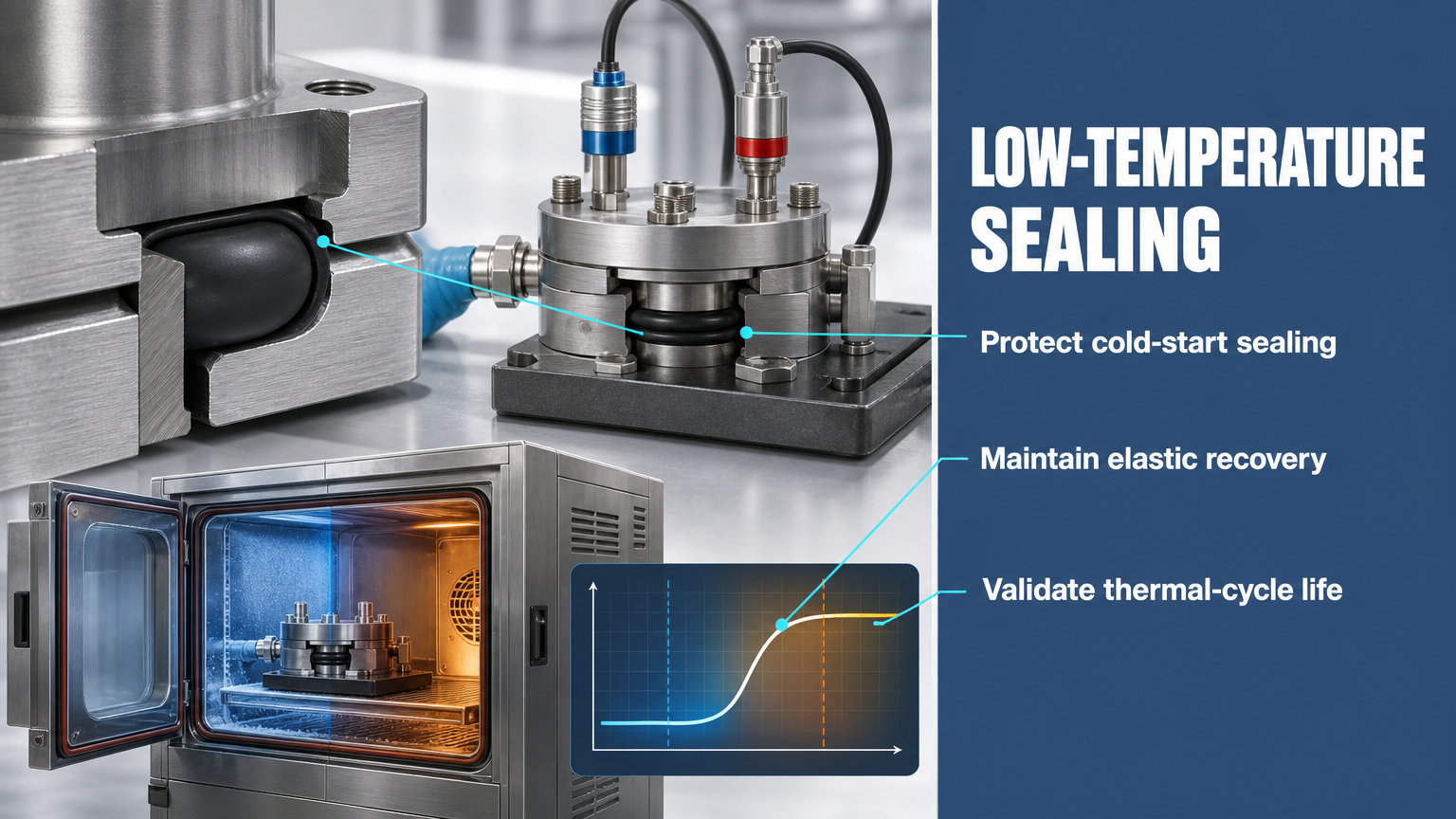
Low-temperature startup creates a sealing condition that is different from normal operation. As an elastomer cools, molecular mobility can decrease, stiffness can rise and elastic recovery can slow. A seal that works at room temperature may temporarily lose contact stress during a cold start, while a dynamic seal may require higher actuator force and generate more wear. Repeated heating and cooling can then accumulate compression set, cracks and permanent loss of sealing force.
The risk is not defined by a material minimum-temperature label alone. It depends on glass-transition behavior, compound formulation, hardness, compression, groove geometry, hardware contraction, coolant or chemical exposure, pressure ramp, motion and installation condition. Static and dynamic seals require different design and test approaches.
This article treats cold-start leakage, low-temperature friction and thermal-cycle life as a coupled reliability problem. EPDM, FKM, FFKM, silicone rubber and HNBR may each be suitable in selected conditions, but the compound, geometry and operating envelope must be verified together.
Low-Temperature Sealing Physics
Glass transition describes the temperature region in which polymer-chain mobility changes substantially. As an elastomer approaches that region, stiffness can increase and elastic recovery can become slower or incomplete. Compression set is different: it is permanent deformation retained after compression and can reduce future contact force even when the current temperature is moderate.
Contact stress is created by seal interference and compression. Cooling changes the dimensions and stiffness of both the seal and the hardware, so the installed squeeze and contact pressure may not remain constant. Chemical swelling can enlarge the seal while hardening or thermal contraction can reduce conformability. Surface cracking and installation damage are separate mechanisms that may be accelerated by low temperature but should not be confused with low-temperature hardening itself.
Leak-before-failure behavior is also important. A seal may first show intermittent leakage during cold startup, then recover as it warms, or develop permanent damage after repeated cycles. Diagnosis must correlate temperature, pressure, time, leakage, friction and inspection rather than assigning every event to one material property.
Cold Start and Static Seal Performance
A static O-ring depends on initial compression and recovered contact pressure. During cold start, the seal may not recover quickly enough after a pressure change or hardware contraction. A fast pressure ramp can load a boundary before the seal has established stable contact. Local cooling from the incoming fluid can also create a transient dimensional mismatch between the seal, groove and metal housing.
The design variables are compression ratio, groove dimensions, gland fill, flange separation, seal hardness, temperature ramp, pressure ramp and initial sealing force. Compression set can reduce the available recovery before the cold event. Excessive compression may increase installation damage and permanent set, while insufficient compression leaves little contact margin when the material stiffens.
Cold-start qualification should record leakage during the minimum-temperature hold, pressure ramp and warm recovery. It should distinguish a temporary recovery-limited leak from a permanent pressure-boundary defect. This problem is separate from pipe-length expansion or compensation; the relevant mechanism is local contact stress at the seal interface.
Dynamic Sealing and Low-Temperature Friction
Dynamic seals face additional risk because low-temperature hardening changes friction, lip deformation and recovery during movement. Reciprocating and rotary motion create different shear patterns. At low temperature, startup torque may rise, stick-slip may appear and the seal lip may fail to conform to the shaft or rod surface.
Higher friction can overload an actuator, produce incomplete stroke or generate wear particles. A surface that is acceptable for static sealing may be too rough or poorly lubricated for low-temperature motion. The test should therefore measure force or torque at startup and during movement, not only leakage after the motion is complete.
Material selection, squeeze, surface finish, lubrication control, movement speed and startup procedure must be considered together. A dynamic seal should not be approved only because an identical material passed a static pressure-hold test.
Elastomer Material Selection
EPDM may be suitable for selected water-based coolant systems, but its grade, formulation, temperature and fluid exposure must be confirmed. FKM low-temperature and chemical performance varies by compound and should not be inferred from the family name. FFKM can provide broad chemical resistance in selected grades, but it does not automatically provide the best low-temperature recovery or dynamic friction.
Silicone rubber may retain useful low-temperature flexibility, while strength, tear resistance, wear, permeability and chemical compatibility require separate evaluation. HNBR can be considered for selected temperature and dynamic conditions, but its compound limits remain important. Every comparison should include glass-transition behavior, elastic recovery, compression set, coolant or chemical compatibility, permeation, temperature cycling, pressure, friction, particle generation, service life and maintenance.
Table I: Elastomer Low-Temperature Performance Comparison
|
Material |
Low-temperature behavior |
Elastic recovery |
Compression-set tendency |
Chemical limitation |
Dynamic suitability |
Main boundary |
| EPDM | May retain flexibility in selected water-based service | Compound and temperature dependent | Exposure and dwell dependent | Not universal for solvents or oxidizers | Selected dynamic duties | Validate actual coolant and grade |
| FKM | Behavior varies strongly by grade | May reduce near transition region | Thermal and chemical history dependent | Compound-specific chemistry limits | Selected dynamic service | Confirm grade and temperature |
| FFKM | Broad chemical range in selected grades | May not maximize low-temperature recovery | High-cost compound still requires testing | Process-specific chemistry | Selected high-consequence service | Validate recovery and fatigue |
| Silicone rubber | Often flexible at low temperature | Generally favorable in selected designs | Strength and compression history matter | Permeation and chemistry limits | Selected low-load motion | Assess wear and fluid exposure |
| HNBR | Condition-dependent low-temperature response | Grade and formulation dependent | Pressure and chemical history matter | Medium-specific limits | Selected dynamic service | Validate compound and duty cycle |
Material families are screening categories. Final selection must use the compound, hardness, seal geometry, medium, temperature, pressure and motion profile.
Thermal Cycling and Failure Development
Thermal cycling exposes the seal to repeated contraction, expansion, stress redistribution and recovery. Damage may accumulate through compression-set growth, material hardening, crack initiation, interface fretting, chemical aging or loss of sealing force. The number of cycles, cooling and heating rate, low-temperature dwell, pressure state and fluid condition all affect the result.
A single low-temperature pass cannot establish long-term life. After cycling, the seal should be checked for leakage, recovery force, friction, hardness change, swelling, surface cracks and permanent deformation. The result should be compared with the initial condition and linked to the actual installed compression.
Table II: Factors Affecting Cold-Start Seal Reliability
|
Factor |
Local mechanism |
Expected effect |
Failure risk |
Recommended control |
| Minimum temperature | Higher stiffness and lower recovery | Reduced contact force | Cold-start leakage | Define tested temperature envelope |
| Cooling rate | Fast material and hardware mismatch | Temporary gap or stress change | Transient leakage | Control ramp and test rate |
| Pressure ramp | Load rises before recovery | Seal displacement | Leak or extrusion interaction | Limit startup pressure rate |
| Compression ratio | Low or excessive contact | Poor recovery or damage | Leakage or friction | Control squeeze and gland fill |
| Seal hardness | Modulus changes at low temperature | Conformability shift | Static or dynamic leakage | Select grade and hardness by duty |
| Groove design | Interference changes with temperature | Contact stress variation | Leak path | Check worst-case geometry |
| Chemical medium | Swelling or hardening interaction | Property change | Low-temperature degradation | Test actual fluid |
| Dynamic movement | Friction and stick-slip | Wear or actuator overload | Surface damage | Use dynamic cold-start testing |
Cold-start reliability depends on the combined thermal, pressure, geometric, chemical and motion history. The minimum temperature alone cannot define the risk.
Testing and Maintenance
A validation plan should combine low-temperature pressure hold, cold-start leakage, thermal cycling, compression-set, elastic-recovery, dynamic-friction, actuation-cycle and chemical-immersion tests. The test record should identify seal material and hardness, size, groove, compression, medium, minimum and maximum temperature, cooling and heating rates, pressure, cycle count, leakage, recovery force and friction.
Post-test visual and microscopic inspection should look for cracks, hardening, softening, swelling, wear and installation damage. A recovery-force result should be interpreted with the temperature and time after warming. Maintenance intervals should be based on the observed degradation mechanism and duty cycle rather than on a generic calendar interval.
Table III: Low-Temperature Seal Validation Matrix
|
Test |
Test objective |
Key parameter |
Detectable failure |
Main limitation |
Suitable stage |
| Cold-start pressure hold | Check seal at minimum temperature | Temperature, pressure and dwell | Cold-start leakage | Does not prove dynamic life | Design and acceptance |
| Thermal-cycle test | Assess repeated contraction and expansion | Range, rates, dwell and cycles | Leakage, set or cracking | Cycle profile specific | Qualification |
| Compression-set test | Measure permanent deformation | Compression, temperature and time | Recovery loss | Material and geometry dependent | Material selection |
| Elastic-recovery test | Measure return of sealing force | Temperature and recovery time | Delayed or insufficient contact | Requires defined fixture | Design validation |
| Dynamic friction test | Assess motion at low temperature | Speed, force, temperature | Stick-slip or overload | Seal and surface specific | Dynamic design |
| Chemical immersion test | Assess fluid interaction | Medium, concentration and duration | Swelling, hardening or cracking | Representative fluid required | Material qualification |
| Post-test inspection | Identify morphology | Visual and microscopy method | Cracks, wear or damage | Destructive or local evidence | Root-cause analysis |
No single test proves low-temperature reliability. Cold-start, recovery, dynamic-friction, chemical and thermal-cycle evidence should be combined for the intended service condition.
FMEA Risk Analysis
A low-temperature seal FMEA should distinguish hardening, insufficient recovery, compression set, cracking, dynamic friction, chemical swelling, thermal-cycle fatigue, incorrect material selection, incorrect compression and improper low-temperature installation. The system effect may be a temporary cold-start leak, actuator overload, progressive wear or permanent pressure-boundary failure.
RPN is a prioritization aid, not a universal safety limit. The values below are illustrative engineering assessments; project scoring must define Severity, Occurrence and Detection and convert high-priority items into design, test and maintenance controls.
Table IV: Low-Temperature Seal FMEA and RPN Analysis
|
Failure mode |
Cause |
Local effect |
System effect |
Detection method |
Illustrative RPN |
Corrective action |
| Low-temperature hardening | Temperature below recovery envelope | Higher stiffness | Cold-start leakage | Cold-start and recovery test | 170 | Requalify compound and temperature |
| Insufficient elastic recovery | Compression set or delayed recovery | Contact force loss | Leak after cooling | Recovery-force and pressure test | 165 | Review compound and squeeze |
| Cold-start leakage | Fast cooling or pressure ramp | Temporary leak path | Fluid loss or contamination | Low-temperature pressure hold | 180 | Control ramp and verify contact |
| Compression set | Long dwell or thermal exposure | Permanent deformation | Reduced life | Compression-set evaluation | 155 | Review material and dwell |
| Surface cracking | Thermal or chemical stress | Local leak path | Progressive failure | Microscopy and immersion test | 175 | Reduce stress and requalify |
| Dynamic friction increase | Hardening or poor surface interaction | High startup force | Actuator overload or wear | Friction and actuation test | 160 | Adjust material and surface |
| Chemical swelling | Medium interaction at temperature | Geometry and hardness change | Leak or motion error | Immersion and dimensional test | 170 | Validate actual fluid |
| Thermal-cycle fatigue | Repeated contraction and expansion | Crack or recovery loss | Leak after cycles | Thermal-cycle and teardown | 185 | Define cycle envelope |
| Incorrect compression | Assembly or groove error | Low or excessive contact | Early leakage | Dimensional and assembly check | 180 | Control installation and inspection |
| Improper cold installation | Seal fitted outside allowed condition | Damage or misfit | Immediate failure | Assembly audit and pressure test | 150 | Define installation temperature |
All RPN values are illustrative engineering assessments, not universal safety limits, certification results or field-failure statistics.
Conclusion
Low-temperature sealing reliability is not established by a material minimum-temperature label alone. Glass-transition behavior, elastic recovery, compression set, contact stress, chemical compatibility, pressure, dynamic motion, thermal cycling, installation condition and validation method must be considered together.
A reliable design provides stable low-temperature elasticity, adequate contact stress, controlled compression, low compression set, chemical compatibility, thermal-cycle resistance and verifiable cold-start performance. The final acceptance boundary must be demonstrated with the actual seal, geometry, medium, pressure and temperature history.
Engineering FAQ
Q:Why do elastomer seals become less reliable during cold start?
A:Cooling can reduce molecular mobility, increase stiffness and slow elastic recovery. If contact stress falls below the required level, a temporary leak can occur before the seal warms and recovers.
Q:How are glass transition behavior and elastic recovery related?
A:As an elastomer approaches its glass-transition region, stiffness rises and molecular mobility decreases. Recovery becomes slower or insufficient for the installed compression and hardware movement.
Q:How should EPDM, FKM, FFKM, silicone rubber and HNBR be compared?
A:Compare the specific compound and hardness against medium, temperature, pressure, motion, compression set, recovery, chemical exposure, wear and maintenance requirements.
Q:What is the difference between cold-start leakage and thermal-cycle failure?
A:Cold-start leakage may occur during one low-temperature event. Thermal-cycle failure develops through repeated contraction, expansion, compression-set accumulation, cracking or chemical aging.
Q:Which tests are necessary to validate low-temperature seal reliability?
A:Use cold-start pressure hold, thermal cycling, compression-set, recovery-force, dynamic-friction, chemical immersion and post-test inspection under defined conditions.
Q:How can low-temperature dynamic friction and stick-slip be reduced?
A:Use an appropriate compound and surface, control squeeze and finish, limit startup speed and verify friction at the minimum temperature with the actual motion profile.
Post time: Aug-21-2026