
Executive Summary
A change in clean-equipment seal outgassing after low-temperature transport should initially be treated as a state- and measurement-dependent observation, not automatic proof of permanent seal damage. Cooling and storage may alter molecular mobility, moisture distribution, adsorption, absorption or dimensional condition. Rewarming, package opening and handling may then release retained species or introduce new volatile material. Test timing, background and configuration can also change the measured result.
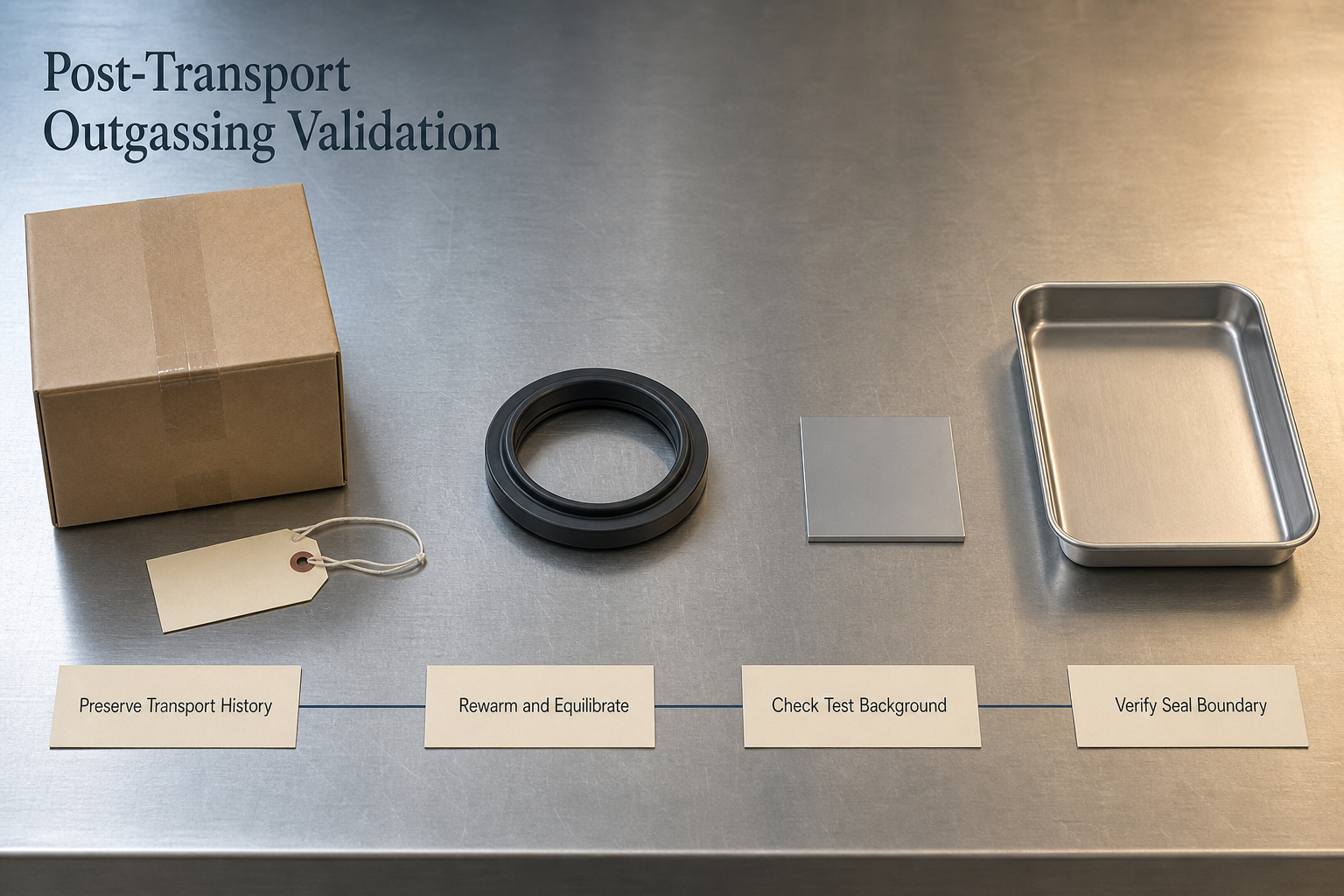
The first question is whether the comparison used equivalent states and boundaries. Preserve transport and storage history, package condition, opening sequence, seal condition, rewarming or conditioning, handling exposure, fixture configuration and test background. Separate reversible conditioning from material damage, compression change, chemical incompatibility, packaging effects and measurement error before accepting or rejecting the seal.
This article is a general engineering framework for clean equipment, vacuum and high-cleanliness manufacturing. It does not assume a particular seal compound, package atmosphere, route, temperature profile, cleanliness class, outgassing rate or acceptance limit.
Clean-Equipment Seal Boundary and What Outgassing Measures
Outgassing is a response of a defined test boundary, not automatically a property of the seal alone. Depending on the setup, the boundary may include the seal, adjacent materials, fixture surfaces, packaging residue, chamber walls, test plumbing or other parts exposed during the measurement. A post-transport signal can therefore be real while still being misattributed to the seal if the boundary is not isolated.
Record what was measured, the seal location, whether it was tested as received or after rewarming, surrounding materials, and how the blank or background was established. Stabilization, sensor response, calibration, detection limit and data reduction affect interpretation. A system reading cannot prove a seal-only source without boundary control.
The signal may also reflect timing. A recently opened package can contribute short-lived release, while an equilibrated seal may respond differently. Neither is inherently more representative; the relevant state depends on the intended use and qualification question. Record conditions rather than treating them as interchangeable.
Table 1. Post-Transport States and Possible Outgassing Interpretations
| State or observation | Possible contributing condition | Evidence to preserve | What it may indicate | Limitation |
| Valid pre-transport baseline | A comparable earlier measurement exists | Boundary, fixture, timing and baseline method | Reference for a later state comparison | Baseline may not match later configuration |
| Seal as received in package | Package and seal have not been opened or conditioned | Package state, labels, custody and test timing | Combined package-and-seal response | Does not isolate the seal |
| After rewarming | Temperature and molecular mobility are changing | Rewarming sequence and time to test | Conditioning or release effect | No permanent-damage conclusion follows |
| After defined conditioning | A documented conditioning step changes the state | Method, sequence and before/after result | Reversible contribution or persistence | Conditioning is not universal proof |
| Blank or background change | Fixture, chamber or adjacent material contributes | Blank method, calibration and system history | Measurement-boundary effect | Blank coverage may be incomplete |
Low-Temperature Transport, Storage and Rewarming Effects
Cooling can change the physical state of a polymeric or elastomeric seal without proving permanent damage. Molecular mobility may decrease, moisture or vapor distribution may shift, and species associated with the surface or bulk may be released at a different rate during rewarming. A package can also preserve a local environment that differs from the later test environment. These are possible mechanisms, not confirmed conditions for an unspecified seal.
Rewarming matters because temperature, time and surrounding atmosphere can change together. A quick opening followed by an immediate test may capture package-related release, condensed moisture, handling exposure or a transient seal state. A later test may show lower or differently timed release after equilibration. Conversely, conditioning can reveal a persistent contribution that was masked during an earlier state. The sequence must be treated as part of the test definition.
Storage history also matters. Delays, excursions, package integrity, barrier performance and packaging contact may affect release. Do not infer a transport cause from low-temperature alone; identify known route and custody facts, unknowns, and observations made before and after package changes.
A reversible state effect differs from cracking, embrittlement, swelling, surface damage or lost recovery, which require physical or material evidence. A higher reading after rewarming may fit desorption or moisture release but does not establish a defect. Persistence after representative conditioning justifies investigation, not automatic diagnosis.
Packaging, Opening and Handling as Potential Contributors
Packaging is part of the post-transport history. Package material, barrier behavior, trapped vapor, internal surfaces, integrity and any documented atmosphere may influence release. Preserve packaging and labels, record when and how it was opened, and identify materials that contacted the seal afterward.
Opening changes the surrounding environment. Tools, gloves, wipes, work surfaces and temporary fixtures can introduce residues or volatile species. Clean handling controls can reduce that risk, but a clean appearance does not identify a source. A package-related signal and a seal-related signal can coexist, and a post-opening rise does not by itself distinguish release from introduction.
Compare defined states with the same measurement boundary where practical, distinguishing as-received, opened, rewarmed, conditioned and assembled states. No universal rewarming time, package material, cleanroom class or handling method is prescribed; controls must match the actual seal, package, route and test objective.
Table 2. Packaging and Handling Factors Behind a Post-Transport Change
| Observation or symptom | Possible contributor | Alternative mechanism to separate | Verification approach | Limitation |
| Higher signal immediately after opening | Package or retained vapor is released | Seal desorption or handling residue | Preserve package and compare defined opening states | Timing alone does not identify the source |
| Signal changes after rewarming | Moisture or adsorbed species are redistributed | Material damage or fixture background | Record state sequence and compare matched conditions | No universal recovery time is assumed |
| Residue appears near the seal | Packaging contact or handling adds material | Process residue or seal surface change | Map location and review custody and contact history | Appearance is not chemical identification |
| Result changes after reassembly | Fixture or adjacent boundary contributes | Seal compression or seating disturbance | Isolate the boundary and review assembly record | Disassembly can alter evidence |
| Package integrity is uncertain | Moisture or ambient exposure may have entered | Transport mechanical disturbance or seal condition | Inspect package history and compare controls | Integrity cannot be inferred from appearance alone |
Separating Material Damage, Compression Change and Chemical Effects
Low-temperature transport can be discussed alongside several mechanisms without treating them as equivalent. Material damage may include cracking, embrittlement, surface change or reduced recovery, but these require inspection or material evidence. Thermal contraction and later dimensional recovery may alter contact temporarily. Compression set and stress relaxation may change contact force independently of outgassing. A seal can show a boundary change without being the dominant source of volatile release, and it can release species without producing a leak.
Chemical incompatibility is another separate hypothesis. A process chemical, cleaner, rinse, packaging-related substance or absorbed contaminant may affect a material response. Cold exposure alone does not establish chemical attack, and a visible residue does not identify a chemical source. Review the actual exposure history and compatible evidence before naming a compound or mechanism.
Shock, vibration, compression or movement may disturb seating or expose a weakness. Assembly can add pinching, twisting, misalignment, surface damage or fixture effects. These mechanisms may change leakage or boundary behavior while leaving the outgassing source unresolved; link the signal to a defined boundary and compare physical evidence with transport, packaging and maintenance history.
Keep observations separate: record the gas-release signal, seal condition, contact behavior, package state, adjacent materials and test background as different evidence streams. Combine them only after timing and boundaries are understood.
Outgassing Inspection and Validation Workflow
Begin before discarding the package or cleaning the seal. Record the change, test boundary, equipment state, timing, baseline and known transport or storage history. Preserve package condition, labels, custody and opening sequence, and state whether testing was as received, after opening, rewarming, conditioning or reassembly.
Inspect the seal, package and adjacent materials for visible damage or residue, but do not treat appearance as chemical identification. Review cleaning, handling, fixture and assembly history. Separate blank and chamber behavior from the seal signal, and document stabilization, calibration, detection-limit and data-reduction conditions. Where the plan permits, compare matched states rather than changing several variables at once.
Species analysis, microscopy, compatibility review or exposure testing each has a defined limitation. An exposure test does not reproduce shipping automatically; a post-warming reading does not prove recovery or damage; visual inspection does not identify species; and a system reading does not isolate the seal without boundary control. Classify conclusions as observed, suspected, confirmed, inconclusive or not evaluated.
Table 3. Inspection and Validation Guide for Transport-Related Outgassing Changes
| Check or test | Objective | Key variable or evidence | What it may indicate | Limitation |
| Transport and storage history review | Reconstruct possible state changes | Route, custody, storage and package records | Known and unknown exposure history | Missing records cannot be reconstructed by assumption |
| Package condition and opening record | Preserve boundary before exposure | Integrity, contact surfaces and opening sequence | Package contribution or ambient introduction | Inspection does not identify every volatile source |
| As-received versus rewarmed comparison | Separate state-dependent release | Defined states, timing and same test boundary | Reversible conditioning contribution | Comparison is meaningful only if conditions match |
| Defined conditioning comparison | Check persistence after a documented step | Method, sequence and before/after response | Persistent or reduced signal | No universal conditioning method is implied |
| Seal and adjacent-material inspection | Find physical evidence | Cracks, residue, surface and seating condition | Material, handling or assembly concern | Disassembly and cleaning can erase evidence |
| Blank, fixture and calibration review | Check measurement boundary | Background, stabilization and sensor status | System or measurement contribution | Blank coverage may not include every part |
| Boundary-isolated verification | Confirm the assembled condition | Defined test state, fixture and result | Persistence at the intended boundary | Does not establish lifetime or universal transport performance |
Transport, Storage, Packaging and Pre-Use Controls
Controls should be derived from actual qualification evidence rather than from a generic cold-shipping rule. Define packaging and storage requirements for the seal, package, route and intended test. Control custody and handling, preserve package identity, document opening and provide an evidence-based rewarming or conditioning sequence. Protect the seal during assembly, verify seating and inspect the adjacent boundary before use.
Pre-use verification should match the question being asked. If the concern is volatile release, define the relevant test boundary and background. If the concern is sealing, verify the assembled contact under the applicable state. If the concern is contamination, preserve sample location and handling history and use a method that can support the intended conclusion. No single check covers all three questions.
A transport control is not proven by clean appearance or one passing reading. Link it to the actual package, material, route, storage, handling and measurement method. Any acceptance limit, temperature, time, atmosphere or cleanliness requirement must come from the applicable specification or qualification record.
Qualitative FMEA: Post-Transport Outgassing Change in Clean-Equipment Seals
The following FMEA is a qualitative screening aid for organizing investigation. It is not field statistics, a product rating or a confirmed failure analysis. It uses no RPN, probability, severity, outgassing rate, total release, temperature, time, package atmosphere, contamination value or service-life claim. Each row remains conditional until supported by evidence from the actual seal and test boundary.
Table 4. Qualitative FMEA for Post-Transport Outgassing Changes
| Failure Mode | Cause | Local Effect | System Effect | Detection Method | Control Action |
| Reversible release after rewarming | State change, desorption or moisture redistribution | Short-term release changes | Apparent post-transport increase | Matched state comparison | Define representative rewarming and record timing |
| Package-opening contribution | Retained vapor or packaging-associated species | Release near opening | Signal attributed to seal | Package and opening record | Preserve package evidence and boundary |
| Handling residue contribution | Gloves, wipes, tools or work surface | Local surface residue | Added volatile background | Handling review and residue mapping | Control contact history and clean handling |
| Transport seating disturbance | Shock, vibration, compression or movement | Contact or alignment changes | Leakage or boundary shift | Assembly inspection and isolated test | Protect seating and verify after transport |
| Suspected cold-exposure damage | Unverified material or dimensional response | Surface or recovery concern | Possible persistent signal or leak | Visual and material evidence | Do not diagnose without defined evidence |
| Compression or stress change | Recovery loss or stress relaxation | Contact-force change | Boundary behavior changes | Seal and assembly review | Check actual compression and state |
| Chemical or cleaner incompatibility | Process, cleaner or package-related exposure | Surface or bulk response | Release or sealing change | Exposure-history and compatibility review | Use actual chemical evidence |
| Fixture or chamber background | Adjacent material, blank or calibration condition | Measured baseline shifts | False seal attribution | Blank, fixture and calibration checks | Control boundary and stabilization |
| Incomplete history | Missing route, storage or opening records | Unknown state sequence | Weak root-cause confidence | Record review and evidence grading | Preserve custody and classify uncertainty |
Conclusion
A change in clean-equipment seal outgassing after low-temperature transport is best treated as a condition- and measurement-dependent observation. Cooling, storage, packaging, rewarming, opening and handling can change the quantity or timing of released species without proving permanent seal damage. Material damage, compression change, chemical incompatibility, transport disturbance, assembly effects and test-system background remain separate hypotheses.
The strongest conclusion comes from preserving transport, package and test history; separating as-received, opened, rewarmed, conditioned and assembled states; controlling the measurement boundary; and matching each inspection or test to a defined objective and limitation. Until those comparisons are available, the result should be reported as observed, suspected, inconclusive or not evaluated rather than upgraded to a universal material or transport conclusion.
FAQ
Q:Why might seal outgassing change after low-temperature transport?
A:Cooling and storage may alter molecular mobility, moisture distribution, adsorption, absorption or dimensional condition. Rewarming and package opening can then change release timing. Packaging, handling and the test background may also contribute. The observation does not identify one cause by itself.
Q:Does a post-transport outgassing increase prove permanent seal damage?
A:No. It may be consistent with a reversible conditioning effect, package contribution, handling exposure or measurement change. Permanent damage requires relevant physical or material evidence and a defined comparison after representative rewarming or conditioning.
Q:Why does rewarming time matter before an outgassing test?
A:Rewarming changes the seal state and may release moisture or adsorbed species. Opening and handling can change the surrounding environment at the same time. The time and sequence should be recorded because readings from different states are not automatically comparable.
Q:Can packaging or package opening affect the measured result?
A:Yes. Packaging surfaces, retained vapor, barrier behavior, package integrity and opening exposure may contribute to the signal. Preserve the package and opening record, and separate package, seal, adjacent-material and chamber contributions where the test plan permits.
Q:How can material damage be separated from reversible conditioning?
A:Compare defined as-received, rewarmed and conditioned states while inspecting the seal and boundary for relevant physical evidence. Review transport and exposure history. A higher reading alone does not prove cracking, embrittlement, swelling or loss of recovery.
Q:Can compression set or stress relaxation explain a post-transport change?
A:They can affect contact force and boundary behavior, but they do not automatically explain a volatile-release signal. Review seal condition, assembly, compression history and the outgassing boundary separately before combining the mechanisms.
Q:What should be recorded before testing a transported clean-equipment seal?
A:Record transport and storage history, package condition, custody, opening sequence, seal state, rewarming or conditioning, handling contacts, fixture configuration, test boundary, blank/background, stabilization and calibration conditions. Mark unknowns explicitly.
Q:How can test background and measurement error be checked?
A:Review the blank method, chamber and fixture contribution, sensor calibration, detection limit, stabilization behavior, placement and data reduction. Repeat a defined boundary comparison when appropriate. A changing signal is not automatically a changing seal.
Post time: Sep-14-2026