
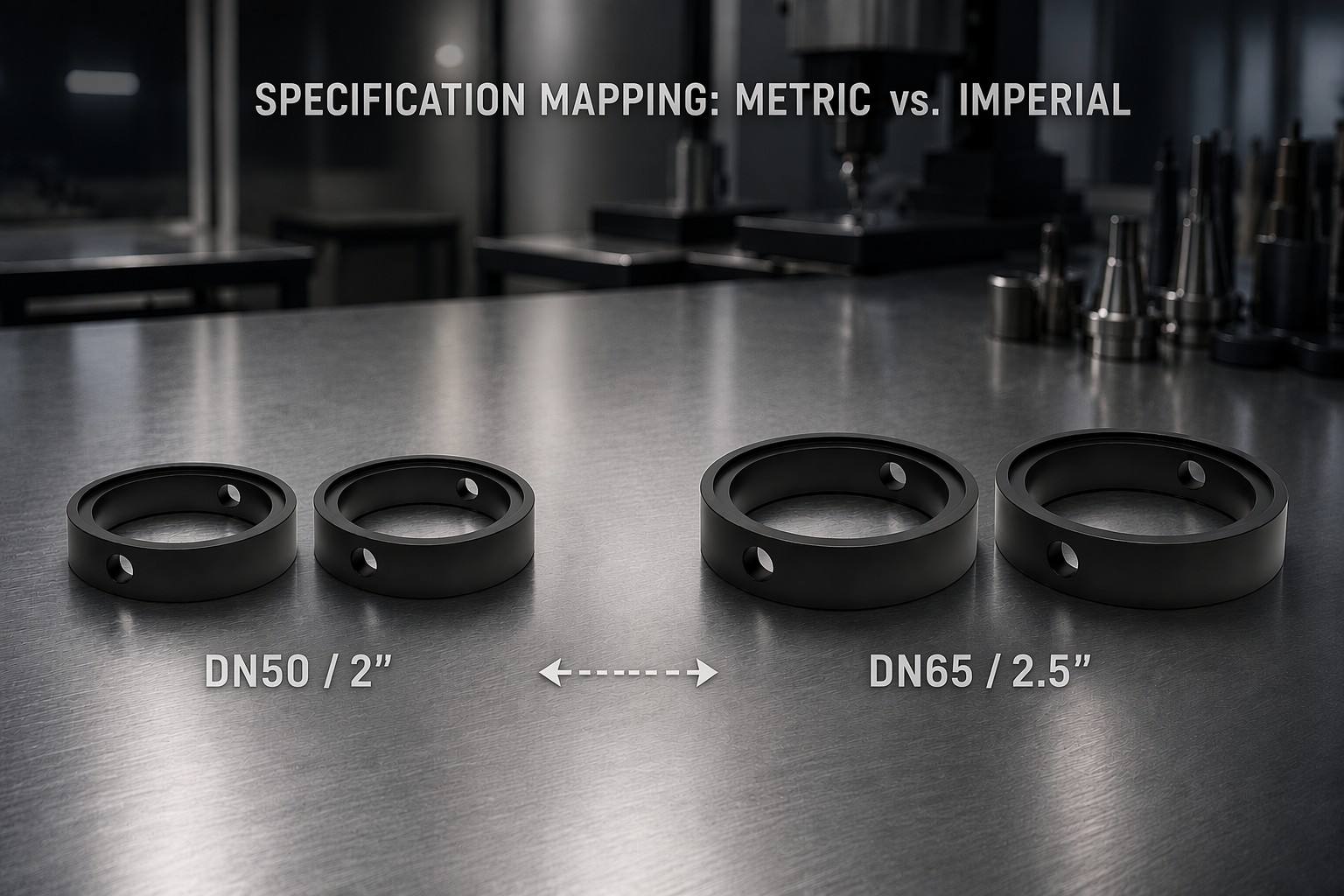
In global fluid infrastructure, DN50 (2″) and DN65 (2.5″) butterfly valve gaskets are considered the ‘Golden Specifications’ due to their massive installed base. However, the prevailing industry logic of ‘low-price bidding’ often results in gaskets with loose tolerances (exceeding ±0.15mm), triggering systemic failures. Yokey Precision, leveraging deep expertise in elastomer mechanics, presents this in-depth technical inquiry. We explore how to achieve ‘Zero-Drift’ breakout torque control in small-bore specifications, maintaining that an elite seal must go beyond leak prevention to provide life-cycle overload protection for expensive automated actuators through micron-level consistency.
I. Standard Mapping and Mechanical Deviations: The Critical Role of ISO vs. ANSI in Small-Bore Systems
In international procurement, while DN50/DN65 and 2″/2.5″ share physical通径, they operate within distinct engineering paradigms: ISO/DIN (European) and ANSI (American). These nuances dictate the terminal reliability of the seal.
1. Pressure Compensation through Sealing Face Width: ANSI Class 150 valve seats are designed with 10-15% wider sealing faces to accommodate high-pressure redundancy in the North American O&G sector. Utilizing an ISO-standard seat in an ANSI body can lead to insufficient ‘Effective Compression Area,’ resulting in instantaneous leaks during pipeline surges. Yokey maintains independent tooling libraries for both standards to ensure a 1:1 geometric fit.
2. Non-linear Torque Amplification via Lip Interference: In small valves like DN50, the shorter circumference of the valve plate means every micron of interference deviation is drastically amplified by the actuator’s leverage ratio. ISO standards prioritize extreme compactness, leaving zero room for tolerance drift. Our research indicates that for every 1-degree deviation in lip geometry, the peak breakout torque fluctuates by over 25%.
|
Specification Metric |
ISO/DIN Solution (DN50/DN65) |
ANSI Solution (2″ / 2.5″) |
|
Regulatory Framework |
ISO 5752 / DIN EN 593 |
ANSI/ASME B16.10 / API 609 |
|
Sealing Geometry |
Compact, Micro-Precision Fit |
Wider Face, High-Pressure Redundancy |
|
Yokey Mold Tolerance |
± 0.015 mm (Strict Value) |
± 0.015 mm (Strict Value) |
|
Primary Market Fit |
European Precision HVAC/Pharma |
N. American Process Control/O&G |
II. Pain Point Analysis: How Tolerance Drift Triggers Actuator ‘Thermal Failure’
For smaller valves like DN50/DN65, the electric or pneumatic actuators employed are typically low-power units with minimal margin. Gasket consistency is the ‘Physical Firewall’ for these systems:
1. The Breakout Torque Crisis: Commodity gaskets produced from generic molds suffer from shrinkage fluctuations caused by environmental humidity. In a DN50 valve, a ±0.15mm deviation in lip thickness can cause breakout torque to spike by 40-50%. This forces actuators into frequent stall-protection cycles, inducing thermal stress in motor windings and eventually causing insulation failure (burnout).
2. Countering ‘Plastic Creep’ and Sealing Fade: Under high-frequency cycles (3000-5000 operations), low-grade materials experience ‘Plastic Creep’—a permanent thinning of the contact zone. The ideal technical path requires 16-hour stabilized post-curing. This protocol improves the Compression Set, ensuring that even after 10,000 operations, the lip maintains its 100% gas-tight interference fit with the valve plate.
III. Conclusion: Redefining Value through Technical Certainty
Even for the most ubiquitous specifications, we maintain the engineering logic of a ‘Hidden Champion.’ Respect for international standard nuances and an obsession with mold precision are the bedrock of the technical certainty Yokey provides. We invite global engineers to partner with us in defining the future of high-frequency precision sealing, moving away from ‘cheap commodities’ towards ‘asset reliability.’
Post time: Jul-28-2026