
Executive Summary: The Financial Cost of Contamination
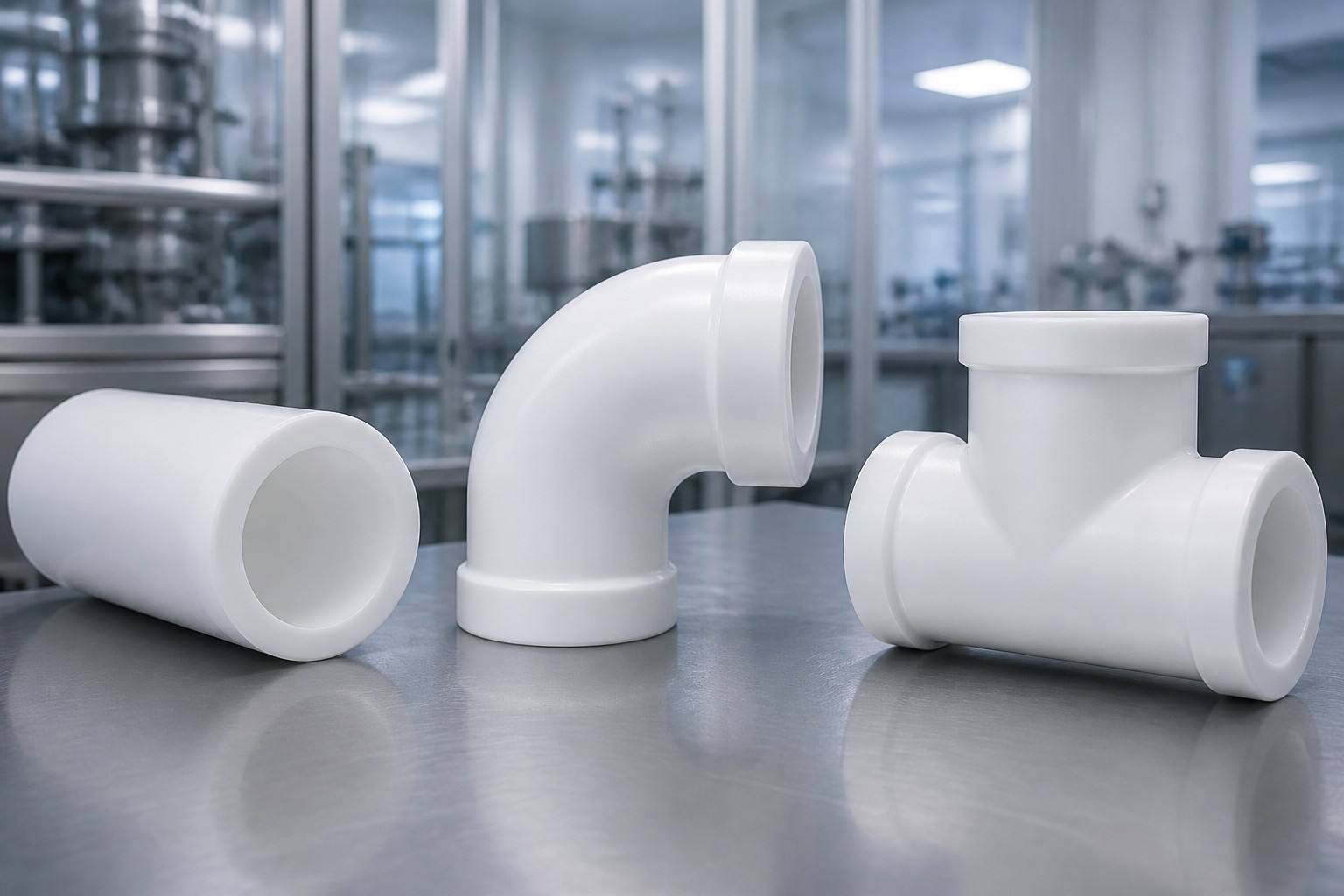
In the high-stakes environment of a semiconductor fab or a pharmaceutical bioreactor, fluid handling is not a matter of basic logistics—it is a matter of ‘Financial Integrity.’ A single low-quality PTFE tee or tube can be the catalyst for disaster. For instance, in a 24/7 wafer fabrication line, a microscopic level of heavy metal leaching from a substandard pipe wall can lead to ionic contamination that destroys entire batches of processors. In an industry where a single downtime event or yield loss can cost $1M to $5M, the selection of piping components is a strategic risk-mitigation decision. The transition to Yokey’s high-purity PTFE piping represents the industry’s shift toward ‘Zero-Contamination’ and absolute chemical sovereignty.
This masterclass moves beyond simple material discussions to explore the intersection of ‘Polymer Physics’ and ‘Geometric Engineering.’ We deconstruct why the physical form of a component is as critical as its chemical composition, providing data-driven benchmarks for UHP system designers.
I. Molecular Architecture: The Carbon-Fluorine Bond Fortress
The unmatched chemical inertness of PTFE piping is rooted in the architecture of its polymer chain. PTFE consists of a carbon backbone entirely encased by fluorine atoms, creating a ‘Helical Shield’ that is nearly impossible for external reactants to breach. This atomic structure provides the baseline for ‘Chemical Sovereignty.’
Fluorine is the most electronegative element in the periodic table. The resulting C-F bond energy (~485 kJ/mol) far exceeds that of C-H bonds (~413 kJ/mol) found in commodity plastics. This extreme bond dissociation energy ensures that PTFE pipe walls remain physically and chemically stable in environments up to 260°C. Yokey’s raw material selection process mandates a specific molecular weight distribution to ensure that this bond density is uniform throughout the component volume, eliminating microscopic weak points that lead to localized degradation.
|
Technical Variable |
Generic HDPE/PP |
Yokey UHP-PTFE |
| Primary Atomic Bond | C-H (Hydrocarbon) | C-F (Fluorocarbon) |
| Bond Energy (kJ/mol) | ~413 | ~485 (Fortified) |
| Ion Leaching Threshold | High (>50 ppb) | < 10 ppt (UHP Elite) |
The data in Table I illustrates the thermodynamic wall that Yokey components provide. For semiconductor FABs, the jump from parts-per-billion (ppb) to parts-per-trillion (ppt) leaching is not just an improvement—it is a requirement for advanced process nodes.
II. Fluid Dynamics: Ra Impact on Particle Excitation
Straight piping performance is governed by the Reynolds Number (Re). In a perfectly smooth tube, laminar flow persists at higher velocities, preventing the ‘Particle Excitation’ that occurs during turbulence. Substandard PTFE pipes, often produced via simple ram extrusion, exhibit a ‘Shark-skin’ surface texture that induces local eddies.
Yokey’s straight pipes achieve a surface roughness (Ra) of <0.20μm. By maintaining a clean laminar boundary layer, we reduce the particle shedding rate by over 90% compared to standard industrial grades. This is critical for CMP slurry handling, where turbulence can cause slurry agglomeration, clogging expensive point-of-use filters.
|
Internal Ra Value |
Laminar Stability (Re) |
Particle Count (/ml) |
| < 0.20μm (Yokey) | 2300 (Stable) | < 5 (UHP-Elite) |
| 0.65μm (Market Avg) | 1850 (Unstable) | ~42 (Generic) |
As demonstrated in Table II, the smoother the bore, the lower the risk of ionic ‘incubation’—a process where metallic contaminants hide in the surface pits and are released during pressure surges.
III. Geometric Integrity: The ‘Dead-Leg’ Physics in T-Junctions
In semiconductor wet benches and DI water loops, T-junctions are the most frequent source of ‘Resistivity Lag.’ A stagnant leg acts as a diffusion source, slowly bleeding bacteria and ionic impurities back into the main process stream. The industry-standard SEMI F57 specifies a 2:1 L/D ratio (Length to Diameter).
Yokey’s precision-molded tees push the boundaries of geometry, achieving a 1:1 ratio. This geometric optimization reduces the ‘Rinse-down Volume’—the amount of high-cost UPW required to clear the system—by as much as 42%. During chemical changeovers, this translates to faster tool uptime and lower operational expenditure (OpEx).
|
L/D Ratio |
Rinse Time (to 18MΩ) |
Contamination Risk |
| 1:1 (Yokey Precision) | 12 mins | Negligible |
| 2:1 (SEMI Baseline) | 38 mins | Low to Moderate |
| 5:1 (Substandard Tee) | > 120 mins | Critical (Bio-burden) |
Table III quantifies the massive time penalty associated with poor geometry. In high-volume FABs, a 26-minute difference in rinse time per tool can equate to millions in additional yearly revenue.
IV. Mechanical Stability: Bolt Torque Standards for Zero-Leak Joints
PTFE’s cold flow (creep) behavior makes installation the most critical phase of the system lifecycle. Under bolt load, PTFE molecules naturally migrate, leading to seal thinning. Yokey addresses this through ‘Groove-and-Lip’ containment, which physically traps the material. However, correct torque application remains mandatory.
Below are the data-driven torque values for 150lb ANSI flanged connections. Yokey mandates a 24-hour ‘Re-torque’ phase. After the first thermal cycle, PTFE settles into its permanent geometric seat, and a final adjustment is required to ensure 100% seal integrity for the life of the system.
|
Pipe Size (ANSI) |
Target Torque (N·m) |
Settlement Period |
| 1″ (25mm) | 45 N·m | 24 Hours |
| 2″ (50mm) | 90 N·m | 24 Hours |
| 4″ (100mm) | 150 N·m | 24 Hours |
Ignoring the torque standards in Table IV is the #1 cause of catastrophic leaks in chemical delivery systems. Proper lubrication of bolts is essential to convert 100% of the torque into actual gasket stress.
V. Comparative Analysis: UHP Component Selection Matrix
Engineers must balance the benefits of modularity with the risks of stagnation. Straight pipes provide the highest efficiency but create the most expansion stress. Elbows allow for compact routing but suffer from back-wall erosion. The matrix below serves as a final selection tool for system integrators.
|
Component |
Pros |
Cons |
Yokey Solution |
| Straight Pipe | Max flow stability | High expansion rate | CLTE-annealed resin |
| 90° Elbow | Modular routing | Centrifugal wall erosion | Hyper-elliptic back-wall |
| T-Junction | Efficient branching | Bio-film in dead-leg | < 1:1 molded ratio |
VI. FMEA: Risk Mitigation for Fluid Networks
The Risk Priority Number (RPN) provides a quantitative look at potential failures. By optimizing component geometry, Yokey reduces the RPN of bio-film growth and cold-flow leaks by over 80%. This ensures that the high-purity fluid remains within the designated safety perimeter at all times.
|
Failure Mode |
RPN (Generic) |
RPN (Yokey) |
Resulting Impact |
| Bio-film Stagnation | 360 | 32 | Stable Resistivity |
| Cold Flow Seepage | 240 | 20 | Zero Scrapping |
VII. Conclusion: Establishing Physical Determinism
In advanced fluid management, there is no room for ‘Approximate Engineering.’ By providing quantifiable torque values, verified L/D rinse-down data, and hyper-elliptic erosion protection, Yokey moves the conversation from commodity sales to deterministic reliability. Our commitment to geometric integrity ensures that your fluid chemistry remains pure, your yields remain high, and your operational risk remains managed.
Appendix: Engineering FAQ
Q1: Is Yokey PTFE piping suitable for sub-5nm semiconductor nodes?
A: Yes. Yokey UHP-Elite grades are manufactured in Class 100 cleanrooms and tested to ensure metallic ion leaching levels are below 10 ppt, meeting the stringent requirements of sub-7nm nodes.
Q2: How does ‘Isostatic Pressing’ improve PTFE pipe life?
A: Traditional extrusion can leave microscopic internal stresses. Isostatic pressing ensures uniform molecular density from all angles, eliminating stress-concentration points and significantly reducing the risk of stress cracks in high-pressure tees and elbows.
Q3: Does PTFE handle high-vacuum environments at elevated temperatures?
A: Standard PTFE can collapse under vacuum at high temperatures. Yokey’s modified high-modulus PTFE is specifically engineered to maintain structural rigidity under full vacuum (0.1 mbar) even at 150°C.
Q4: What is the benefit of the ‘Smooth-Bore’ design in bio-pharma pipes?
A: Smooth-bore geometry reduces internal surface roughness (Ra < 0.4μm), preventing protein adhesion and bacterial growth. This ensures that CIP/SIP cycles are 100% effective, protecting batch purity.
Q5: Can Yokey PTFE handle static-charge sensitive chemicals like IPA?
A: Yes. Yokey’s ESD-Elite series uses high-purity carbon black micro-dispersion to provide safe grounding while maintaining ultra-low particle shedding standards.
Q6: How does Yokey validate chemical corrosion data?
A: All data is verified in Yokey’s ISO 17025 accredited material lab through long-term immersion testing according to ASTM G31 and ASTM D471 protocols, ensuring data integrity for Tier 1 engineering decisions.
Post time: Aug-12-2026