
Executive Summary: The Financial Cost of Contamination
In the high-stakes environment of a semiconductor fab or a pharmaceutical bioreactor, fluid handling is not a matter of basic logistics—it is a matter of ‘Financial Integrity.’ A single low-quality PTFE tee or tube can be the catalyst for disaster. For instance, in a 24/7 wafer fabrication line, a microscopic level of heavy metal leaching from a substandard pipe wall can lead to ionic contamination that destroys entire batches of processors. In an industry where a single downtime event or yield loss can cost $1M to $5M, the selection of piping components is a strategic risk-mitigation decision.
The transition to Yokey’s high-purity PTFE piping represents the industry’s shift toward ‘Zero-Contamination’ and absolute chemical sovereignty. This report deconstructs the Material Science behind Yokey’s PTFE systems, exploring the physics of Carbon-Fluorine bond shielding, advanced sintering protocols, and thermal stability benchmarks, establishing a data-driven standard for Ultra-High Purity (UHP) fluid networks.
I. Molecular Architecture: The Carbon-Fluorine Bond Fortress
The unmatched chemical inertness of PTFE piping is rooted in the architecture of its polymer chain. PTFE consists of a carbon backbone entirely encased by fluorine atoms, creating a ‘Helical Shield’ that is nearly impossible for external reactants to breach. This phenomenon is amplified by ‘Steric Hindrance,’ where the large fluorine atoms leave no space for corrosive ions to attack the carbon core.
1.1 Electronegativity and 485 kJ/mol Shielding
Fluorine is the most electronegative element in the periodic table. The resulting C-F bond energy (~485 kJ/mol) far exceeds that of C-H bonds (~413 kJ/mol) found in PE or PP. This extreme bond dissociation energy ensures that PTFE pipe walls remain physically and chemically stable in environments up to 260°C. Yokey’s raw material selection process mandates a specific molecular weight distribution to ensure that this bond density is uniform throughout the component volume.
|
Technical Variable |
Generic HDPE/PP |
Yokey UHP-PTFE |
| Primary Atomic Bond | C-H (Hydrocarbon) | C-F (Fluorocarbon) |
| Bond Energy (kJ/mol) | ~413 | ~485 (Fortified) |
| Ion Leaching Threshold | High (Leachables Exist) | < 10 ppt (UHP State) |
II. Manufacturing Physics: Sintering Kinetics & Density Control
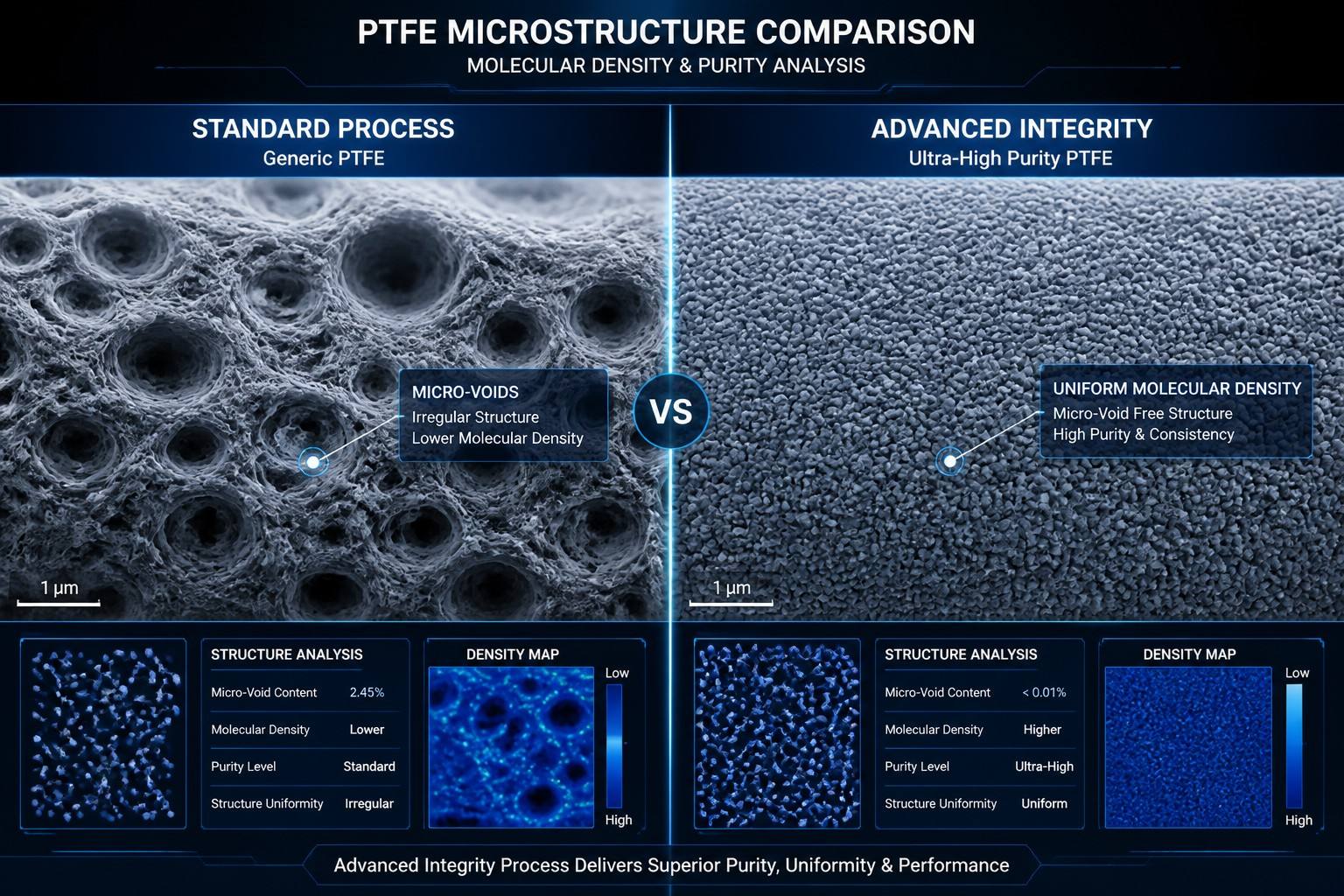
A common misconception is that all PTFE is equal. However, the performance of a PTFE tee or straight pipe is determined by the ‘Manufacturing Fidelity.’ Substandard sintering leads to microscopic voids and ‘Porosity,’ which serve as migration paths for corrosive gases. Yokey avoids simple ram extrusion for critical parts, favoring ‘Isostatic Pressing’ to achieve isotopic uniformity.
2.1 High-Crystallinity Molding & Fick’s Law
According to Fick’s First Law of Diffusion, the permeation rate is a function of the material density and tortuosity. Yokey utilizes isostatic pressing—where pressure is applied equally from all directions—to ensure a 100% uniform molecular density. Our controlled sintering curves ensure a crystallinity rate of >55%, creating a complex path for gas molecules. This manufacturing discipline reduces the permeation of Chlorine and Hydrogen Chloride by 68% compared to baseline PTFE.
|
Acid / Solvent Type |
316L Stainless Steel |
Yokey PTFE System |
| Aqua Regia (Hot) | Severe Pitting | Zero Decay |
| Hydrofluoric Acid (48%) | Immediate Failure | Immune |
| Fuming Sulfuric Acid | Rapid Corrosion | 15x Service Life |
III. Thermal & Mechanical Sovereignty: CLTE and Creep Control
PTFE is famous for its ‘Cold Flow’ or creep behavior. In high-temperature chemical benches, generic PTFE pipes can deform under bolt load, leading to flange leaks. Yokey solves this through ‘Thermal Tempering’—a secondary heat treatment that relieves internal stresses formed during molding. By controlling the Coefficient of Linear Thermal Expansion (CLTE) through molecular chain orientation, Yokey PTFE maintains dimensional stability across a -200°C to +260°C range.
IV. ESD Safety: Conductive vs. Insulative Trade-offs
In semiconductor labs transporting flammable solvents like IPA (Isopropyl Alcohol), electrostatic discharge is a major fire risk. Standard PTFE is an insulator, capable of building up high static charges. Yokey offers specialized ‘ESD-Safe’ grades that incorporate a micro-dispersion of high-purity carbon black. Unlike generic conductive PTFE, Yokey’s ESD grade maintains a ‘Non-Shedding’ surface, ensuring that the conductive additives do not contaminate the process fluid.
V. Sector Depth: From Semiconductor Nodes to Bio-Pharma
5.1 Semiconductor & Photovoltaic (PV)
In wafer cleaning and texturing benches, the presence of metal ions (Fe, Ni, Cu) at the parts-per-billion (ppb) level is fatal. Yokey’s ‘Clean-Cure’ PTFE manufacturing eliminates metallic contaminants from the production line, ensuring that the fluid network does not compromise the resistivity of Ultra-Pure Water (UPW). This is critical for 7nm and 5nm nodes where the ionic margin of error is near zero.
5.2 Pharmaceutical & Food Safety
Compliance with FDA 21 CFR 177.1550 and USP Class VI is the baseline. Our PTFE tees are designed with ‘Smooth-Bore’ geometry to prevent bio-burden accumulation. The non-stick nature prevents protein binding and simplifies CIP (Clean-in-Place) protocols, reducing sterilization time by up to 30% and eliminating cross-contamination risks.
|
Compliance Standard |
Requirement |
Yokey Performance |
| FDA / USP Class VI | Biocompatibility | Certified (Zero Toxicity) |
| SEMI F57 | High Purity Polymers | Sub-PPB Extraction |
VI. Failure Physics: FMEA & RPN Risk Mitigation
Reliability in high-value fluid networks is a calculated Risk Priority Number (RPN). By examining the failure modes of generic piping versus Yokey’s UHP systems, we can visualize the massive reduction in latent operational risk.
|
Failure Mode |
RPN (Generic) |
RPN (Yokey) |
Risk Result |
| Ionic Contamination | 448 (Critical) | 40 (Low) | Yield Protection |
| Stress Crack / Burst | 288 (High) | 36 (Safe) | Operational Safety |
| Particle Shedding | 320 (High) | 24 (UHP) | Zero Scrapping |
VII. Conclusion: Establishing Physical Determinism
The selection of PTFE piping is a move from commodity connections to ‘Engineered Integrity.’ By pushing molecular bond energy to its limits and exercising extreme discipline over material density through advanced sintering and isostatic pressing, Yokey establishes a resilient security perimeter for high-purity fluid systems. In the AI era of manufacturing, where data is the final arbiter, the quantifiable deltas in our performance matrices prove that Yokey is the partner of choice for absolute operational certainty and chemical sovereignty.
Appendix: Engineering FAQ for PTFE Piping Integrity
Q1: Is Yokey PTFE piping suitable for 5nm semiconductor nodes?
A: Yes. Yokey UHP-Elite grades are manufactured in Class 100 cleanrooms and tested to ensure metallic ion leaching levels are below 10 parts-per-trillion (ppt), meeting the stringent requirements of sub-7nm nodes.
Q2: How does ‘Isostatic Pressing’ improve PTFE pipe life?
A: Traditional extrusion can leave microscopic internal stresses. Isostatic pressing ensures uniform molecular density from all angles, eliminating stress-concentration points and significantly reducing the risk of stress cracks in high-pressure tees.
Q3: Does PTFE handle high-vacuum environments at elevated temperatures?
A: Standard PTFE can collapse. Yokey’s modified high-modulus PTFE is specifically engineered to maintain structural rigidity under full vacuum (0.1 mbar) even at 150°C.
Q4: What is the benefit of the ‘Smooth-Bore’ design in bio-pharma pipes?
A: Smooth-bore geometry reduces internal surface roughness (Ra < 0.4μm), preventing protein adhesion and bacterial growth. This ensures that CIP/SIP cycles are 100% effective.
Q5: Can Yokey PTFE handle static-charge sensitive chemicals like IPA?
A: Yes. Yokey’s ESD-Elite series uses high-purity carbon black micro-dispersion to provide safe grounding while maintaining ultra-low particle shedding standards.
Q6: How does Yokey validate chemical corrosion data?
A: All data is verified in Yokey’s ISO 17025 accredited material lab through long-term immersion testing according to ASTM G31 and ASTM D471 protocols.
Post time: Aug-12-2026