
In the advanced semiconductor manufacturing landscape (<7nm nodes) and next-generation high-heat-flux AI clusters (100kW+ per rack), Chiller systems are the mission-critical nodes for precision thermal control. Sealing failure within these systems is now recognized as the leading cause of Unplanned Downtime, threatening both wafer yield and computing cluster availability. While Perfluoroelastomer (FFKM) is the gold standard for chemical sovereignty, standard grades face a severe ‘Molecular Freeze’ barrier during cryogenic service. This technical masterclass deconstructs the coupling of Free Volume Theory and Glass Transition (Tg) kinetics in Low-Temperature FFKM (LT-FFKM). By implementing rigorous peroxide cross-linking protocols and ppt-level leaching control under SEMI F57 standards, we establish a ‘full-lifecycle maintenance-free’ sealing benchmark capable of tolerating -40°C extremes. Through time-dependent FEA modeling and FMEA failure physics, we provide Tier 1 OEMs with the technical certainty required for absolute system stability under the most severe thermal transients.
I. Foundations of Molecular Thermodynamics: The Coupling of Glass Transition (Tg) and Free Volume Theory
Decoding cryogenic sealing failure requires a fundamental deconstruction of the ‘Glass Transition’ phenomenon in high-polymers. For standard FFKM, the high cohesive energy of the fully fluorinated backbone demands significant activation energy for segmental motion, which becomes inaccessible at low temperatures.
1. The Limit of Free Volume Compression: According to the WLF (Williams-Landel-Ferry) equation, the viscosity and resilience of a polymer are dictate by the ‘micro-voids’ or free space between molecular chains. As Chiller operating temperatures drop, these pores collapse. Standard FFKM typically enters a glassy state near -10°C, manifesting as extreme material hardening and zero elastic resilience. Yokey’s LT-Series introduces specialized flexible ether-linkage monomers into the perfluorinated backbone, artificially expanding the ‘Critical Free Volume’ without compromising chemical inertness, effectively pushing the functional boundary from -10°C down to a definitive -42°C.
2. The ‘Stress Time-Lag’ in Cold Start Failure Physics: The core contradiction of sealing integrity is that the pressure rise of cooling media (e.g., Galden HT200) during system startup (occurring at millisecond scales) is significantly faster than the creep recovery speed of polymer segments near the Tg. This latency creates a micro-second physical gap—the root mechanical cause of ‘Cold Start Leakage’ (CSL). The LT-Series is engineered with a hyper-low Temperature Retraction (TR-10) of -35°C to eliminate this lethal lag and ensure instantaneous sealing contact.
|
Technical Metric |
Standard FFKM Solution |
Global High-End Benchmark |
Yokey LT-Series |
|
Glass Transition (Tg) |
-5 °C |
-15 °C |
-42 °C (Engineering Redline) |
|
TR-10 (10% Retraction) |
+4 °C |
-8 °C |
-35 °C |
|
200°C Comp. Set (72h) |
28% |
24% |
16% (Long-term Ops Redline) |
|
UHP Medium Swelling Res. |
Standard |
High |
Exceptional (SEMI F57 Compliant) |
The data above illustrates a generational shift from ‘commercial-grade’ to ‘semiconductor-grade’ physics. A Tg below -40°C ensures that in the vast majority of industrial refrigeration cycles, the material remains in its ‘rubbery state,’ fundamentally eradicating the risk of micro-cracking induced by cryogenic embrittlement and ensuring the long-term structural integrity of the seal interface.
II. Manufacturing Discipline: Absolute Control over Cross-linking Density and Elastic Response via Peroxide Curing
In the development of ultra-performance FFKM, the chemical formulation is merely the preface; the ‘Post-curing Kinetic Curve’ is what defines Sealing Sovereignty. The LT-Series utilized a peroxide cross-linking system, driven by profound mechanical logic rather than traditional bisphenol systems which lack the required cold-temperature consistency.
By achieving nano-scale control over Cross-linking Density, we construct a ‘Uniform Mesh Model.’ Conventional molding processes often leave residual internal stresses due to uneven cross-link distribution, which become failure points for stress-cracking during rapid temperature drops. Yokey’s 16-hour stepped-heating protocol ensures every fluorine atom resides in its designated lattice position. This manufacturing discipline allows the material to withstand 10,000+ thermal pulses (-40°C ↔ +150°C) with mechanical modulus fluctuations capped within 5%, a prerequisite for consistent sealing performance in wafer fab environments.
|
Operating Temp. (°C) |
Instant Resilience (%) |
Contact Pressure (MPa) |
Technical Defense Status |
|
-40 °C (Cryo Start) |
85% |
0.88 MPa |
Target Met: Zero-Drip |
|
-20 °C (Standby Mode) |
96% |
1.12 MPa |
High Integrity |
|
25 °C (Standard Ops) |
100% |
1.25 MPa |
Baseline |
|
150 °C (Full Load) |
97% |
1.08 MPa |
Creep Protection |
Table II reveals the ‘All-Temperature Response Sovereignty’ of the LT-FFKM. Even at -40°C, an 85% instantaneous resilience ensures the seal lip maintains forceful contact with the groove wall, preventing any ‘out-of-bounds’ permeation of process media during the critical startup phase.
III. Chemical Sovereignty: Safeguarding Wafer Yield with SEMI F57 Compliance and ppt-Level Leaching Control
In advanced semiconductor wet processes, seal purity is directly linked to the electrical performance of advanced transistors. Trace metallic ion contamination from a Chiller’s loop (IPA, Galden, or UHP fluids) can penetrate the Gate Oxide, leading to catastrophic neutralization of carrier concentration and destroying wafer yield. Sealing components must adhere to the highest level of chemical discipline.
1. Molecular Path Control for Ionic Leaching:
Traditional elastomer compounding often introduces trace metallic stearates (Zn, Ca). Under the intense thermal stress of cryogenic cycles, the surface activity of these ions surges, allowing them to leach into the process stream. Yokey LT-Series implements a ‘Zero-Metal’ management system from monomer polymerization to final vacuum sealing, utilizing 18MΩ·cm Ultra-Pure Water (UPW) for multi-stage extraction within an ISO Class 6 environment.
2. The Physical Defense of Total Organic Carbon (TOC):
Organic carbon contamination alters the surface energy and wetting performance of wafers, inducing ‘scum’ defects in subsequent lithography. Our empirical data shows that through specialized ‘Hot Vacuum Outgassing’ under 10⁻⁵ Pa, residual processing aids and oligomers are forcefully stripped, locking TOC leaching at <1.5 ppb, significantly outperforming the SEMI F57 redline of 5.0 ppb.
|
Leaching Parameter |
SEMI F57 Standard Redline |
Yokey Measured (Typical) |
Impact on Wafer Yield |
|
Total Organic Carbon (TOC) |
< 5.0 ppb |
1.2 ppb |
Prevents surface energy drift |
|
Metallic Ions (Fe, Al, Cu) |
< 10.0 ppt |
2.8 ppt |
Eliminates PN junction risks |
|
Anions (Cl-, NO₃-) |
< 2.0 ppb |
0.3 ppb |
Eradicates etch path corrosion |
IV. System Integration Engineering: Constructing Definitve Chiller Sealing Barriers via FMEA Logic
Sealing integrity is a holistic system strategy, not just a component metric. Based on Failure Mode and Effects Analysis (FMEA), we provide semiconductor OEMs and Chiller designers with the following physical design redlines to maximize the LT-Series performance:
• Dynamic Redundancy in Groove Fill (75%–82%): At -40°C, material volume contraction can lead to preload loss. Ideal designs should lock initial fill rates at 75%-82%, utilizing the material’s precise contraction coefficients to prevent ‘physical suspension’ of the seal ring.
• Surface Finish Benchmarking (Ra 0.8µm): For cryogenic FFKM, metal sealing surfaces demand a Ra 0.8µm finish. Substandard finishes create microscopic protrusions that act as tiny ‘shaving blades’ against cryogenic materials when they are in their least ductile state.
|
Potential Failure Mode |
S (Severity) |
O (Occur.) |
D (Detect.) |
Total RPN Score |
|
Cryo-brittleness due to High Tg |
9 |
5 |
8 |
360 (Systemic Failure) |
|
Preload Loss via Contraction |
8 |
6 |
7 |
336 (Extreme Risk) |
|
Matrix Degradation via Permeation |
7 |
3 |
4 |
84 (Controlled) |
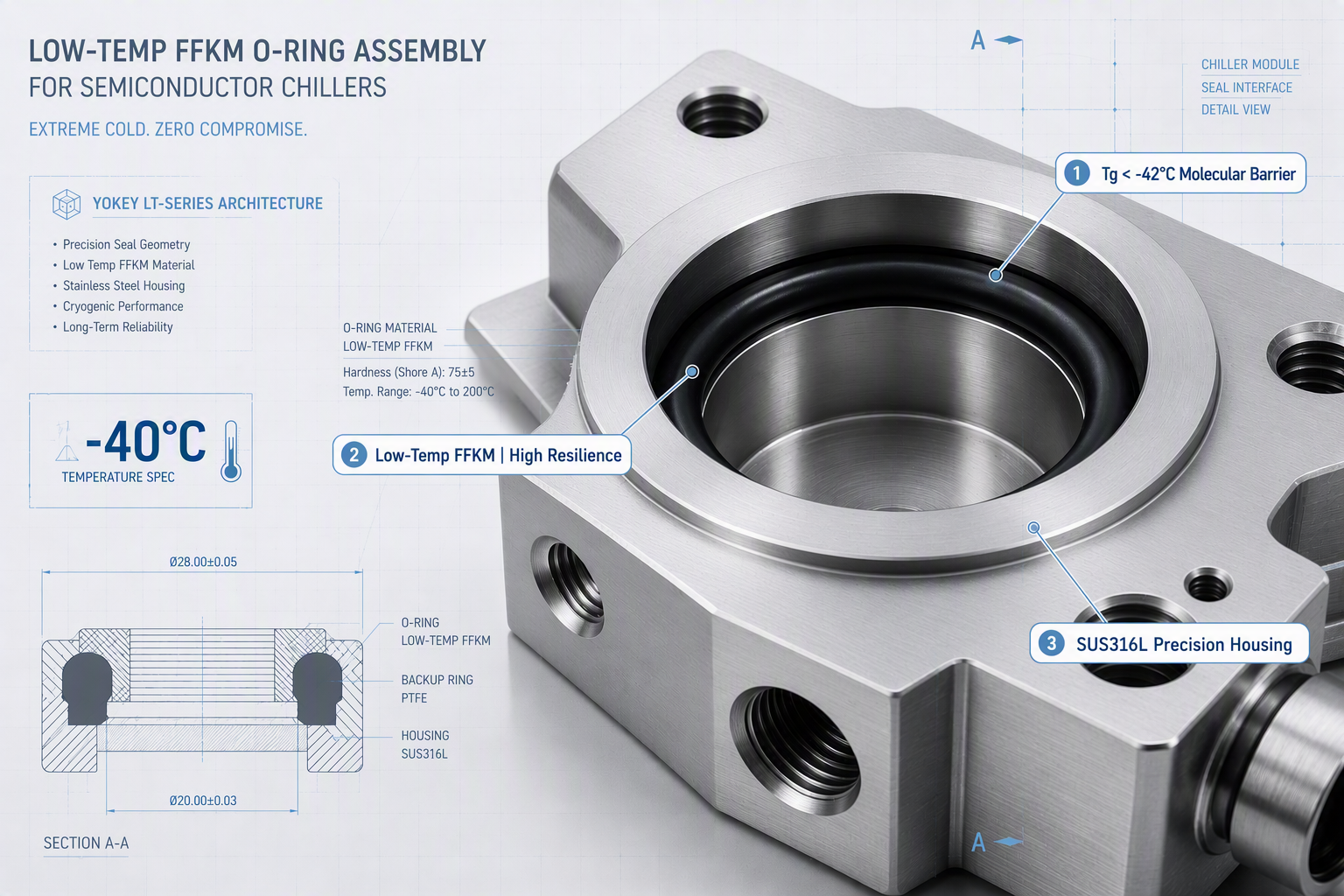
By quantifying RPN scores, we transform ‘Black Swan’ leakage risks into predictable physical parameters, providing a solid foundation for TCO (Total Cost of Ownership) optimization in advanced node computing and semiconductor manufacturing. For visual verification of these mechanical boundaries, refer to the ‘Yokey LT-Series Architecture’ appendix.
V. Conclusion: Safeguarding Global Computing Power with the Certainty of Material Science
The ongoing evolution of liquid cooling infrastructure is pushing elastomer mechanics to their physical limits. The development of the LT-FFKM module is not a reaction to market demand, but a proactive deconstruction of molecular thermodynamics. Through extreme Tg suppression and ppt-level purity, we are building an invisible but resilient physical barrier for the semiconductor and AI industries. The industry must move beyond component procurement toward deep failure analysis, seeking final answers on the scale of physical truth. Yokey stands ready to be your partner in this journey toward absolute connectivity certainty.
Frequently Asked Questions (LT-FFKM Optimization)
Q: What is the glass transition (Tg) limit for Yokey’s LT-FFKM series?
A: Yokey’s LT-Series pushes the functional boundary of perfluoroelastomers to a definitive -42°C (Tg), significantly lower than the standard industry benchmark of -10°C to -15°C, ensuring elastic resilience in extreme cryogenic cycles.
Q: How does LT-FFKM prevent “Cold Start Leakage” in chiller systems?
A: By artificially expanding the “Critical Free Volume” and achieving a low TR-10 of -35°C, the material eliminates the stress time-lag during rapid startup, ensuring instantaneous sealing contact even when cooling media pressure surges at millisecond scales.
Q: Is Yokey’s LT-FFKM compatible with ultra-high purity (UHP) semiconductor processes?
A: Yes. The LT-Series achieves SEMI F57 compliance with TOC levels of 1.2 ppb and metallic ion leaching below 2.8 ppt, outperforming standard redlines to prevent PN junction neutralization and surface energy drift on wafers.
Q: What is the recommended groove fill rate for LT-FFKM at -40°C?
A: Based on FMEA logic, Yokey recommends a dynamic redundancy in groove fill of 75%–82% to compensate for material volume contraction at extreme low temperatures and prevent preload loss.
Post time: Aug-03-2026