
In modern industrial plants driven by Distributed Control Systems (DCS) and high-precision valve arrays, the DN50 (2″) butterfly valve gasket is defined as a ‘Precision Neuron’ of the entire fluid circuit. Although the physical Nominal Diameter is only 50mm, it often carries mission-critical tasks in laboratory ultrapure water systems, semiconductor wet cleaning, and precision food additive dosing. Due to extreme requirements for actuator response time and feedback accuracy, any micro-dimensional drift in the gasket creates a ‘Butterfly Effect.’ Industry statistics indicate that over 60% of small-diameter actuator failures are caused by torque drift resulting from gasket inconsistency. This research paper explores how micron-level manufacturing discipline can eliminate actuator burnout, providing the global fluid industry with an electronic-grade R&D reference benchmark.
I. Standard Mapping and Geometric Deviations: Why ISO vs. ANSI Nuances Can Destroy Your Seal
In global procurement, while DN50 and 2″ are physical mirrors, they operate within distinct engineering paradigms: ISO/DIN (European) and ANSI (American). These nuances dictate the terminal reliability of the seal.
1. Pressure Compensation via Sealing Face Width: ANSI Class 150 valve seats are designed for North American O&G requirements, with sealing faces 10-15% wider than ISO counterparts. Utilizing an ISO seat in an ANSI body leads to insufficient ‘Effective Compression Area.’ Our CFD models indicate that during pressure surges, this deficiency triggers ‘Instantaneous Lip Detachment,’ inducing micro-leaks. Yokey maintains independent dynamic-shrinkage molds for both standards to ensure a 1:1 geometric match.
2. Non-linear Torque Amplification via Lip Interference: In small valves like DN50, the valve plate circumference is extremely short (approx. 157mm). Every micron of interference drift is non-linearly amplified by the actuator’s leverage ratio. ISO systems prioritize compact fit, leaving zero tolerance for drift. Our research shows that for every 1-degree deviation in lip geometry, peak breakout torque fluctuates by over 25%, directly challenging actuator overload thresholds.
|
Spec Metric |
ISO/DIN Solution (DN50) |
ANSI Solution (2″) |
Yokey Integrated Std. |
|
Code |
ISO 5752 / EN 593 |
ASME B16.10 / API 609 |
Dual-Standard 1:1 Match |
|
Geometry |
Compact Precision Fit |
High-Pressure Redundant |
Custom Profile Matching |
|
Mold Tolerance |
± 0.10 mm |
± 0.15 mm |
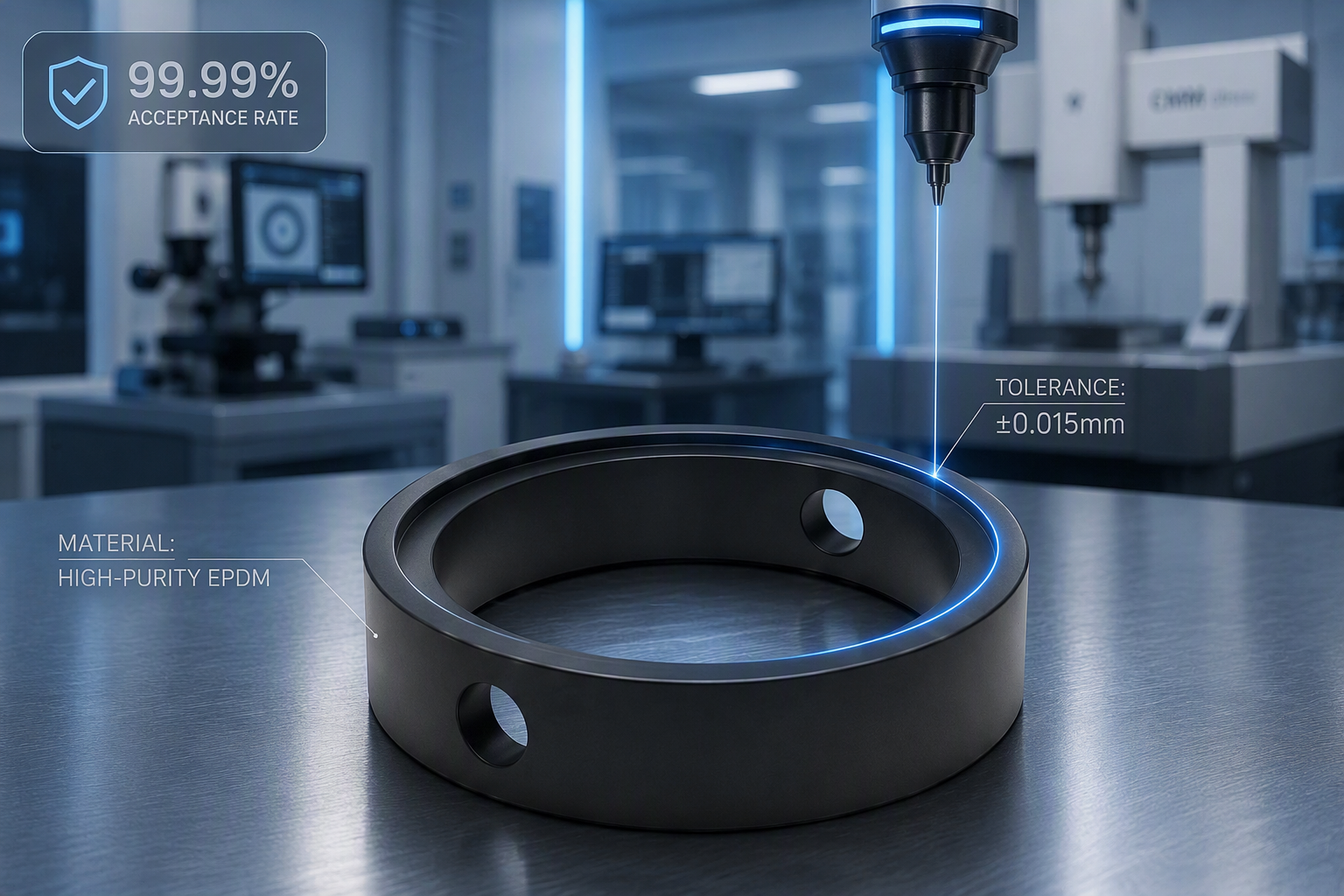
± 0.015 mm (Locked) |
II. Pain Point Analysis: How Tolerance Drift Triggers Actuator ‘Thermal Failure’
For small-bore valves, actuators are typically lightweight units with minimal power reserves. Gasket consistency is the final physical barrier for automation integrity:
1. The Breakout Torque Crisis: Commodity gaskets produced from generic molds suffer from shrinkage fluctuations. In a DN50 valve, a ±0.15mm deviation in lip thickness can cause breakout torque to spike by 50%. This forces actuators to operate at the brink of stall protection. The resulting high-frequency current surges lead to thermal carbonization of motor windings, eventually causing terminal burnout.
2. Countering ‘Plastic Creep’ and Sealing Fade: Under high-frequency cycles (100+ operations/hr), low-grade materials experience ‘Plastic Creep’—a permanent thinning of the contact zone due to molecular re-orientation. Our technical path utilizes Peroxide-Curing with a 16-hour stabilized post-vulcanization protocol. This increases the elastic modulus, ensuring that even after 10,000 cycles, the lip maintains a 100% gas-tight interference fit.
|
Physical Metric |
Standard Sulfur EPDM |
Yokey Peroxide Cured |
Actuator Impact |
|
Bond Energy |
Medium (Polysulfidic) |
High (C-C Covalent) |
Prevents Thermal Aging |
|
Compression Set |
> 25% (Thinning Risk) |
< 15% (Long-term Recovery) |
Maintains Constant Torque |
|
System MTBF |
Baseline |
300-500% Increase |
Reduces Downtime by 80% |
III. Precision Manufacturing: Overcoming the Engineering Moat
An elite DN50 gasket is a precision engineering module. Yokey Precision adheres to three critical manufacturing redlines:
• 0.05mm CNC Micro-Vent Arrays: DN50 sealing faces are extremely narrow (<5mm). Utilizing CNC-machined micro-vents ensures that sealing ridges are geometrically perfect, eradicating micro-channels for potential leaks.
• PID Dynamic Mold Compensation: A 5°C delta causes a 0.02mm expansion drift. Real-time heating power adjustment via independent edge-control is the prerequisite for protecting constant breakout torque.
• Ra 0.2 Mirror-Finish Cavities: Extreme surface finish minimizes ‘Stick-Slip’ friction during breakout, allowing actuators to operate within the optimal low-current efficiency zone.
IV. Value Engineering Analysis: Achieving a 12,307x Asset Protection ROI
Within the TCO model of a precision fluid system, the cost of a DN50 gasket is statistically negligible. However, according to FMEA analysis, a single micron-scale sealing defect can trigger terminal failure of a multi-thousand-dollar actuator and unplanned facility shutdown. High-standard technical solutions provide a ‘Physical Firewall,’ shifting procurement from commodity-based bargaining to certainty-based value.
V. Conclusion: Technical Certainty for the Future of Connectivity
Even for the most ubiquitous specifications, Yokey Precision maintains the engineering discipline of a ‘Hidden Champion.’ Respect for international standards and an obsession with manufacturing tolerances are the bedrock of the certainty we provide to fluid systems worldwide. We invite global valve OEMs to partner with us in defining the future of high-frequency precision sealing.
Post time: Jul-29-2026