
In next-generation high-density compute architectures such as NVIDIA Blackwell (GB200), blind-mate connectivity is transitioning from an option to a mission-critical standard. Since nodes are coupled without direct line-of-sight, the physical robustness and tolerance-handling of the connector dictate the survival of the entire liquid cooling loop. Yokey Precision, leveraging deep heritage in elastomer dynamics and precision machining, presents this R&D roadmap. We explore the technical redlines required for ideal blind-mate connectors—including radial offset compensation, zero-drip dynamic sealing, and flow resistance optimization—to establish electronic-grade certainty for the industry.
I. Deep Analysis of Core Challenges: Countering ‘Tolerance Accumulation’ in Rack Assembly
The primary engineering hurdle for blind-mate connectors is not material science alone, but ‘spatial geometric alignment.’ In a standard 42U rack, the cumulative tolerance between compute nodes, sliding rails, manifold backplanes, and rack chassis can often exceed ±2.0mm. Traditional rigid connectors forced into such misalignments induce uneven stress on sealing surfaces, leading to ‘instantaneous internal leaks’ or catastrophic valve jamming.
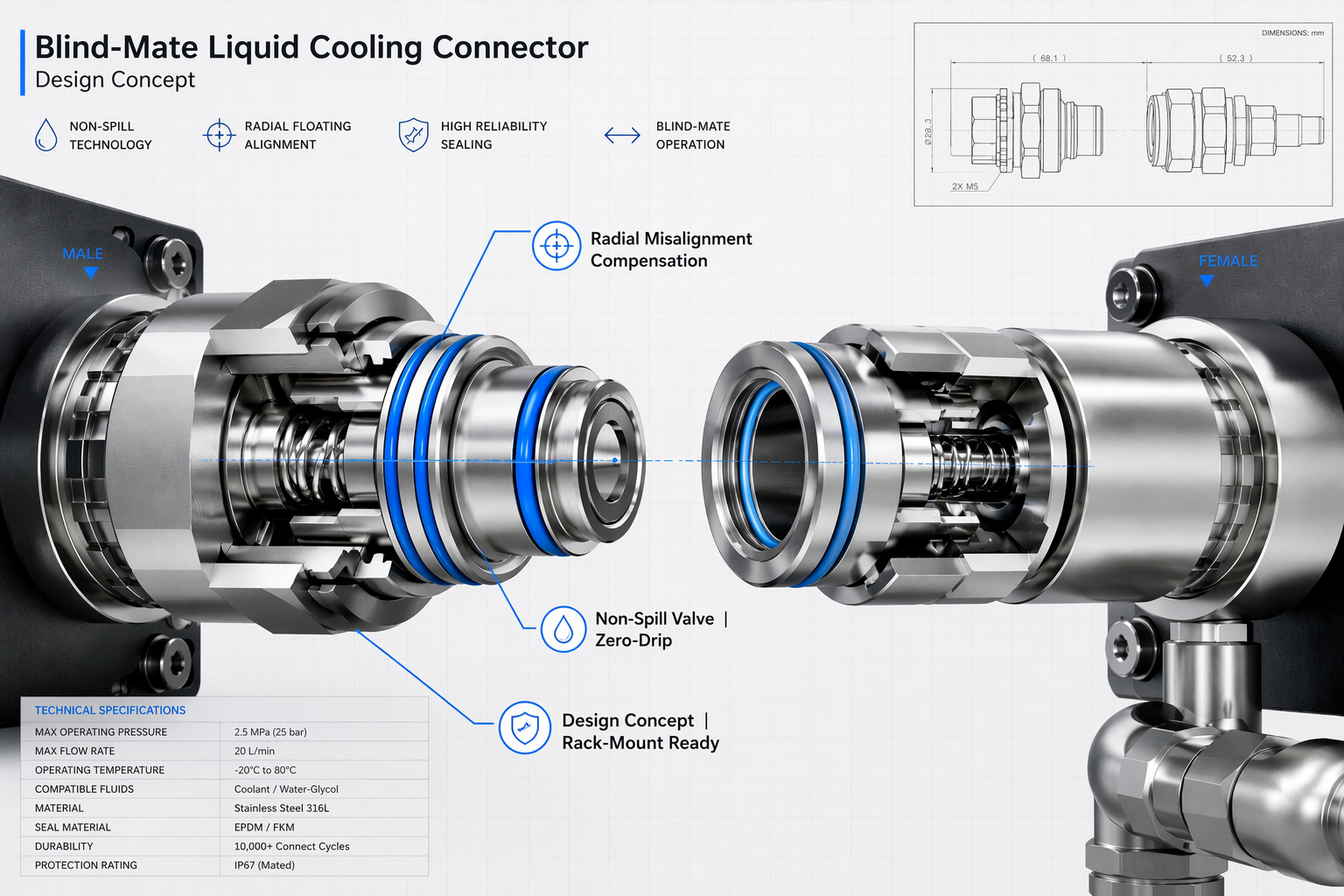
An ideal R&D path focuses on a ‘Floating Compensation Architecture.’ Our vision involves integrating omni-directional floating sleeve mechanisms at the plug or socket end, utilizing dynamic O-ring damping characteristics to achieve a radial offset tolerance of ±2.0mm or higher. This requires not only precision CNC machining (±0.015mm mold standards) but also elastomer seals that maintain constant preload under severe off-center loads. This logic of ‘flexible adaptation’ is the physical prerequisite for 10,000+ zero-failure coupling cycles.
|
Innovation Objective |
Current Standard Solution |
Proposed Yokey R&D Benchmark |
|
Radial Compensation |
< ±0.5mm (High Jam Risk) |
> ±2.0mm (Omni-Float Design) |
|
Dry-Break Leakage |
> 0.5 mL (Contamination Risk) |
< 0.03 mL (Zero-Drip Standard) |
|
Flow Efficiency (Cv) |
Low (Turbulent Internal Path) |
CFD-Optimized (Low Pumping Power) |
|
Coupling Cycles |
500 Cycles (Wear Failure) |
> 5,000 Cycles (PTFE-Infused Coating) |
II. Fluid Dynamics Breakthrough: ‘Zero-Drip’ Valve Cores and Cv Optimization
In high-pressure cold loops of compute centers, every leaked drop is a potential disaster. High-performance blind-mate connectors must achieve technical leaps in two dimensions:
1. ‘Flat-Face’ Zero-Dead-Space Technology: Traditional ball or poppet structures trap micro-residual fluid during disconnection. The ideal technical path utilizes ‘Flat-Face’ paired valve designs. By minimizing internal ‘Dead Space’ and locking lip gaps to micron scales, we target an extreme zero-drip performance of < 0.03mL. This prevents coolant accumulation at golden-fingers and eradicates electrolytic sediment risks.
2. Reducing Parasitic Power through Flow-Path Optimization: Valve core structures are often the primary source of flow resistance. Through CFD simulation, ideal designs should feature streamlined valve flaps and graduated convergent-divergent flow paths to maximize Cv and minimize pressure drop. This directly reduces pump parasitic energy consumption by 10-15%, improving overall rack PUE.
III. Material & Lifecycle Research: Countering ‘Galling’ Wear in 10,000+ Cycles
Blind-mate connectors typically utilize stainless steel or aluminum shells. In unlubricated, high-heat cold water environments, frequent metal-to-metal sliding induces ‘Galling’ wear. Our R&D roadmap focuses on ‘Hard-Anodized + Nano-PTFE Infusion’ composite coatings. This path reduces friction coefficients by 60%, ensuring connectors maintain initial torque and gas-tightness over 5,000 to 10,000 cycles, realizing the vision of ‘Maintenance-Free’ lifecycle engineering.
IV. Conclusion: Defining Connectivity Certainty for the AI Era
The evolution of liquid cooling infrastructure is pushing connectivity to physical limits. Yokey Precision aspires to be a technical explorer in the sector. We are currently dedicated to exploring material dynamics simulations for UQD interfaces and 14-day agile prototyping mechanisms. We invite global server OEMs to engage in synchronized R&D, leveraging our expertise in material physics to build an invisible but robust fortress for your power integrity.
Post time: Jul-28-2026