
Face extreme temps, chemicals, or low friction? Learn how spring-energized PTFE seals (Variseals) work and why they are the reliable solution for demanding applications in aerospace, automotive, and manufacturing.
Introduction: The Engineering Limits of Elastomeric Seals
In high-performance engineering, the sealing component is often the critical link determining system reliability. While standard rubber seals like O-rings serve well in many applications, they reach their limits when confronted with extreme temperatures, aggressive chemicals, dynamic motion, or low-friction requirements. These challenges demand a solution that combines the superior material properties of advanced polymers with consistent, adaptive sealing force.
This is the domain of the spring-energized seal (commonly known as a Variseal or Spring Seal). This article provides a technical deep-dive into how this seal functions, the key problems it solves, and the critical design considerations for engineers specifying seals for demanding environments.
1. Core Principle: The Synergy of Spring and Polymer
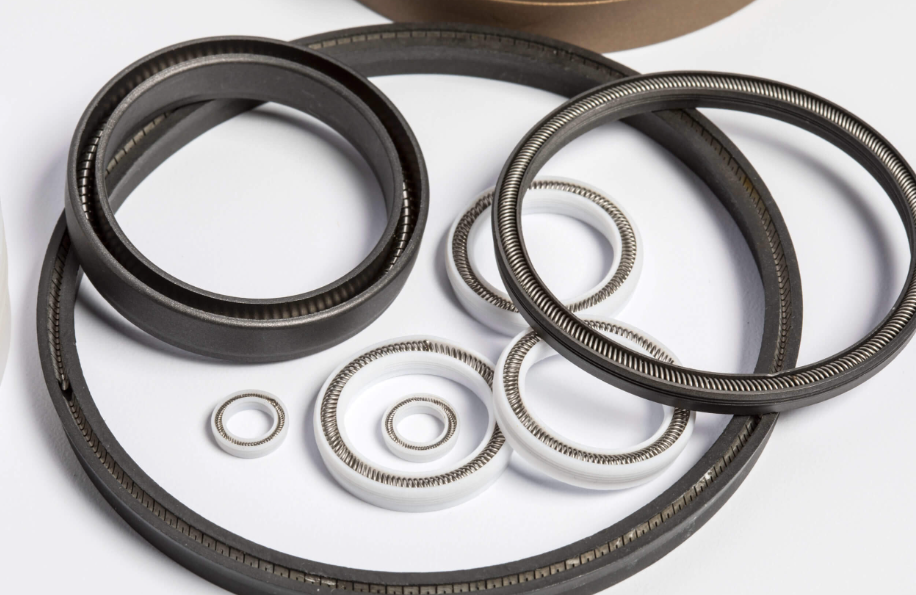
A spring-energized seal is a precision-engineered two-component system:
The Polymer Jacket: Typically a U-shaped seal lip machined from PTFE (Teflon®) or other high-performance polymers like PEEK or UHMWPE. This jacket provides the primary sealing interface, leveraging the material’s inherent chemical inertness, wide temperature range, and extremely low coefficient of friction.
The Energizing Spring: A helical spring, usually made from stainless steel or high-performance alloys like Elgiloy®, housed within the U-channel of the jacket.
The sealing mechanism is elegantly effective:
1.The spring provides a constant, pre-determined radial force, pushing the sealing lip of the jacket against the shaft or housing (gland wall).
2.When system pressure is applied, it acts upon the seal, further increasing the lip pressure against the mating surface. This creates a highly reliable, pressure-energized seal.
3.The spring’s crucial role is to compensate for material wear (abrasion) and maintain sealing force despite minor system misalignments, eccentricity, or temperature-induced dimensional changes. This ensures consistent performance throughout the seal’s service life.
2. Key Application Challenges and How Spring-Energized Seals Solve Them
This technology is specified to overcome specific, costly engineering problems:
Challenge: Extreme Temperature and PTFE Cold Flow.
Scenario: Sealing cryogenic fluids like liquid nitrogen (-200°C) or high-temperature hydraulic fluids (>200°C).
The Solution: PTFE maintains its properties across a vast temperature range where elastomers fail. However, PTFE is prone to “cold flow” – deformation under constant load. The internal spring actively counters this creep, maintaining optimal lip pressure and preventing seal failure over time.
Challenge: Aggressive Chemical or Plasma Environments.
Scenario: Sealing strong solvents, acids, bases, or in semiconductor wafer processing equipment with corrosive plasmas.
The Solution: PTFE is highly chemically inert, offering exceptional resistance to a vast range of aggressive media. This makes spring-energized seals ideal for chemical processing, pharmaceutical, and semiconductor applications.
Challenge: Dynamic Applications with Low/No Lubrication.
Scenario: High-speed rotary shafts in food-grade equipment, cleanrooms, or applications where lubricant is undesirable.
The Solution: The natural lubricity of PTFE allows these seals to operate with minimal friction and wear, even in dry or marginally lubricated conditions. This reduces power consumption and heat generation.
Challenge: Long-Term Reliability with Minimal Maintenance.
Scenario: Seals in inaccessible locations or in applications where unplanned downtime is prohibitively expensive.
The Solution: The spring’s constant force compensates for lip wear, effectively making the seal “self-adjusting.” This translates to dramatically extended service intervals and improved mean time between failures (MTBF), reducing the total cost of ownership.
3. Critical Design and Material Selection for Optimal Performance
Selecting the right spring-energized seal is not generic; it requires careful consideration of several factors:
Jacket Material:
Virgin PTFE: The standard for most chemical and temperature applications.
Filled PTFE (e.g., with Glass, Carbon, Graphite, Bronze): Used to enhance wear resistance, reduce cold flow, improve thermal conductivity, or increase stiffness.
Other Polymers (PEEK, UHMWPE): Chosen for specific needs like higher mechanical strength (PEEK) or superior abrasion resistance (UHMWPE).
Spring Type and Material:
Spring Force: Light, medium, or heavy load springs are selected based on pressure, speed, and required friction.
Spring Material:
Stainless Steel (302, 316): For general corrosion resistance.
Elgiloy®/Hastelloy®: For the most demanding environments requiring exceptional resistance to pitting, high temperatures, and corrosive fluids like saltwater.
Seal Geometry: The U-cup design can be optimized for rotary, reciprocating, or static sealing. Factors like lip angle, heel height, and jacket thickness are critical and are best determined in consultation with a knowledgeable manufacturer.
4. The Manufacturing Difference: Why Precision Matters
The theoretical performance of a spring-energized seal is only achieved through manufacturing excellence. Inconsistent springs or poorly machined jackets lead to premature failure. Key manufacturing pillars include:
Precision Machining of Jackets: The PTFE jacket should be precision-machined, not just extruded, to achieve exact tolerances and superior surface finishes on the sealing lip. A smooth, consistent lip is essential for low friction and effective sealing.
Spring Consistency: The spring must be coiled to exact specifications, ensuring uniform force distribution around the entire seal circumference. Batch-to-batch consistency is non-negotiable.
Rigorous Quality Control: Every production batch should undergo dimensional inspection and material certification. Traceability from raw material to finished product provides assurance of quality and compliance (e.g., with ROHS, REACH).
Conclusion: Specifying the Right Seal for Ultimate Reliability
Spring-energized seals are a proven, high-reliability solution for applications where standard elastomers fall short. Their ability to perform in extreme conditions while reducing long-term maintenance costs makes them a smart engineering investment.
Success hinges on understanding the application’s specific demands and partnering with a supplier that masters the nuances of material science and precision manufacturing.
Ready to address your most demanding sealing challenges?
Contact us to discuss your application. Our technical team can provide data-driven recommendations, custom designs, and samples to ensure your project’s success.
Post time: Dec-18-2025