
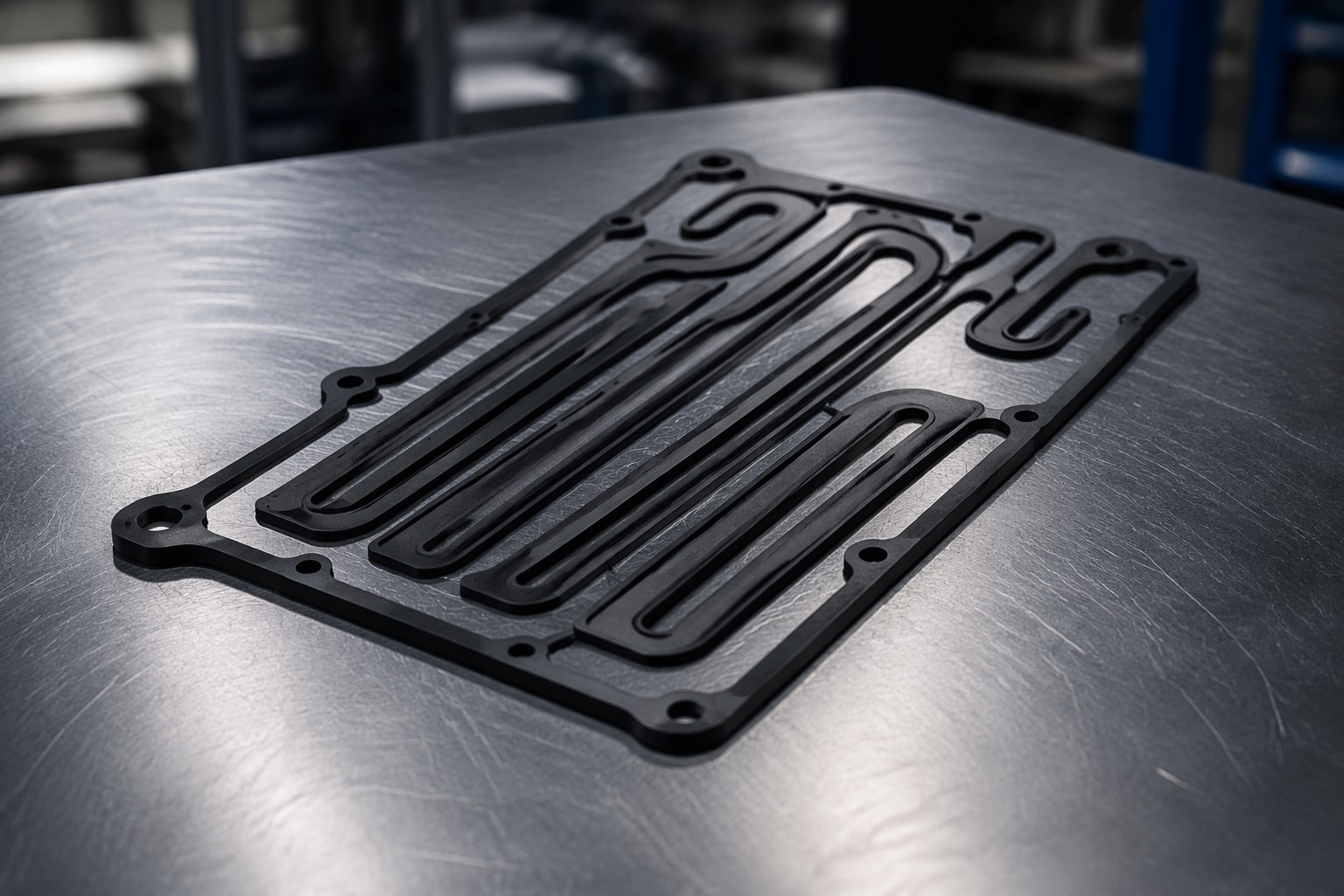
With the full-scale deployment of next-generation computing architectures like NVIDIA Blackwell (GB200), liquid cooling cold plates are evolving from basic thermal components to high-precision integrated modules. In this mission-critical environment, the internal ‘Labyrinth’ gasket—the physical barrier isolating high-flow coolant channels from fragile electronic circuitry—has become a pivotal variable for system reliability. Yokey Precision, leveraging a deep heritage in elastomer physics, presents this technical research paper. We explore the benchmarks required for electronic-grade certainty through the lens of molecular kinetics, rheological modeling, and micro-precision manufacturing. We invite global server OEMs and thermal solution providers to engage in synchronized R&D for the next frontier of cold plate sealing.
I. Deep Risk Analysis: Why ‘Internal Leaks’ represent a Terminal Threat to Computing Assets
In traditional cooling paradigms, maintenance focused on external drip prevention. However, within the constrained geometry of a modern liquid-cooled cold plate, internal cross-leakage is the ‘Silent Killer.’
1. The Physics of ‘Thermal Throttling’ induced by Internal Leaks: When a Labyrinth seal fails at a complex corner or rib interface, coolant bypasses the critical heat-exchange micro-channels. This internal short-circuiting causes Tjunction (junction temperature) to spike within milliseconds, triggering hardware throttling or permanent thermal stress fractures without any external visual signs of leakage.
2. Overcoming Non-linear Shrinkage in Complex Ribbon Geometries: Labyrinth gaskets feature extremely thin ribs (often < 1mm width) with complex closed-loop paths. During post-molding cooling, the drastic variation in aspect ratios causes non-uniform shrinkage. Yokey’s engineering roadmap utilizes single-cavity precision tooling coupled with 3D profile scanning to model dynamic shrinkage compensation, targeting a ±0.05mm thickness consistency to ensure reliable multi-node rack synchronization.
|
Technical Dimension |
Standard Commodity Baseline |
Yokey Targeted R&D Benchmarks |
|
Outgassing Control |
No specific protocol (Oil film risk) |
ASTM E595 (TML < 1.0%) |
|
Dimensional Tolerance |
± 0.15mm (Risk of gap-leakage) |
± 0.05mm (Precision Integrity) |
|
Vulcanization Quality |
Sulfur-cured (Copper corrosion risk) |
Electronic-grade Peroxide Cured |
|
Asset Protection ROI |
Minimal (Part level only) |
> 12,000x System Risk Mitigation |
II. Material R&D Redlines: Satisfying ASTM E595 Low-Outgassing Protocols
In proximity to high-voltage, high-density compute boards, material chemical purity is a non-negotiable prerequisite. We are investigating the following frontiers of electronic-grade sealing:
1. Preventing Oil Film Condensation: Unreacted low-molecular-weight fragments within elastomers can volatilize under 85°C sustained stress. Based on SEMI standards, this outgassing can condense into micron-scale insulating oil films on GPU dies or Golden Fingers, affecting signal integrity or inducing Electrostatic Discharge (ESD) damage. Our roadmap utilizes peroxide-cured systems with 16-hour stabilized forced outgassing to ensure TML < 1.0%.
2. Controlling Ionic Leaching and Insulative Sovereignty: In coolant immersion scenarios, residual sulfur, phosphorus, or heavy metal ions from substandard rubber can diffuse into the PG25 coolant. This leaching causes conductivity drift, leading to ‘Ion Migration’ under high voltage gradients. Our R&D objective is to achieve zero metallic leaching, safeguarding the absolute insulative sovereignty of the computing rack.
III. Value Engineering Analysis: Achieving a 12,307x Asset Protection ROI
Within the TCO (Total Cost of Ownership) structure of an AI server, the price of a sealing gasket is statistically negligible. However, according to FMEA (Failure Mode and Effects Analysis), a single micron-scale sealing defect or chemical leaching event can trigger an Unplanned Downtime of a single node worth $800,000. By integrating Dynamic Mechanical Analysis (DMA) and long-term compatibility simulations, high-standard technical solutions serve as a ‘Physical Firewall.’ This risk-weighted logic shifts procurement from commodity-based bargaining to value-based certainty.
IV. Future R&D Inquiry: Navigating the Technical Boundaries of Sealing
Yokey Precision is currently defining its technical focus for future maintenance and OEM integration excellence. We are committed to exploring the theoretical frameworks and implementation paths of the following forward-looking initiatives:
• Algorithm development for ‘Flow-Balanced Tooling’ targeting ultra-thin ribs.
• Establishing a digital ‘Scan-to-Verify’ platform for 100% thickness heatmap reports.
• Correlation studies between elastomer outgassing indices and 1.6T transceiver signal integrity.
V. Conclusion: Safeguarding Compute Power with Engineering Integrity
The explosion of the liquid cooling market signals a shift from ‘component processing’ to ‘solution definition.’ A profound understanding of physical mechanics, material kinetics, and manufacturing tolerances is the bedrock of high-reliability systems. Yokey Precision aspires to be a technical explorer in the sector, partnering with global innovators to drive infrastructure toward a more efficient and secure future.
Post time: Jul-24-2026