
Executive Summary: Reconstruct the Event Before Replacing the Seal
This guide is for design, maintenance, reliability and quality engineers investigating a filter-housing leak that appears after differential-pressure exposure, opening, cleaning or reassembly. The first question is not whether the seal should be replaced. It is whether the leakage path is more consistent with a pressure-cycle-related change in contact, damage introduced during disassembly or assembly, or another condition at the housing interface.
The first-leak timing is the starting evidence. A leak before opening belongs to a different event history from one immediately after removal and reassembly. Differential pressure may change load through the housing, cover, seat or restraint; disassembly may expose the seal to an edge, shoulder, thread, tool, particle or damaged surface. Alignment, cleanliness, material condition, lubrication and closure can produce similar symptoms. A pressure record establishes an event, not local contact, fatigue damage or the complete leak path. A cut or flattened region shows damage, not when or why it formed. This article provides an event-reconstruction and validation path before corrective action.
Start With the Maintenance Timeline, Not the Failure Label
Place the leak on a time line. Record the last leak-free state, pressure history, operating changes, opening reason, pre-opening pressure, cleaning, inspection, removal, storage, reassembly, closure and first post-maintenance result. “Leak after pressure cycling” and “leak after disassembly” are different event descriptions; the sequence determines which mechanisms and evidence remain relevant.
Do not call repeated pressure exposure fatigue by default. The hypothesis strengthens only when response changes with a defined pressure history, seal and seat evidence are compatible, and controlled comparison reproduces or separates the response. A leak after intervention likewise does not prove removal damage: the seal or surface may have been degraded earlier, or closure may have changed during reassembly.
Table 1 – Filter-Housing Leak Event Timeline and Evidence Priority
| Event Position | Question to Answer | Evidence Priority | Interpretation Boundary | Immediate Control |
| Before the last pressure cycle | Was the housing leak-free under a defined operating state? | Operating record, prior leakage result and maintenance history | A prior leak-free observation does not prove all seal surfaces were undamaged | Define the reference state before assigning a new cause |
| During differential-pressure exposure | Did leakage, pressure response or housing behavior change with the pressure state? | Time-linked pressure, leakage and functional records | Event correlation does not directly measure local seal contact or fatigue | Compare pressure history with the actual seal interface |
| Before opening | Was pressure made safe and was the pre-opening condition recorded? | Isolation record, pressure state, photographs and operator notes | Missing pre-opening evidence limits reconstruction of later damage | Preserve the sequence before cleaning or removal |
| During disassembly and cleaning | Could an edge, tool, particle, solvent or handling step affect the seal? | Removal path, tool condition, cleaning method and seal orientation | A plausible removal path is not proof that it created the observed mark | Control access, handling and evidence preservation |
| After reassembly | When did the first leak or functional change appear? | Closure record, assembly sequence, inspection findings and first test | Immediate leakage narrows the event window but does not identify one cause | Inspect the seal, seat, cover and closure path together |
Define the Housing Interface and Its Load Path
Before comparing fatigue with disassembly damage, identify the seal function. A filter housing may use a cover-to-body, cartridge-seat, flange, grooved O-ring or other arrangement for pressure retention, zone separation or external-leak prevention. Function cannot be inferred from appearance.
Map pressure zones, cover restraint, groove or recess, seat, mating surface, guides, clamp or fastener path and removal path. Note corners, shoulders, bores, threads or removable elements crossed during service. A nominally static seal may move during closure, uneven tightening, pressure application, release or cover distortion; the relevant load is at the assembled interface, not simply a remote pressure reading.
Differential pressure may redistribute contact if restraint, support or alignment permits movement; pressure release may reveal a condition hidden under load. Housing geometry, support, surface and assembly state determine whether this occurs. A pressure trace cannot distinguish local compression change from a scratch, particle or closure error.
Locate Damage Before Assigning Its Cause
Disassembly creates a separate damage path. Removal may drag the seal across an edge, thread, shoulder, guide or rough surface; a tool may contact it directly or through the cover. During reassembly, poor alignment, lubrication, cleanliness or insertion control may cause stretching, rolling, twisting or pinching.
Read damage location with the complete interface. An entry-edge cut may fit removal contact; a circumferential mark may reflect seating, roughness, contamination or tool contact. Flattening may reflect compression, temperature, material condition or closure load. A particle indentation does not prove it caused the leak. Inspect the seal, groove, seat, edges, cover, mating surface and tool path before cleaning.
Table 2 – Damage Location and Disassembly Mechanism Discrimination
| Observed Pattern | Possible Event Path | Interface Question | Evidence That Strengthens the Hypothesis | Alternative Explanation to Exclude |
| Cut or nick near an entry edge | Removal or insertion over an edge, thread or shoulder | Does the mark align with the access path and a matching housing feature? | Location match, edge witness mark, removal record and controlled rebuild | Pre-existing damage or damage during inspection |
| Twist, roll or displaced section | Seal rotation, drag or pinching during closure | Was orientation controlled and was the seal supported during insertion? | Asymmetric witness marks, orientation record and assembly observation | Uneven seat, contamination or prior compression history |
| Long abrasion or transfer mark | Sliding contact against a rough surface or tool path | Is there a corresponding roughness, burr or transfer source? | Surface mapping, material transfer, tool review and directional consistency | Normal seating movement or particle abrasion |
| Localized indentation | Particle, burr, edge or concentrated closure contact | Does the seat contain a matching object or geometric discontinuity? | Particle recovery, surface image and matching location | Compression set, storage damage or handling pressure |
| Flattening or recovery loss | Service compression, repeated closure or material condition change | Is the condition distributed or localized, and does it match the seat? | Seal history, reference comparison and controlled reassembly result | Temperature, medium exposure, excessive closure load or age |
Separate Pressure History From Maintenance Variables
Analyze pressure and maintenance history as separate but related inputs. Record pre-opening pressure, the sequence before leakage, intervention reason, removal order, cleaning, inspection, lubrication, orientation, closure and first test. If several variables changed together, attribution weakens.
Review cover seating, guide condition, restraint sequence, support, surfaces, burrs, corrosion, particles, lubricant, medium, temperature and seal history. Medium and temperature may alter recovery, friction, swelling or material response. Replacement can hide the original path if housing, seat and assembly are not examined together.
Table 3 – Pressure, Interface and Maintenance Variables to Separate
| Variable Group | Why It Matters in This Event | What May Be Observed | Record or Inspection Needed | Maintenance Decision |
| Differential-pressure sequence | May redistribute housing or cover load and alter seal contact | State-dependent leakage or response change | Time-linked pressure and leakage history | Repeat representative states before assigning fatigue |
| Cover seating and restraint | May create uneven closure or local load transfer | One-sided marks, uneven gap or localized leak | Seating, alignment and closure evidence | Control restraint and closure sequence |
| Seat and mating surface | May create a leak path or concentrate contact | Scratch, burr, corrosion, indentation or transfer | Cleaned visual inspection and surface mapping | Protect and inspect before reassembly |
| Removal path and tools | May cut, stretch, twist or abrade the seal | Directional or edge-matched damage | Tool review, access path and damage location | Define controlled removal and access |
| Orientation, lubrication and insertion | May change drag, rolling tendency and seating | Twist, pinch, displacement or uneven witness mark | Assembly record and controlled rebuild | Standardize only the confirmed configuration practice |
| Medium and temperature | May change recovery, friction, swelling or material response | Condition-dependent leakage or altered appearance | Operating history, medium identity and temperature record | Evaluate actual service compatibility |
| Particles and contamination | May interrupt contact or abrade the mating surface | Intermittent leak, indentation or abrasive mark | Cleaning record, particle inspection and surface evidence | Prevent re-entry during maintenance |
| Seal service history | Compression history or exposure may change recovery | Flattening, hardening, softening, cracking or recovery loss | Replacement and operating history with reference comparison | Set configuration-specific replacement criteria |
Use Converging Evidence to Decide What the Event Supports
Before cleaning, photograph the housing, cover, seat, groove, edges, mating surface, seal orientation and visible particles or transfer; preserve each mark’s location. Align pressure, leakage, temperature, maintenance and functional records by event sequence. The aim is to identify explanations compatible with the evidence, not force one label.
Pressure records establish an event at a measured location and time, not seal contact pressure, local deformation, extrusion, fatigue damage or a complete leak path. A static test represents its defined state, not every pressure or assembly condition. Visual marks identify morphology, not independent timing or cause. Stronger conclusions require converging evidence.
Compare reference, operated and controlled-reassembly states where possible. If seal, housing, lubricant, closure and test conditions all change together, a successful test shows restoration without proving which cause was removed.
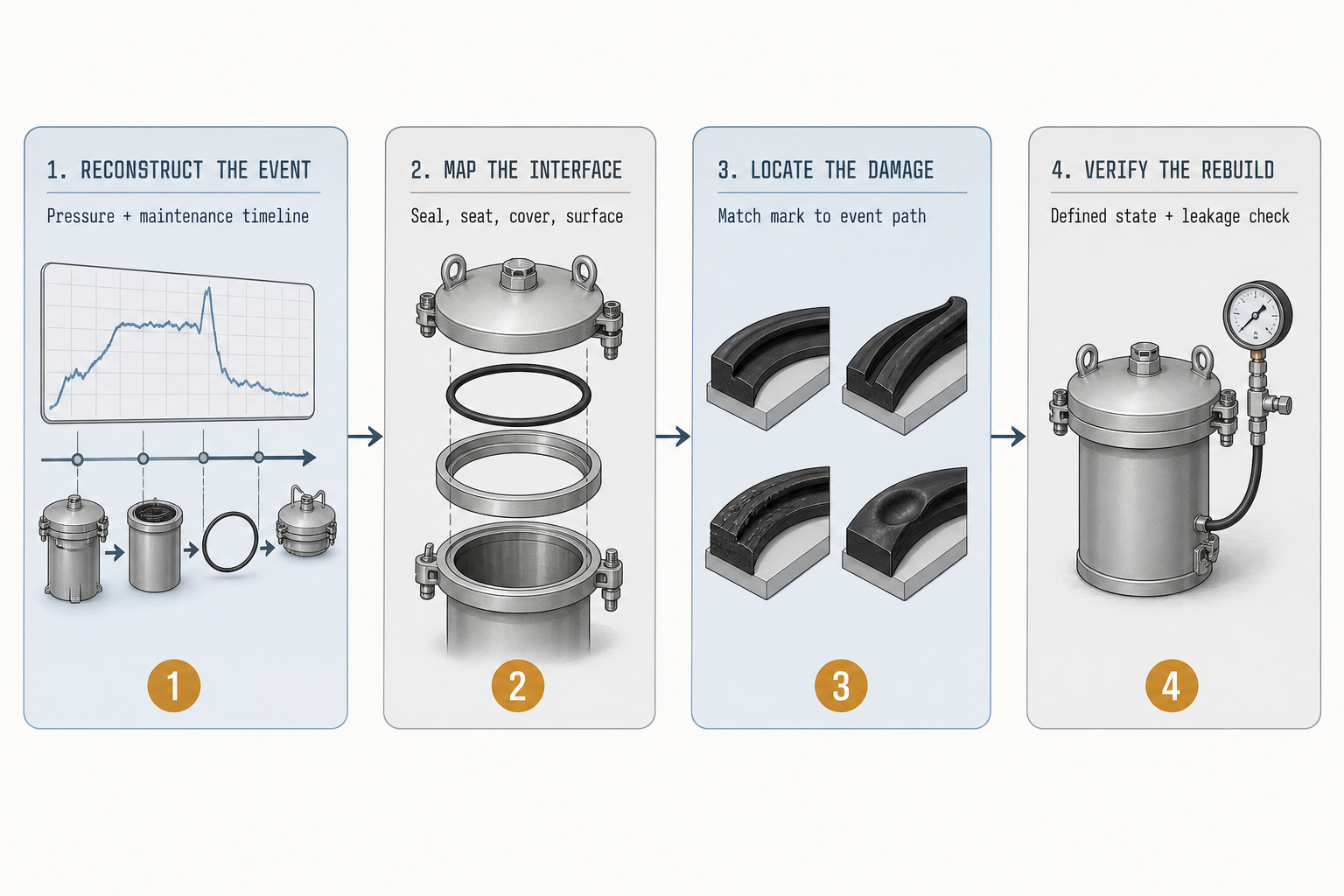
Validation Path: From Maintenance Event to Verified Seal Condition
1. Freeze the Event Record — Preserve pre-opening pressure state, leak timing, photographs, seal orientation and maintenance sequence before cleaning or replacement.
2. Map the Physical Interface — Identify pressure zones, seal function, seat, groove, edges, cover restraint, mating surface and removal path; record uncertainties.
3. Match Damage to the Path — Compare seal morphology with housing features, tool access, particles, surface condition and closure marks without assigning cause from appearance alone.
4. Rebuild and Test by Defined State — Use a controlled reassembly and defined leakage or functional check, stating what pressure and assembly condition the result represents.
5. Close the Maintenance Loop — Separate pressure-cycle effects, disassembly damage, surface condition, alignment, material state and contamination; record the verified configuration and remaining uncertainty.
When a Configuration-Specific Review Is Justified
A configuration-specific technical review is justified when leakage repeats after a controlled rebuild, when the first-leak timing conflicts with the presumed cause, when damage does not match the removal path, when pressure response changes without corresponding interface evidence, or when housing, seat and seal conditions have changed together. The purpose is to resolve an evidence conflict, not to apply a generic seal replacement rule.
Yokey can evaluate the actual filter-housing structure, seal function and location, pressure and maintenance history, seat and mating-surface condition, contamination, alignment, assembly practice and leakage evidence on a case-by-case basis. This can help distinguish a possible pressure-cycle contact change from disassembly, surface, material, alignment, assembly or maintenance factors. The assessment does not establish a universal material, dimension, differential-pressure limit, cycle life or leakage performance.
For review, prepare the housing and seal structure, seal function and position, pressure or operating records, leak timeline, opening and cleaning history, medium, closure method and inspection evidence from the seal, seat, cover and mating surfaces. The conclusion depends on preserving the event sequence and physical evidence.
Maintenance Controls That Preserve the Evidence and the Seal
First preserve the event: record the last operating state, opening reason, pressure isolation, leak location and seal orientation before disassembly. Do not clean, discard or replace the seal before documenting its relationship to the seat and housing.
Next control access and handling. Protect edges, threads, shoulders and mating surfaces; use a suitable access path and tool method. Control particles, cleaning, lubrication, orientation and insertion so assembly does not create an unrecorded damage path.
Finally control closure and revalidation. Compare the relevant state after a leak or maintenance change rather than relying only on a new seal. Record what was checked, changed and remains unverified. Tool, lubricant, replacement interval and acceptance limit depend on configuration.
FMEA: Conditional Failure Paths in a Filter-Housing Seal Event
This qualitative FMEA identifies paths for investigation; it does not assign an RPN or confirm a customer failure.
Table 4 – Filter-Housing Seal Maintenance and Differential-Pressure FMEA
| Failure Mode | Cause | Local Effect | System Effect | Detection Method | Control Action |
| Seal contact becomes non-uniform | Pressure load acts through uneven restraint, seating or alignment | Local unloading or altered contact width | State-dependent leakage | Pressure/leakage correlation, seating marks and geometry review | Control restraint, alignment and representative revalidation |
| Seal is cut during removal | Entry edge, thread, shoulder or tool path contacts the seal | Nick, cut or local loss of continuity | Leakage after maintenance | Damage-location mapping and removal-path review | Protect edges and define removal practice |
| Seal is twisted or pinched | Misalignment, contamination or uncontrolled insertion condition | Uneven compression or local gap | Early or intermittent leakage | Witness marks, orientation check and controlled rebuild | Control cleaning, orientation and closure sequence |
| Seat creates a leak path | Burr, scratch, corrosion product, particle or surface damage remains | Local gap or abrasion | Persistent or intermittent leakage | Surface inspection, cleaning record and repeat test | Inspect and protect the seat before assembly |
| Recovery is reduced | Material condition or compression history changes under service exposure | Incomplete recovery after unloading | Leakage after cycling or storage | Seal history, condition examination and controlled comparison | Use configuration-specific replacement and validation |
| Root cause is misassigned | One pressure record, visual mark or leak test is treated as complete proof | Wrong mechanism selected | Repeated leakage after corrective action | Evidence-boundary review and multi-source comparison | Require structure, history, inspection and repeatability evidence |
Conclusion
A filter-housing leak after pressure exposure or maintenance is an event-reconstruction problem before a replacement problem. Pressure cycling may alter contact; disassembly may introduce cuts, twists, pinches, particles or surface damage. These paths can create similar symptoms and cannot be separated by one pressure record, appearance or static test.
Freeze the timeline, map the interface, locate damage, compare pressure with maintenance history, perform a controlled rebuild and test, and record verification limits. Seek configuration-specific review when event sequence, damage and test response disagree. Controls should prevent both the leak mechanism and loss of evidence.
FAQ: Filter-Housing Seal Events After Pressure Cycling and Maintenance
Q:Does a leak after differential-pressure cycling prove seal fatigue?
A:No. Pressure cycling may change contact, but alignment, surface damage, contamination, material condition and assembly can produce the same result. Fatigue remains an investigation hypothesis until history, inspection and controlled comparison converge.
Q:Does a leak immediately after disassembly prove the technician damaged the seal?
A:No. The timing narrows the event window but does not establish cause. Inspect the seal, removal path, edges, seat, cover and mating surface together, including evidence that existed before opening.
Q:What should be recorded before opening a leaking filter housing?
A:Record the operating and pressure state, leak location, reason for opening, seal orientation, photographs and relevant maintenance history. Preserve the seal and interface before cleaning or replacement.
Q:Which marks are consistent with removal damage?
A:Cuts near an entry edge, directional abrasion, twisting or localized pinching may be consistent with removal or insertion contact. The corresponding housing feature, tool path and assembly history must also be checked.
Q:Can a new seal prove that the housing problem is fixed?
A:No. A new seal may restore leakage performance while leaving a damaged seat, alignment problem, contamination source or closure issue unchanged. Revalidate the relevant housing and maintenance state.
Q:Is a static leakage test enough after reassembly?
A:It characterizes the defined test state but does not automatically represent every pressure-cycle or maintenance condition. State, duration, assembly condition and repeatability must be identified.
Q:When should a configuration-specific technical review be requested?
A:Request one when leakage repeats, damage does not match the presumed path, pressure response and interface evidence disagree, or several housing and maintenance variables changed together. Provide the structure, event timeline and inspection evidence.
Q:What information should be prepared for the review?
A:Prepare the housing and seal structure, seal function and position, pressure or operating records, leak timeline, opening and cleaning history, medium information, closure method and inspection evidence from the seal, seat, cover and mating surfaces.
Post time: Sep-28-2026