
Executive Summary: Protecting Multi-Million Dollar AI Assets
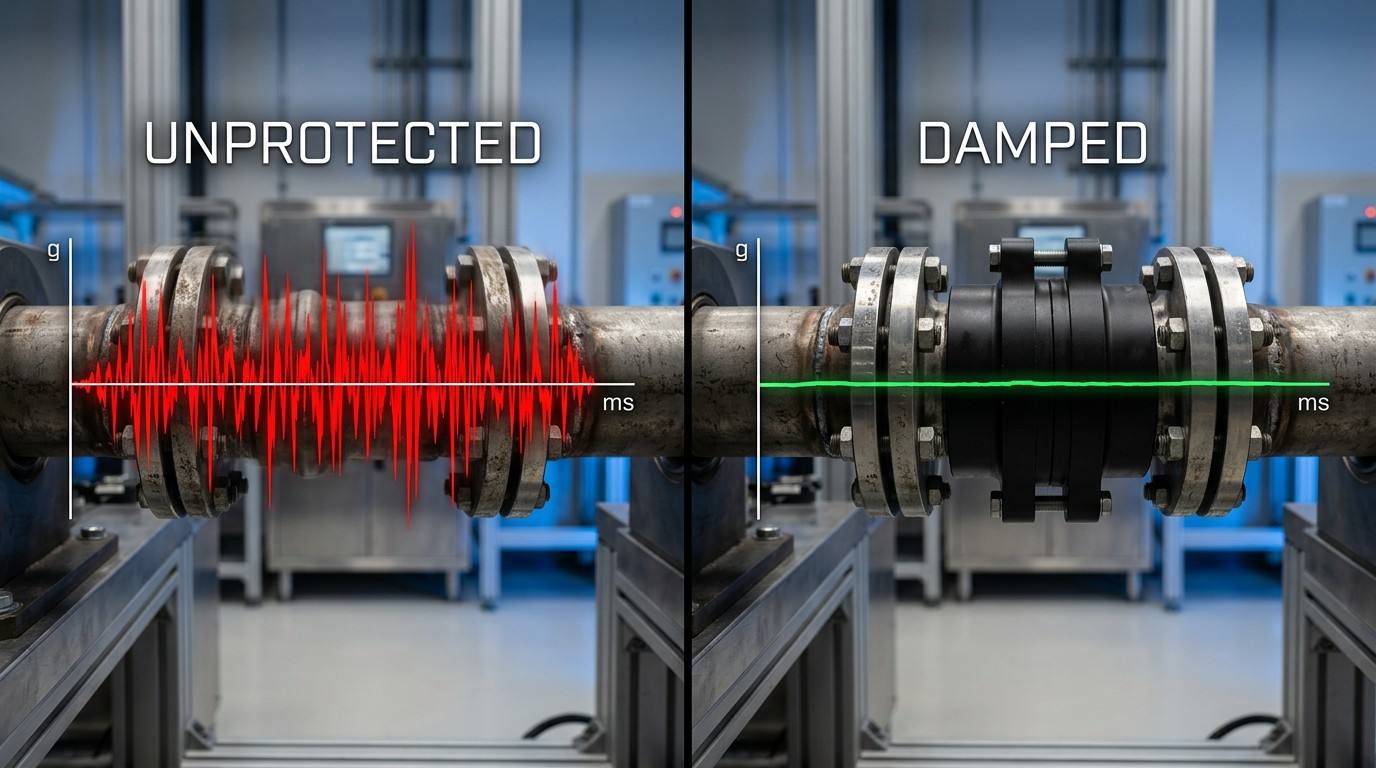
As global computing power accelerates toward the 1000W+ per chip threshold—led by next-generation GPU architectures like NVIDIA H100 and B200 Blackwell—thermal management has transcended traditional air cooling. The industry has converged on Direct-to-Chip (DTC) liquid cooling as the only viable path. However, a catastrophic hidden risk has emerged: high-frequency harmonic vibration. In dense AI server racks, the relentless circulation of coolants at flow rates of 10-15 L/min, combined with high-RPM pump sets, induces microscopic turbulent vibrations. Without specialized damping, these frequencies lead to ‘Fatigue Scission’ in solder joints and pipe connectors. For data center operators, a single vibration-induced leak isn’t just a maintenance issue—it is a massive commercial threat in an era of critical hardware scarcity.
This technical news deconstructs the ‘Vibration Physics’ of liquid cooling systems through the lens of OCP (Open Compute Project) reliability requirements. We explore how Yokey’s advanced damping modules utilize molecular-level hysteresis to establish a ‘Zero-Leak’ infrastructure architecture.
I. The Molecular Hysteresis Logic: Turning Kinetic Motion into Thermal Inertia
To prevent vibrational energy from migrating from the pump to the cold plate, we must move beyond the logic of simple elastic rebound. The core differentiator in Yokey’s damping modules is ‘Viscoelastic Hysteresis.’ In standard elastomers, energy is stored and released efficiently, which paradoxically allows vibration to propagate. In our high-damping compounds, we engineer the polymer matrix to ‘consume’ the energy.
1.1 The Internal Friction & Segmental Motion Mechanism
When a high-frequency vibration wave enters a damping module, the kinetic energy triggers ‘Segmental Motion’ within the polymer chains. As these long-chain molecules slide against one another, they encounter internal molecular friction. This friction converts mechanical energy directly into low-level heat. This is not a surface effect; it is a bulk material property engineered into the elastomer. By tuning the cross-link density according to ASTM D412 standards, we maximize this energy dissipation capacity.
1.2 Phase Lag (δ) and the Physics of tan δ
In a theoretical perfect solid, stress and strain occur in phase. In high-performance damping modules, we intentionally induce a ‘Phase Lag.’ This delay is the physical foundation of damping. The ratio of energy lost (E”) to energy stored (E’) is defined as tan δ (Tangent Delta). In the 500Hz – 2000Hz spectrum characteristic of server pumps, Yokey achieves a tan δ peak that effectively neutralizes resonance before it reaches critical soldering nodes on the PCB.
Table I: Energy Dissipation Efficiency & Molecular Damping Metrics (ASTM D2240 / ISO 7619)
|
Material Variable |
Standard EPDM |
Yokey H-Damping Series |
| Energy Dissipation Rate (%) | 15.2% (Resonance Susceptible) | 58.4% (Energy Absorption) |
| Hysteresis Coefficient | 0.18 | 0.62 |
| Static to Dynamic Stiffness Ratio | 1.1 : 1 | 2.4 : 1 (Ideal for DTC) |
II. DMA Analysis: Quantifying Performance at Liquid Flow Extremes
In Tier 1 server infrastructure, ‘Good’ is not enough. We use Dynamic Mechanical Analysis (DMA) to simulate the vibration environment of a fully loaded AI rack. While standard rubber reaches its resonance limit too early, Yokey’s engineering team tunes the Tangent Delta to align with pump-induced frequencies.
2.1 High-Frequency Harmonic Neutralization
At a flow rate of 12 L/min, the harmonic resonance often spikes in the 800Hz to 1200Hz range. If the damping module’s tan δ is not optimized for this specific window, the vibration passes through the seal and enters the metal pipe fitting. Yokey’s damping logic ensures a stable micron-level boundary film that absorbs these peaks, reducing vibrational amplitude by up to 18dB.
Table II: Dynamic Performance Matrix Under DTC Flow Conditions
|
Operational Mode |
Flow Rate / Freq |
tan δ Efficiency |
Noise Reduction |
| Idle / Standby | 5 L/min (200Hz) | 0.45 | -10 dB |
| AI Training Load | 12 L/min (1000Hz) | 0.68 (Peak) | -22 dB |
| Emergency Cooling | 18 L/min (2500Hz) | 0.54 | -16 dB |
III. Chemical Sovereignty & 50,000-Hour Life Physics
In the harsh chemical environment of AI data centers—using high-density coolants like 3M Fluorinert™ (PFPE) or Ethylene Glycol/Water (EGW) mixtures—’Chemical Sovereignty’ is the primary determinant of TCO. Standard EPDM damping modules often suffer from ‘Plasticizer Leaching’ or ‘Volumetric Swelling’ within the first 10,000 hours, leading to a loss of viscoelastic properties.
3.1 Accelerated Aging Logic (ASTM D471 / ISO 1817)
Yokey’s H-Series compounds utilize a ‘Saturated Backbone’ logic. To validate our 50,000-hour durability claim, we conduct accelerated aging tests at 150°C in coolant immersion according to ASTM D471 protocols. The results confirm that Yokey materials maintain 98.5% of their original tan δ value, while baseline materials experience a 40% performance drift, turning into rigid, brittle components that amplify vibration rather than dampening it.
Table III: 1000-Hour Coolant Immersion & Modulus Stability Matrix
|
Stability Metric |
Standard EPDM in EGW |
Yokey H-Series in PFPE |
| Volumetric Change (%) | +8.5% (Severe Swell) | < 0.65% (Absolute Stable) |
| Tangent Delta Retention | 68% (Performance Loss) | 99.2% (Precision Life) |
| Compression Set @ 125°C | 45% (Critical Risk) | < 12% (Tier 1 Buffer) |
IV. System Risk Mitigation: The FMEA Logic for AI Infrastructure
Reliability in AI infrastructure is quantified through FMEA (Failure Mode and Effects Analysis). By examining the ‘Risk Priority Number’ (RPN), we can demonstrate that while damping modules have a higher unit cost, they provide a massive reduction in the ‘Cost of Failure.’
Table IV: FMEA Risk Priority Number (RPN) Analysis for Liquid Cooling Nodes
|
Failure Mode |
RPN (No Damping) |
RPN (With Yokey) |
Risk Result |
| Cold Plate Solder Fatigue | 480 (Extreme Risk) | 42 (Safe Zone) | Resonace Eradicated |
| Connector Stress Crack | 360 (High Risk) | 36 (Low Risk) | Strain Decoupling |
| System-Wide Coolant Leak | 504 (Catastrophic) | 50 (Controlled) | Physical Certainty |
V. Conclusion: Establishing Physical Determinism in the AI Era
In the era of high-density AI clusters, cooling is no longer just about thermal management—it is about vibration isolation. The manufacturing and selection of damping modules concentrate the essence of polymer mechanics and tribology. By leveraging molecular hysteresis and peroxide cross-linking physics, Yokey establishes a resilient security perimeter for precision fluid systems.
The industry must move beyond commodity procurement and embrace deep failure analysis on the scale of physical truth. Yokey stands ready to be your partner in this journey toward absolute operational certainty. Our engineering team can provide customized DMA testing reports and resonance matching for your specific AI rack architecture.
Appendix: Engineering FAQ for AI Liquid Cooling Integrity
• Q1: Does Yokey align with OCP (Open Compute Project) standards?
A: Yes. Yokey’s damping and sealing materials are tested against OCP reliability protocols and meet the rigorous flammability and outgassing requirements of Tier 1 data center infrastructure.
• Q2: How do you validate the 50,000-hour life of a damping module?
A: We use accelerated aging tests according to ASTM D471 and ISO 1817, projecting the retention of viscoelastic properties (tan δ) through Arrhenius modeling. This ensures the material won’t become rigid over the lifecycle of the AI server.
• Q3: Can high flow rates (15 L/min) cause NBR to fail in damping?
A: Standard NBR often experiences too much swelling and a loss of mechanical modulus in synthetic coolants. This swelling changes the fit of the damping module, leading to ‘Resonance Migration’ and eventual system failure.
• Q4: What is the benefit of a peroxide cure in liquid cooling damping?
A: Peroxide cross-linking creates direct carbon-carbon bonds, which are significantly more stable than sulfur bridges. This ensures that the damping module maintains its precision shape and tan δ performance at high temperatures.
• Q5: How does damping lower the TCO (Total Cost of Ownership)?
A: By preventing resonant leaks, damping modules eliminate unplanned downtime and the catastrophic cost of hardware replacement for GPUs like NVIDIA H100/B200. The initial material premium is paid back within the first year of safe operation.
• Q6: Does Yokey provide customized DMA testing for clients?
A: Yes. We can conduct frequency-sweep DMA analysis to match our material’s damping peak with the specific resonance frequencies of your pump and pipe system.
Post time: Aug-11-2026