
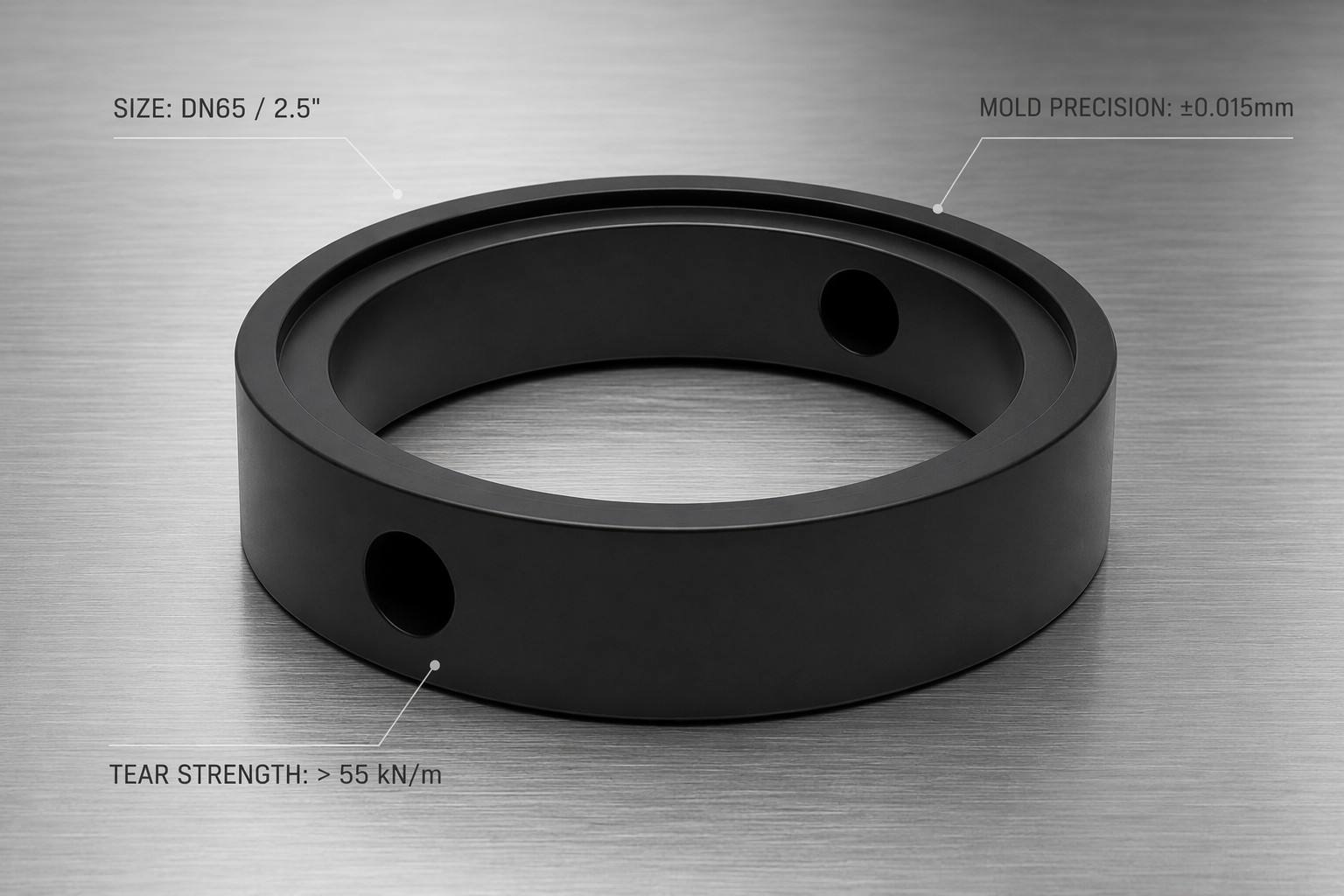
In modern industrial fluid networks, the DN65 (2.5″) butterfly valve gasket is defined as the ‘Flow Hub’ of the entire system. Unlike small-bore specifications (e.g., DN50) that focus on breakout torque, DN65 is typically installed in centrifugal pump outlets, large-scale heat exchangers, and primary HVAC lines. The primary engineering hurdle for this通径 is the relentless physical erosion and dynamic peeling torque induced by high pressure-drops and flow velocities (often exceeding 5m/s). Industry failure statistics indicate that over 45% of DN65 internal leaks result from ‘Lip Flapping’ fatigue or ‘Seal Blow-out’ during high-differential closure events. Yokey Precision, leveraging deep heritage in elastomer physics and fluid dynamics, presents this technical roadmap to establish reliability benchmarks for the world’s most aggressive flow environments.
I. Standard Mapping and Geometric Deviations: Why ISO DN65 vs. ANSI 2.5″ Perform Differently
In global commerce, while DN65 and 2.5″ are physically mirrors, critical nuances in ‘Effective Sealing Face Diameter’ and sealing-rib height dictate their survival. These micro-deviations are amplified under turbulent flow conditions, leading to premature redundancy failure.
1. Impact of Sealing Face Redundancy on Erosion Resistance: ANSI Class 150 valve seats are designed with 10-15% wider faces than ISO counterparts to accommodate higher pressure-drop surges. Utilizing a standard ISO gasket as a ‘drop-in’ replacement in an ANSI body results in insufficient ‘Effective Compression Area.’ Our CFD models indicate that during pressure fluctuations, this deficiency triggers ‘Micro-detachment’ of the lip, inducing physical peeling of the rubber surface. Yokey maintains independent dynamic-shrinkage tooling for both standards to ensure a 1:1 geometric match.
2. Geometric Curvature and Contact-Stress Distribution: For DN65 valves, uneven instantaneous rebound pressure during disc closure is the root cause of internal leaks. By implementing R-angle micro-compensation in the mold cavity, we aim to normalize the contact stress curve into a ‘Gaussian Distribution,’ preventing rubber tearing under extreme 25-bar differentials.
|
Technical Index |
ISO Solution (DN65) |
ANSI Solution (2.5″) |
Yokey R&D Benchmark |
|
Flange Compliance |
DIN EN 1092-1 / ISO |
ASME B16.5 / ANSI |
Dual-Std. 1:1 Mapping |
|
Sealing Geometry |
Compact Precision Fit |
High-Redundancy Wide-Face |
Anti-Erosion Reinforced |
|
Mold Tolerance |
± 0.10 mm |
± 0.12 mm |
± 0.015 mm (Locked) |
II. Failure Mechanics Research: Countering ‘Lip Flapping’ and ‘Seal Blow-out’
For DN65 valves installed at pump outlets, gasket lips operate in environments exceeding 5m/s flow velocity. Rheological modeling indicates that material ‘Shear Modulus’ is the ultimate barrier for physical safety:
1. Dynamic Tear Strength Assessment: Conventional sulfur-cured elastomers suffer from polysulfidic bond (S-S) breakdown under long-term high-heat stress. During valve opening, high-velocity fluid induces a massive Bernoulli Effect at the lip. If material tensile stress is insufficient, the gasket can be ‘sucked’ out of the housing—a phenomenon known as ‘Seal Blow-out.’ Yokey utilizes Peroxide-Curing systems to establish stable Carbon-Carbon (C-C) bonds (approx. 347 kJ/mol), increasing tear strength by over 2.5x.
2. Solving ‘Lip Flapping’ Induced Secondary Leaks: When flow velocity exceeds critical thresholds, irregular turbulent flow causes high-frequency ‘Flapping’ of the gasket lip. This not only accelerates mechanical fatigue but also creates instantaneous ‘vacuum cavitation bubbles’ at the interface. Precisely adjusting the Storage Modulus via optimized carbon black reinforcement is the only engineering solution to suppress this micro-resonance.
|
Performance Metric |
Standard Sulfur EPDM |
Yokey Peroxide Cured |
Value to DN65 System |
|
Tear Strength (kN/m) |
25 ~ 30 |
55 ~ 65 |
Prevents High-Velocity Peeling |
|
Modulus (100%) |
Low (Easily Deforms) |
High (Stable Profile) |
Prevents Lip Flapping |
|
MTBF Enhancement |
Baseline |
300% ~ 500% |
Significant Maintenance Saving |
III. Precision Manufacturing: Overcoming the Engineering Moat
Yokey Precision adheres to three critical manufacturing redlines for the DN65 ‘Golden Specification’:
• Anti-Ejection Anchoring Ribs: Since DN65 surface area is much larger than DN50, friction alone cannot counteract 2.5 MPa pressure-drops. We integrate proprietary ‘Mechanical Anchoring Ribs’ on the gasket’s back-face, which interlock with the valve body grooves to eradicate blow-out risks.
• Ra 0.2 Mirror-Finish Cavities: Extreme surface finish suppresses ‘Cavitation’ erosion on the gasket surface and minimizes friction-induced heat during high-frequency cycles.
• 16-Hour Stabilized Post-Curing: Eliminating residual VOCs ensures that gaskets maintain over 95% elastic recovery in 150°C saturated steam, enabling ‘Fit and Forget’ technical certainty.
IV. Asset Protection ROI: Shifting from Part-Cost to ‘Physical Insurance’
In mission-critical DN65 flow hubs, the cost of a seal is statistical noise. However, its failure triggers multi-thousand-dollar unplanned shutdowns. Yokey’s precision solutions provide a modeled Asset Protection ROI exceeding 13,000x. We assist clients in transitioning from ‘Commodity Purchasing’ to ‘System Integrity’ investment.
V. Conclusion: Technical Certainty for the Flow Hub
Even for the most ubiquitous specifications, Yokey Precision maintains the engineering discipline of a ‘Hidden Champion.’ Reverence for fluid dynamics and mastery of failure mechanisms are the only paths to building high-reliability systems. We invite global engineers to partner with us in defining the future of high-velocity precision sealing.
Post time: Jul-29-2026