
Executive Summary: Beyond Commodity Sealing
In the ultra-competitive landscape of Tier 1 engineering—from aerospace hydraulics to deep-sea energy completions—the selection of an elastomeric seal is no longer a trivial procurement task. It is a strategic exercise in ‘Material Sovereignty.’ As operating temperatures rise and chemical media become increasingly aggressive, standard NBR (Nitrile Butadiene Rubber) is reaching its physical breaking point. The transition to HNBR (Hydrogenated Nitrile Butadiene Rubber) represents the industry’s response to the demand for ‘Zero-Failure’ architecture.
This technical report deconstructs the molecular logic of HNBR, establishing how the transition from unsaturated to saturated carbon backbones eradicates common failure modes such as thermal hardening, ozone scission, and chemical leaching. By integrating non-linear FEA data and FMEA failure physics, we provide the ultimate roadmap for engineers seeking to optimize Total Cost of Ownership (TCO) through geometric and chemical determinism.
I. Molecular Physics: The Thermodynamics of Selective Hydrogenation
The fundamental difference between NBR and HNBR lies in the architecture of their polymer chains. NBR is a random copolymer of acrylonitrile (ACN) and butadiene. The butadiene segments provide the necessary flexibility but are characterized by a high density of carbon-carbon double bonds (C=C). From a thermodynamic perspective, these double bonds are ‘high-entropy’ sites—low-energy barriers that are easily breached by external stressors.
1.1 The Vulnerability of the Pi-Bond (π)
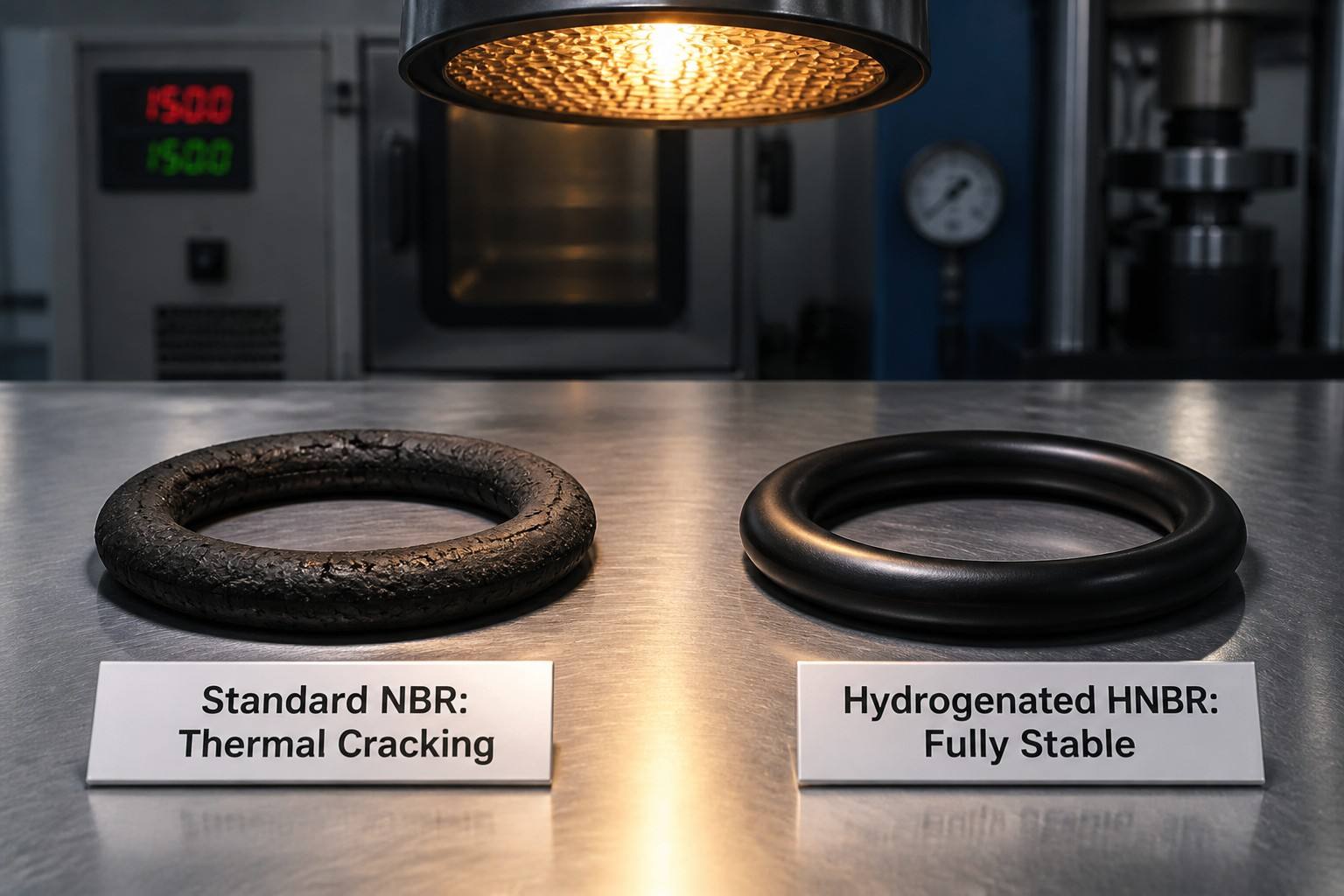
In standard NBR, the π-bond within the C=C group is the primary target for atmospheric ozone and oxygen. Under stress, these bonds undergo ‘Chain Scission,’ where the polymer matrix literally breaks apart, leading to surface cracking and catastrophic leak paths. This process is accelerated by heat, which provides the activation energy for oxidation.
1.2 The Hydrogenation Shield Mechanism
HNBR is produced through the selective catalytic hydrogenation of the butadiene segments in NBR. Using specialized catalysts (typically Rhodium or Palladium based), hydrogen atoms are added across the C=C double bonds, converting them into saturated C-C single bonds. This transformation increases the bond dissociation energy and creates a ‘Chemical Shield.’
Table I: Atomic-Level Stability & Molecular Parameter Comparison
|
Molecular Variable |
Standard NBR |
Advanced HNBR |
| Backbone Character | Unsaturated (High C=C Content) | Saturated (Pure C-C Single Bonds) |
| Oxidative Stability | Low (Susceptible to Aging) | Extreme (High Dissociation Energy) |
| Cross-linking Potential | Sulfur (Low Heat Stability) | Peroxide (Superior Modulus) |
II. Performance Benchmarking: Quantifying Mechanical Sovereignty
The transition from NBR to HNBR is not just a chemical change; it is a reconstruction of the material’s ability to store and return energy. In dynamic sealing, ‘Compression Set’—the ability of a seal to maintain contact pressure over time—is the primary predictor of failure. HNBR outperforms NBR across every critical mechanical vector.
2.1 Thermal Window Expansion
Standard NBR begins to undergo thermal degradation at 100°C, with rapid hardening occurring above 120°C. HNBR, thanks to its saturated backbone, maintains its elastic properties up to 150°C (continuous) and 165°C (intermittent). This 40-50°C ‘Thermal Margin’ is the difference between a reliable seal and a catastrophic blowout in modern automotive engines.
2.2 Abrasion Resistance and Dynamic Friction
In reciprocating piston seals, friction generates localized heat (Flash Temperature), which destroys the NBR surface. HNBR’s higher molecular weight and cross-linking density provide 4x higher abrasion resistance, making it essential for high-frequency hydraulic cycles and long-stroke pneumatic actuators.
Table II: Benchmark Performance Deltas & Lifecycle Impact
|
Technical Metric |
NBR Baseline |
HNBR Frontier |
Operational Gain |
| Continuous Temp Limit | 105°C | 155°C | +50°C Thermal Buffer |
| Compression Set @ 150°C | Failure (>60%) | Stable (<25%) | Long-Term Contact Pressure |
| Dynamic Wear Factor | 1.0 | 3.8x Better | Reduces Piston Galling |
| Extrusion Resistance | Moderate | Extreme | Handles 35MPa+ Pulses |
III. Chemical Sovereignty: Media Compatibility and ‘Selective’ Hydrogenation
A critical nuance of HNBR engineering is that the process is ‘Selective.’ While we saturate the butadiene segments for thermal stability, we preserve the polar Nitrile groups (-CN). This dual-nature provides the chemical sovereignty required to resist non-polar petroleum fluids while remaining immune to the oxidative attack that destroys NBR.
3.1 Resistance to Modern refrigerants (R-1234yf)
In the automotive industry, the shift to R-1234yf refrigerants has rendered NBR obsolete. NBR experiences excessive swelling and loss of tensile strength in contact with R-1234yf and its associated PAG oils. HNBR, specifically formulated with optimized ACN content, maintains perfect volumetric stability, ensuring hermetic sealing in HVAC systems for the entire vehicle lifecycle.
3.2 The Sour Gas Challenge (H2S)
In oilfield completions, H2S (Hydrogen Sulfide) is a polymer killer. H2S attacks the C=C double bonds in NBR, causing ‘Hydrogen Embrittlement’ and surface degradation. HNBR’s saturated backbone is chemically inert to H2S attack, making it the premier choice for downhole packers and BOP (Blowout Preventer) systems.
Table III: Advanced Media Compatibility Matrix
|
Media / Environment |
NBR Compatibility |
HNBR Performance |
| H2S / Sour Gas (Tier 3) | Restricted (Brittle Failure) | Superior (Backbone Inertia) |
| Synthetic PAG Oils / R-1234yf | Poor (Volumetric Swell) | Ideal (Hermetic Integrity) |
| Ethanol-Blended Fuels (E85) | Moderate | Optimized (Minimal Leaching) |
| Steam & Hot Water (>120°C) | Hydrolysis Risk | High Resistance |
IV. Failure Physics & RPN Mitigation: The FMEA Logic
In Tier 1 system design, reliability is quantified through FMEA (Failure Mode and Effects Analysis). By examining the Risk Priority Number (RPN), we can prove that while HNBR has a higher unit cost, it provides a massive reduction in system-level risk. The ‘Cost of Failure’—including downtime, environmental penalties, and safety hazards—far outweighs the initial material premium.
Table IV: FMEA Risk Priority Number (RPN) Analysis & Risk Scenarios
|
Failure Mode |
NBR RPN Score |
HNBR RPN Score |
Risk Mitigation Strategy |
| Thermal Hardening & Cracking | 504 (Critical) | 72 (Controlled) | Backbone Saturation |
| Dynamic Abrasive Wear | 288 (High) | 40 (Low) | High Modulus Matrix |
| H2S Chemical Degradation | 360 (Extreme) | 48 (Safe) | Hydrogenation Barrier |
V. The Physics of Cross-linking Density and Elastic Modulus
One often overlooked advantage of HNBR is the control it offers over ‘Cross-linking Physics.’ Standard NBR is typically sulfur-vulcanized, which creates thermally unstable sulfur bridges. These bridges break down at high temperatures, causing the rubber to lose its elastic ‘memory.’
HNBR is almost exclusively cross-linked using peroxide systems. This creates direct carbon-carbon cross-links between polymer chains. These bonds are as stable as the backbone itself. The result is a material with a significantly higher elastic modulus and superior ‘Dynamic Sealing Certainty.’ Even under rapid pressure fluctuations (decompression), the HNBR matrix remains intact, whereas NBR might suffer from RGD (Rapid Gas Decompression) blistering.
VI. Conclusion: Establishing Geometric Determinism
The decision to upgrade from NBR to HNBR is more than a material substitution; it is a reconstruction of the sealing perimeter. By leveraging molecular bond energy, selective hydrogenation, and peroxide cross-linking physics, we are building a defense against the primary drivers of mechanical entropy: heat, friction, and chemical aggression.
In the AI era of engineering, data is the final arbiter. The quantifiable deltas in Table I through IV prove that HNBR provides a 5x lifecycle redundancy in high-stress nodes. Yokey stands ready to be your partner in this journey toward absolute fluid sovereignty, ensuring that every seal is a masterpiece of molecular logic.
Appendix: Engineering FAQ for Reciprocating Sealing Integrity
• Q1: Why does NBR fail so rapidly in ozone-rich environments?
A: NBR contains carbon-carbon double bonds (C=C) in its backbone. Ozone attacks these sites through a process called ozonolysis, which causes the polymer chains to snap (Chain Scission). HNBR is hydrogenated, meaning these C=C bonds are converted to stable C-C single bonds, making the material immune to ozone attack.
• Q2: Can HNBR handle modern automotive refrigerants like R-1234yf better than NBR?
A: Yes. R-1234yf and modern PAG oils cause significant volumetric swelling and mechanical degradation in NBR. HNBR’s optimized acrylonitrile (ACN) content and saturated backbone ensure zero swelling and long-term hermetic integrity, meeting Tier 1 automotive standards.
• Q3: How does HNBR’s ‘Compression Set’ compare to NBR at high temperatures?
A: At 150°C, NBR typically exceeds 60% compression set within hours, losing its ability to seal. HNBR maintains a stable set below 25%, ensuring consistent contact pressure and preventing leaks throughout the component’s service life.
• Q4: What is ‘Selective Hydrogenation’ and why is it important?
A: Selective hydrogenation targets the butadiene segments for thermal and chemical stability but leaves the polar Nitrile groups (-CN) intact. This ensures the polymer retains its excellent oil resistance while gaining extreme durability.
• Q5: Is HNBR resistant to Rapid Gas Decompression (RGD)?
A: Yes, especially when peroxide-cured. The high cross-linking density and stable carbon-carbon bridges prevent the formation of internal blisters when high-pressure gas is suddenly removed, a common failure mode in oil and gas applications.
• Q6: How does HNBR lower the Total Cost of Ownership (TCO)?
A: Although the unit cost of HNBR is higher, it extends seal life by 3-5x and prevents unplanned downtime. In systems where failure costs thousands of dollars per hour, the material premium is paid back within the first maintenance cycle.
Post time: Aug-10-2026