
Executive Summary
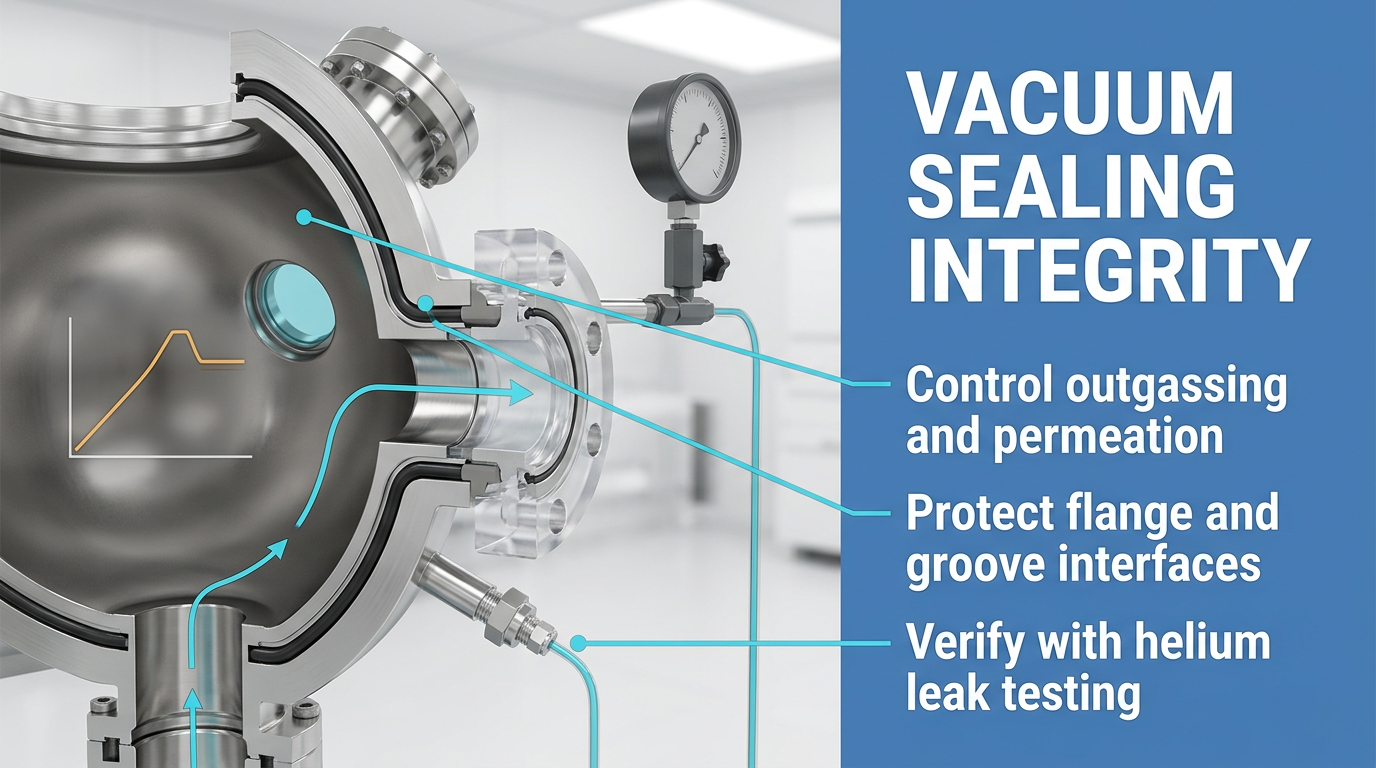
Semiconductor vacuum chambers, load locks and transfer modules require more than a seal that prevents outside air from entering. The sealing system must also control outgassing, permeation, virtual leaks, particle generation, chemical contamination and degradation during bake-out or thermal cycling. A pressure rise can therefore originate from a real leak, material release, gas transport through a seal or a trapped internal volume.
Elastomer O-rings and metal gaskets operate through different mechanisms. An elastomer maintains contact through elastic recovery after compression; a metal gasket typically seals through controlled plastic deformation at a precision ridge or knife-edge. FKM and FFKM may support selected vacuum applications, while metal gaskets may be required when temperature, low-outgassing or process exposure exceeds the validated elastomer envelope. No material is universally correct.
Reliable vacuum sealing is a system design problem involving material, groove or flange geometry, surface condition, cleaning, assembly, bake-out, process chemistry and verification.
Vacuum Sealing Physics
A vacuum leak is an unintended gas path from the environment into the evacuated volume. Outgassing is gas or vapor released from surfaces, absorbed moisture, residues or seal materials. Permeation is gas transport through a material rather than through an open defect. A virtual leak is delayed release from a trapped cavity, blind hole, dead volume or poorly vented interface. These mechanisms can produce similar pressure-rise symptoms but require different corrective actions.
Compression sealing depends on contact stress and elastic recovery. An elastomer is compressed against a groove and mating surface; it must retain enough recovery to follow small dimensional changes while avoiding excessive fill, extrusion or permanent set. A metal gasket relies more strongly on flange geometry, surface finish, hardness, alignment and installation load. Plastic deformation can create a reliable seal, but it also means reuse is generally not assumed.
Diagnostic testing should combine pressure-rise behavior, temperature dependence, helium response, bake-out response and physical inspection. A pressure increase after pump-down is not automatically proof of an O-ring leak.
Elastomer Seals: FKM and FFKM
FKM and FFKM O-rings seal through compression, contact pressure and elastic recovery. Their performance depends on compound formulation, cure system, filler, hardness, groove fill, surface finish, temperature, gas chemistry, plasma exposure and bake-out history. Family names are screening categories, not lifetime guarantees.
FKM may be considered for selected temperature and chemical conditions when its compound is compatible with the process environment. FFKM may be justified when chemical exposure, temperature, purity or leakage consequence exceeds a validated FKM envelope. It should not be described as the best choice for every semiconductor tool. The actual process gas, plasma, temperature, bake-out condition and cleanliness requirement must be tested with the selected grade.
Elastomer risks include compression set, swelling, hardening, softening, permeation, surface damage and outgassing. A compound that performs acceptably at room temperature may behave differently after thermal cycling or extended vacuum exposure. Test records should separate material release, permeation and open leakage.
Metal Gaskets and Rigid Sealing
Metal gaskets commonly seal through controlled plastic deformation at a knife-edge, sealing ridge or defined contact geometry. Their advantages may include high-temperature capability, low outgassing and high-vacuum suitability when the flange and assembly process are properly controlled. Their limitations are equally important: they are sensitive to scratches, particles, flange flatness, surface finish, alignment, installation load and torque sequence.
A metal gasket is not automatically superior to an elastomer. It may require tighter machining, greater replacement cost, more difficult maintenance and a controlled flange condition. Reuse should not be assumed because the gasket may have permanently deformed during seating. The selection should compare vacuum level, process temperature, chemistry, maintenance frequency, surface quality and total system cost.
Low-Outgassing and Contamination Control
Low-outgassing design extends beyond the seal compound. Volatile ingredients, absorbed water, cleaning residues, lubricants, packaging materials and particles introduced during assembly can all affect pump-down and process stability. Cleaning, drying, clean packaging, chamber surface treatment, tool selection and operator procedure are part of the sealing design.
Bake-out can reduce releasable species and help distinguish removable contamination from persistent leakage, but it does not replace leak testing. Low outgassing is a validated property under specified temperature, vacuum and time conditions; it is not a generic label.
Groove, Flange and Assembly Design
For elastomers, groove dimensions, compression ratio, gland fill, extrusion clearance, surface finish, installation direction and thermal expansion allowance must be treated as one tolerance system. Excessive compression can raise friction or damage the seal; insufficient compression can reduce contact stress. Lubrication must be controlled because an unsuitable lubricant can add contamination or change material behavior.
For metal gaskets, ridge geometry, flange flatness, surface finish, alignment, gasket seating and torque sequence dominate performance. Particle-free assembly, clean tools, controlled tightening and traceability are required before pump-down. A correct gasket cannot compensate for a damaged flange or an uncontrolled assembly process.
Table I: Elastomer and Metal Gasket Sealing Comparison
|
Seal type |
Sealing mechanism |
Temperature capability |
Vacuum suitability |
Outgassing risk |
Reusability |
Main limitation |
| FKM O-ring | Elastic compression and recovery | Compound and application dependent | Selected vacuum and process conditions | Compound and processing dependent | Usually replaced after opening | Permeation and compression-set limits |
| FFKM O-ring | Elastic compression with high chemical envelope | Compound and application dependent | Selected aggressive or high-consequence conditions | Must be validated by grade and process | Usually replaced after opening | High cost and gland sensitivity |
| Metal gasket | Plastic deformation at precision ridge | High-temperature capability within design limit | High-vacuum and low-outgassing applications | Generally low when clean and processed | Not normally assumed reusable | Flange finish, flatness and torque sensitivity |
| PTFE-based element | Compression or guided low-friction contact | Application dependent | Selected vacuum interfaces | Processing and permeation dependent | Design and condition dependent | Creep, cold flow and support limits |
The correct choice depends on vacuum level, process gas, temperature, plasma, cleanliness, flange quality, maintenance frequency and replacement procedure. No seal type is universally preferred.
Table II: Vacuum Seal Failure Factors
|
Factor |
Local mechanism |
Possible effect |
Detection method |
Design or process response |
| Temperature | Expansion, softening or embrittlement | Leakage or outgassing change | Thermal-cycle and rate-of-rise trend | Define thermal and bake-out envelope |
| Vacuum level | Increased release or permeation relevance | Pressure rise | Hold and rate-of-rise test | Set vacuum boundary and test method |
| Gas or plasma exposure | Chemical attack or surface modification | Material degradation | Exposure test and inspection | Validate actual chemistry |
| Compression ratio | Low contact or excessive fill | Leakage, extrusion or set | Geometry review and vacuum test | Control groove and compression |
| Flange surface | Scratch, roughness or distortion | Open leak path | Surface metrology and helium test | Protect finish and flatness |
| Cleaning quality | Residue, moisture or particles | Outgassing or contamination | Visual, residue and pressure test | Controlled cleaning and drying |
| Thermal cycling | Repeated stress and dimensional change | Fatigue or loss of contact | Cycle test and post-test inspection | Allow movement and requalify |
Pressure rise and leakage should be interpreted with temperature, surface condition, cleaning record and test history. A single measurement cannot identify every failure mechanism.
Verification and Maintenance
Helium mass-spectrometer testing identifies a defined gas-path response under a stated configuration. Vacuum-hold testing assesses pressure retention but can be influenced by outgassing, virtual leaks, permeation and instrument limits. Rate-of-rise testing characterizes pressure increase over time. Bake-out verification evaluates pressure response after controlled heating; it does not replace leak testing. Thermal-cycle or plasma-exposure tests evaluate selected service stresses and must define gas, temperature, duration and sample condition.
The test record should include seal material, seal size, groove or flange design, compression or seating condition, temperature, vacuum level, test gas, bake-out condition, test duration and leak-rate or pressure-rise result. Visual and surface inspection should record scratches, particles, residues and assembly damage.
Table III: Vacuum Sealing Verification Methods
|
Method |
Test objective |
Main parameter |
Detectable failure |
Main limitation |
Suitable stage |
| Helium leak test | Find defined gas paths | Helium response and configuration | External leak path | Does not quantify outgassing alone | Assembly and acceptance |
| Vacuum hold test | Assess pressure retention | Pressure and duration | Leak or release trend | Sensitive to outgassing and instrument limits | System verification |
| Rate-of-rise test | Characterize pressure increase | Pressure slope and time | Leak, virtual leak or outgassing trend | Requires controlled starting condition | Troubleshooting |
| Bake-out verification | Assess release after heating | Temperature, time and pressure | Outgassing reduction or persistence | Does not replace leak test | Process qualification |
| Thermal-cycle test | Assess thermal stress | Temperature range and cycles | Seal degradation or flange issue | Limited to selected cycle profile | Design validation |
| Plasma exposure test | Assess process-specific exposure | Gas, power, time and temperature | Chemical or surface degradation | Tool-specific and expensive | Process qualification |
| Visual and surface inspection | Find damage and residues | Finish, particles and geometry | Scratches, residue or assembly error | Cannot prove vacuum integrity | Every maintenance stage |
Helium testing, pressure-rise testing, bake-out and visual inspection answer different questions. They should be combined according to the chamber boundary and process risk.
FMEA Risk Analysis
A vacuum-seal FMEA should distinguish true external leakage, material release, permeation and virtual leak before assigning corrective action. Typical failure modes include elastomer compression set, metal-gasket deformation, flange surface damage, incorrect groove compression, particles on the sealing surface, excessive outgassing, thermal-cycle degradation, incorrect torque sequence, reused gasket failure and inadequate cleaning.
The system effect depends on location. A seal issue may cause slow pump-down, process contamination, unstable pressure, chamber downtime or repeated maintenance. RPN is a prioritization aid, not a universal safety limit; the values below are illustrative engineering assessments.
Table IV: Semiconductor Vacuum Seal FMEA and RPN Analysis
|
Failure mode |
Cause |
Local effect |
System effect |
Detection method |
Illustrative RPN |
Corrective action |
| Elastomer compression set | Thermal exposure or long dwell | Reduced contact recovery | Vacuum loss or pressure rise | Vacuum hold and seal inspection | 165 | Review material and compression |
| Metal gasket deformation | Excess load, reuse or flange issue | Changed ridge contact | Leak or chamber downtime | Surface inspection and helium test | 170 | Control load and replace gasket |
| Flange surface damage | Scratch, particle or distortion | Open leak path | Vacuum integrity loss | Surface metrology and helium test | 180 | Protect and rework flange |
| Outgassing | Residue, moisture or volatile material | Pressure rise | Process contamination or delay | Rate-of-rise and bake-out | 175 | Improve cleaning and bake-out |
| Virtual leak | Trapped cavity or blind volume | Delayed gas release | Unstable vacuum performance | Time-dependent pressure analysis | 160 | Redesign or vent trapped volume |
| Particle contamination | Poor cleaning or packaging | Seal damage or residue | Process contamination | Visual and surface inspection | 170 | Clean, cap and trace parts |
| Incorrect groove compression | Tolerance or assembly error | Low or excessive contact | Leak, extrusion or damage | Dimensional inspection and test | 155 | Control groove and assembly |
| Reused gasket failure | Prior deformation not recognized | Insufficient reseating | Repeat leak after opening | Traceability and leak test | 185 | Use controlled replacement policy |
| Incomplete cleaning | Residue or absorbed moisture | High outgassing | Slow pump-down or process drift | Cleaning record and rate-of-rise | 180 | Qualify cleaning and drying |
All RPN values are illustrative engineering assessments, not universal safety limits, certification results or field-failure statistics. Project scoring must define the rating method and convert high-priority items into design and maintenance controls.
Conclusion
Semiconductor vacuum sealing is not simply a material-temperature problem. Vacuum integrity depends on the interaction of seal material, compression, flange geometry, surface finish, cleaning, assembly, bake-out, process exposure and verification.
Elastomer seals can provide elastic compensation and convenient maintenance in selected conditions. Metal gaskets can support high-temperature, low-outgassing and high-vacuum applications when flange quality and installation precision are controlled. The correct choice must follow the actual process gas, vacuum level, temperature, plasma, maintenance plan and cleanliness requirement. There is no single sealing solution for every semiconductor tool.
Engineering FAQ
Q:What is the difference between outgassing, permeation and a true vacuum leak?
A:A true leak is an unintended gas path through a defect or boundary. Outgassing is release from surfaces, residues or materials. Permeation is gas transport through a material. Their pressure-rise behavior and corrective actions differ.
Q:When should an elastomer O-ring be replaced by a metal gasket?
A:Consider a metal gasket when temperature, vacuum, low-outgassing or process exposure exceeds the validated elastomer envelope, and when flange finish, flatness, installation load and replacement practice can be controlled.
Q:How do FKM and FFKM differ in semiconductor vacuum applications?
A:Both are elastomer families with compound-dependent performance. FFKM may be considered for more demanding chemical or temperature conditions, but the grade, process gas, plasma, bake-out and cleanliness requirements must be validated.
Q:Why are flange surface condition and groove compression so important?
A:The seal must generate a continuous contact path. Scratches, distortion, particles or incorrect compression can create a leak path, extrusion, poor recovery or localized stress even when the nominal seal size is correct.
Q:Which tests are necessary to validate a semiconductor vacuum seal?
A:Use helium leak testing, vacuum hold, rate-of-rise, bake-out, thermal cycling and visual or surface inspection as appropriate. Each test answers a different question and none is universal proof alone.
Q:Can a metal gasket be reused after a chamber opening?
A:Reuse should not be assumed. Metal gaskets may plastically deform during seating, so the project procedure should define replacement, inspection and acceptance requirements for each gasket type and flange design.
Post time: Aug-20-2026