Industrial PTFE Straight Union


High-Purity Union Sealing & Direct Ingress Protection
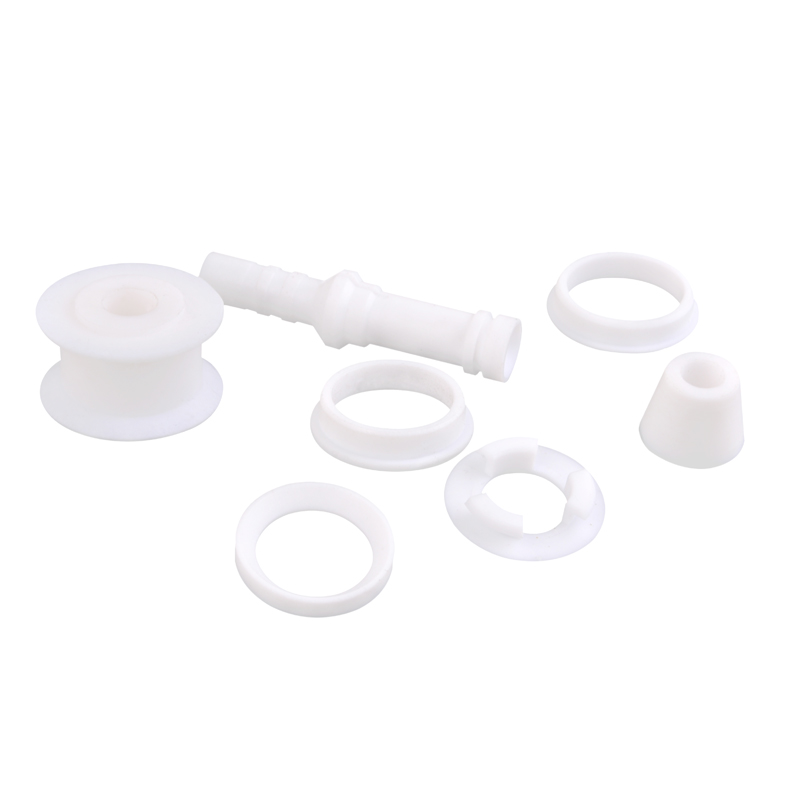
Yokey PTFE Straight Unions are the engineered solution for fluid networks where maintenance accessibility must not compromise system purity. Unlike permanent fusion welding or non-removable threaded joints, our union architecture prioritizes system uptime and total life-cycle cost (TCO) by allowing for non-destructive inspections and rapid component swapping.
- • 100% Metal-Free Fluid Containment: Designed to handle the industry's most aggressive ultra-pure acids, including hot Hydrofluoric Acid (HF), Nitric Acid (HNO3), and Sulfuric Acid (H2SO4), without the risk of heavy-metal ion leaching or galvanic corrosion that often plagues even high-grade stainless steel fittings.
- • Zero Leak-Path Architecture: Utilizing a nano-machined interference-fit sealing face, our unions create a primary gas-tight barrier. This mechanical seal is engineered to maintain its integrity under constant system vibration, high-frequency pressure pulses (up to 150 PSI), and severe thermal shocks common in industrial fluid distribution.
- • Easy-Maintenance Disassembly Logic: The three-piece union design is specifically engineered for "Maintenance-Heavy" zones. It allows engineers to break into a line for pump calibration, filter replacement, or analytical sensor maintenance in minutes, eliminating the risk of particulate generation associated with pipe cutting or solvent-welding.
- • Absolute Dimensional Stability: With zero moisture absorption (ASTM D570 <0.01%), our unions do not swell or lose tolerances in submerged chemical tanks or high-humidity clean-rooms, ensuring that the initial sealing torque and contact pressure remain constant over years of continuous service.
Molecular Engineering: The High-Crystallinity Fluoropolymer Matrix
The technical integrity and long-term reliability of our straight unions are derived from the ultra-pure, high-crystallinity molecular structure of our proprietary virgin PTFE compounds:
- • High-Density Virgin PTFE Body: We utilize premium fluoropolymers with a crystallinity percentage optimized for maximum mechanical strength and dimensional stability. This ensures that the material's Young's Modulus does not drift significantly even at elevated process temperatures, preventing the "Soft-Thread" phenomenon that leads to thread stripping under load.
- • Molecular Permeation Shield: The high-density Carbon-Fluorine bond network acts as a molecular shield, drastically reducing the permeation rates of highly volatile organic solvents and aggressive etchants that would otherwise penetrate and degrade the internal structure of lower-quality polymers.
- • Nano-Polished "Mirror-Bore": Every union body undergoes a proprietary internal machining process to achieve a surface roughness of Ra ≤ 0.25 µm. This ultra-smooth bore prevents the formation of boundary-layer turbulence and eliminates micro-pockets where particulates, metallic contaminants, or microbial films could settle.
Union System Technical Specifications & Performance Matrix
Validated quantitative data for engineering integration into mission-critical UHP chemical delivery systems (CDS) and automated high-speed wet benches:
Table 1: Technical Operating Matrix for PTFE Straight Unions
|
Property |
Value |
Test Standard |
| Operating Pressure | Up to 10 Bar (150 PSI) |
ASME B31.3 |
| Burst Pressure | > 35 Bar (Safety Factor 3.5:1) |
Standard Testing |
| Service Temperature | -200°C to +260°C |
Continuous |
| Helium Leak Rate | < 1 x 10⁻⁹ atm∙cc/sec |
Vacuum Integrity |
| Thermal Expansion Coeff. | 12 x 10⁻⁵ / °C |
ASTM D696 |
| Specific Gravity | 2.14 - 2.19 g/cm³ |
ASTM D792 |
Table 2: Union Fitting Precision & Manufacturing Standards
|
Feature |
Tolerance (CNC) |
Engineering Benefit |
| Inner Diameter (ID) |
± 0.02 mm |
High-Flow Consistency |
| Thread Concentricity |
< 0.01 mm |
Stress-Free Alignment |
| Nut Engagement Pitch |
± 0.05 mm |
Repeatable Torque |
Three-Piece Assembly Logic & Precision Thread Engineering
The reliability of a PTFE straight union depends on the mechanical harmony of its components to manage axial stress and thermal expansion without yielding:
- • Buttress-Compensated Sealing Geometry: Unlike standard symmetrical V-threads, our union threads are machined with a modified profile that maximizes the load-bearing face. This design accounts for the "cold-flow" of fluoropolymers, ensuring that the locking nuts maintain a constant axial compressive force against the central sealing face even during repeated high-temperature cycles.
- • Integrated Hex-Grip Stability: The central body and dual locking nuts feature oversized, precision-machined hexagonal wrench flats. This allows for controlled, high-torque tightening and loosening without the risk of "hex-rounding" or component deformation, ensuring the internal circularity of the fluid path is never compromised.
- • Laminar-Transition Bore Design: The internal transition from the tubing to the fitting body is precision-engineered to eliminate "step-changes" in diameter. By matching the tubing ID perfectly, we minimize boundary-layer turbulence and pressure drop (DP), which is essential for maintaining the overall efficiency of high-purity pumps.
Mission-Critical Applications for High-Purity Union Couplings
- • Semiconductor Wet Benches & CDS: Primary connection joints in automated etchant and solvent delivery Tools where periodic sensor maintenance or filter replacement requires rapid, leak-free component removal without compromising tool vacuum levels or fab safety.
- • Ultra-High Purity (UHP) DI Water Distribution: Maintaining sub-ppb ion levels in deionized water loops. Our 100% metal-free unions ensure that no conductivity drift, metallic ion leaching, or particulate contamination is introduced into the ultra-pure water stream.
- • Analytical Chromatography Baseline Control: Connection joints for HPLC and LC-MS systems where the total elimination of dead-volume is required to reduce baseline noise, eliminate ghost peaks, and prevent sample-to-sample cross-contamination.
- • Aggressive Reagent Pilot Plants: Safe linear coupling for scale-up reactors handling unknown chemical reagents or highly volatile organic compounds (VOCs) that would rapidly attack or swell standard elastomeric ferrule-style fittings.
Union Connection Support & Expert Technical Insights
Q: Can I use a Yokey PTFE union for high-temperature alkaline service?
A: Absolutely. Our high-crystallinity PTFE is immune to strong alkalis (like hot Potassium Hydroxide) at temperatures up to +260°C. Unlike many other plastics that undergo saponification or stress-cracking in high-pH environments, PTFE maintains its full mechanical and chemical integrity without embrittlement.
Q: What surface finish is required on the mating tubing to ensure a gas-tight union seal?
A: To achieve our rated Helium leak-rate (< 1 x 10⁻⁹ atm∙cc/sec), the mating tubing should have a smooth, scratch-free surface with a roughness of Ra ≤ 0.4 µm. Any deep longitudinal scratches on the tube O.D. can act as microscopic leak paths that the internal sealing face may not be able to bridge.
Q: How do you handle the high Coefficient of Thermal Expansion (CTE) of PTFE in rigid systems?
A: PTFE expands approximately 10 times more than stainless steel. When installing unions in rigid piping, we recommend allowing for linear expansion via "looping" or the use of flexible PTFE bellows nearby. This prevents the union from experiencing excessive axial stress that could lead to cold-flow deformation of the primary sealing faces.
Q: What are the specific torque requirements for a 1/2" union?
A: For a 1/2" PTFE union, we suggest an initial hand-tightening followed by a 1/4 to 1/2 turn with a wrench (approx. 4-6 Nm). It is crucial to perform a secondary torque check after 24 hours of process operation to account for the initial material seating and "settling" effect common with fluoropolymers.